If you have cut dairy, changed what your baby drinks, and the skin looks exactly the same, you have not missed the trigger. The AAP is clear that genes and environment both drive eczema and that foods themselves do not cause it.
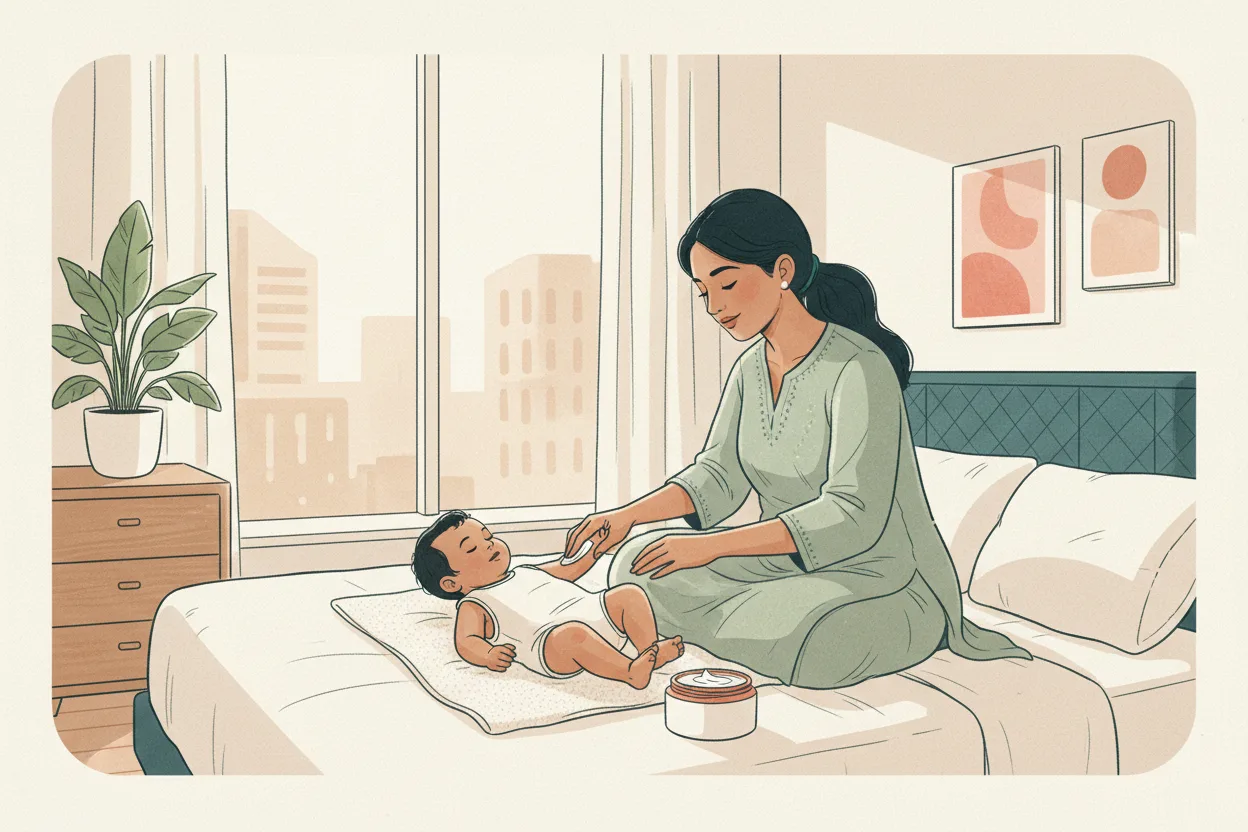
What does change infant eczema is moisturiser, far more often than feels normal, and treating a flare early instead of waiting it out. The NHS advises emollients at least two times a day, continued even if the eczema improves.
Not medical advice — consult your pediatrician for your baby.
Why the trigger hunt usually fails
Eczema is a skin-barrier condition that runs in cycles of its own. The NHS describes flare-ups alternating with periods when symptoms are better, and lists heat or changes in temperature among the things that worsen it. A hot car ride or an AC that switches off at 2 am is a real trigger. Neither is on a plate.
The trigger worth taking seriously in an Indian October is sweat. India's 2019 atopic dermatitis guidelines call sweating an important exacerbating factor and say avoiding high temperature and humidity helps control exacerbation.
Emollients: boring, and the thing that works
A Cochrane review of 77 trials found moisturisers reduced eczema severity and resulted in fewer flares versus no moisturiser, that steroid creams worked better alongside a moisturiser than alone, and that moisturiser reduced the need for them. India's guidelines make regular moisturiser the core of management, at least twice a day and more often during flares, continued even when the skin is clear.
Choose by criteria, not brand:
| Look for | Why |
|---|---|
| An ointment, or a thick fragrance-free cream | Thin lotions are the weakest of the three |
| No perfume, no "baby fresh" scent | Perfume irritates inflamed skin |
| A large tub or pump, not a small tube | You will use far more than you expect |
| A spoon or pump, never fingers in the pot | Keeps the tub clean |
The AAP names ointments such as petroleum jelly or fragrance-free creams as good choices, applied once or twice every day even when the rash is gone. Parents of a flaring baby go well past that — after every bath, every nappy change, before the pram goes out. The NHS adds: wash with an emollient instead of soap, and use a spoon or pump rather than fingers in the pot. Any chemist or an online search for a fragrance-free emollient ointment turns up several — ask your paediatrician which they prefer.
Baths, heat and cotton
The AAP suggests bathing every day or every other day for 5-10 minutes in lukewarm water, no bubble bath, then moisturising the whole body while the skin is still damp. India's guidelines are more specific: once-daily lukewarm bathing at 27 to 30 degrees Celsius for a short period, non-soap cleansers that are neutral to low pH, and perfumed soaps and toiletries avoided. That rules out most scented "baby soap".
Then keep her cool. The AAP lists heat and sweat as triggers, advises soft fabrics such as 100% cotton over wool and synthetics, a mild fragrance-free detergent, and no fabric softener or dryer sheets. A fan during the afternoon nap does more for a sweaty neck crease than a new cream.
Treating the flare instead of waiting it out
This is the part families argue about across generations, so here is the straight answer.
- If your paediatrician has prescribed one, the evidence does not support being frightened of using it as directed. India's guidelines note that used cautiously, long-term low to mid potency topical steroids are reasonably safe, and list them as first-line treatment.
- Which cream and what strength is a prescribing decision, not a WhatsApp one. The AAP says these prescription medicines are very effective and safe when used appropriately, and that the right strength and form is worked out with your doctor.
- If nothing is controlling the flares, go back. The NHS says to see a doctor when treatments are not helping.
The food question — and the half that surprises parents
You cut dairy and nothing happened. That is the normal result.
A Cochrane review of nine trials found no benefit from an egg and milk free diet in people with eczema not selected for proven food allergy, and that adhering to elimination diets is difficult. A 2022 systematic review found only low-certainty evidence of a slight, potentially unimportant improvement, while indirect evidence suggests elimination diets may increase the risk of developing IgE-mediated food allergy. India's guidelines say empirical food restriction is not recommended in atopic dermatitis.
Now the counterintuitive half, and it matters for your baby. Children with eczema are at higher risk of developing peanut and egg allergy — and holding those foods back raises that risk rather than lowering it. In the LEAP trial, 640 infants with severe eczema, egg allergy or both were randomised; peanut allergy by age five was 13.7% among avoiders versus 1.9% among regular eaters, and early introduction significantly decreased the development of peanut allergy. The AAP states there is no evidence that delaying egg, peanut, dairy or sesame prevents allergies, that the highest-risk babies should ideally start peanut products as early as 4 to 6 months, and that a tolerated food is then kept in the diet routinely.
Do not reintroduce or test anything yourself. The NHS is explicit that you should not manage a suspected food allergy by removing a major food like milk on your own, because your child could miss out on essential nutrients, and that you should speak to your GP or health visitor, who may refer you to a dietitian. Book that conversation soon rather than drifting — solids are about to start, and the window in the evidence above is now.
Home remedies: what holds up
| Practice | Where it stands |
|---|---|
| Plain fragrance-free emollient, often | Supported — the core of treatment |
| Short lukewarm bath, non-soap cleanser | Supported in AAP and Indian guidance |
| Soft cotton, nails cut short | Supported |
| Keeping the baby cool and dry | Supported — sweating worsens eczema |
| Mustard oil, coconut oil, besan ubtan, haldi paste | No guideline support either way |
Neither the AAP's eczema advice nor India's national guidelines include traditional oils or pastes as treatment. What the Indian guidelines prescribe is plain moisturiser as the core, short lukewarm baths and non-soap neutral-to-low-pH cleansers, with perfumed toiletries avoided. If an elder is keen on an ubtan or an oil massage, the honest position is that there is no good evidence it helps inflamed eczema — and none that lets anyone call it harmless. Keep perfumed things off broken skin, and stop if the skin looks redder afterwards.
Keep nails short, too: the AAP notes that scratching can worsen itch and lead to open sores and infection.
When to call the same day
The NHS says to ask for an urgent appointment if eczema is blistered, crusty, leaking fluid or has spots filled with pus, if it is painful, swollen or warm, if it suddenly gets worse, or if there is a high temperature or the person feels generally unwell — these can mean it is infected. The AAP describes the signs as yellow or honey-coloured crusting and scabbing and blisters or pus bumps, and says to call if a rash is not getting better even with the usual treatments.
Itch that is wrecking sleep counts as well. Great Ormond Street Hospital notes the itching is often bad enough to disturb sleep, and that scratching makes it worse — so a baby who cannot settle is a reason to go back, exactly as the NHS says when treatments are not helping.
Will it get better?
Probably — but nobody can promise it about your child. The NHS says symptoms usually start in babies and young children and tend to get better as they get older, while noting that atopic eczema cannot be cured. The AAP puts it this way: for some children eczema starts to go away by age 4, and it is hard to predict which children will outgrow it.
Expect years of good weeks and bad weeks, with the bad weeks getting shorter as you get faster at treating them.
FAQ
I have already stopped dairy. Should I start it again?
Not on your own. The NHS says not to remove or manage a major food such as milk yourself, because your child could miss out on essential nutrients. Take it to your paediatrician, and ask about reintroduction and whether allergy testing is worth doing before solids start.
Which moisturiser brand is best?
No guideline names one. The AAP's position is that ointments such as petroleum jelly or fragrance-free moisturizing creams are good choices, and you pick one your child tolerates.
My mother-in-law says steroid creams thin the skin. Is she wrong?
She is naming a real side effect, not the real risk balance. The 2021 review found that fear of these creams drives underdosing and early discontinuation and uncontrolled eczema, and that the harm of undertreated eczema generally outweighs the risk of adverse events when they are used and monitored appropriately. Use what was prescribed, as prescribed, and take the worry back to the doctor rather than quietly stopping.
Does the Indian summer make it worse?
Yes, mainly through sweat. India's guidelines name sweating as an important exacerbating factor and say avoiding high temperature and humidity helps.
Can I stop moisturising when the skin looks normal?
No. The NHS says to continue even if the eczema improves, and India's guidelines say moisturisers are continued even when the eczema is clear.