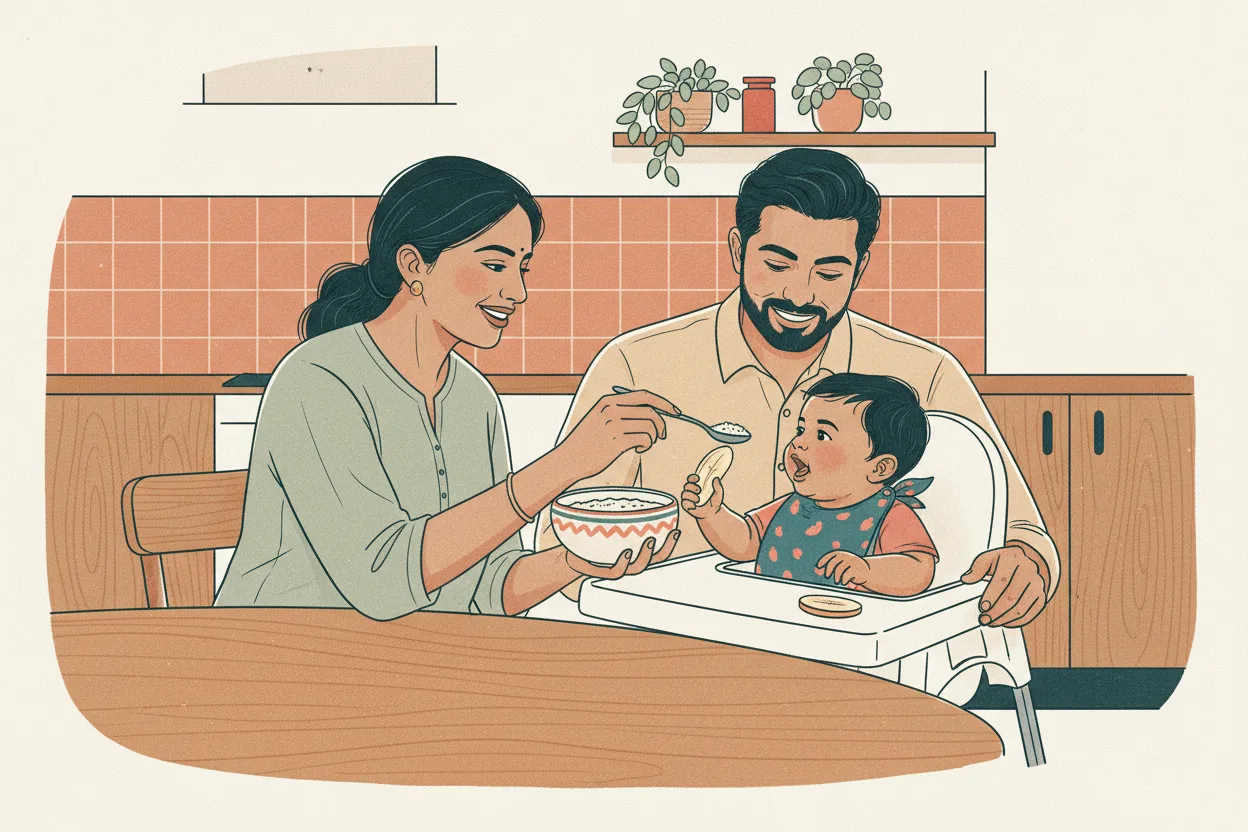

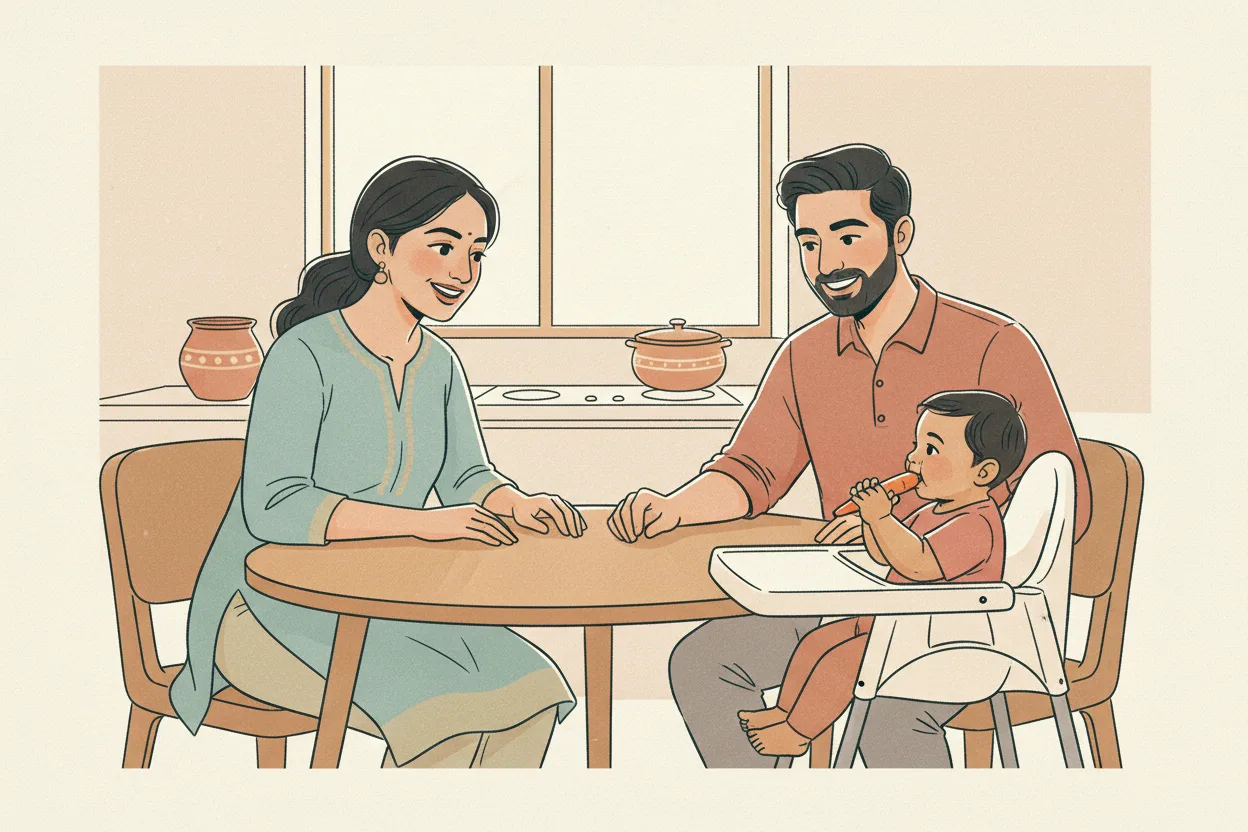
If your baby is 7 months into baby-led weaning and still eating almost nothing, gagging at every meal, or spitting food straight back out, that is not a sign BLW has failed. WHO's guidance on infant feeding states that breast milk can still provide half or more of a baby's energy needs between 6 and 12 months — so a baby who eats very little solid food in the early months is still getting most of their nutrition exactly where it's meant to come from.
Not medical advice — consult your pediatrician about your baby's individual feeding plan, especially if you have concerns about weight gain or a medical condition.
Why It Feels Like It's Not Working
Most BLW troubleshooting isn't really about technique — it's a timeline mismatch. Parents expect a baby to be "eating meals" by 7 or 8 months. WHO's Guideline for Complementary Feeding recommends starting solids at 6 months while continuing to breastfeed — the guidance is about starting the process, not about volume eaten in the first weeks.
That mismatch gets amplified in an Indian home, where grandparents remember spoon-feeding purees by the tablespoon, and a baby playing with a piece of roti for ten minutes can look, to them, like a feeding problem. That worry is understandable — but WHO's guidance confirms milk is still expected to be doing most of the nutritional work at this stage, not solid food.
"My Baby Won't Eat Anything But Milk" — Is That Normal?
Yes, in the early months of starting solids. WHO's Infant and Young Child Feeding guidance states that breast milk can provide one half or more of a child's energy needs between 6 and 12 months, and about a third between 12 and 24 months. Solid food at this stage is genuinely complementary — it is practising a skill, not replacing milk as the main calorie source.
Refusal of specific foods is also expected, not a verdict on them. A 2022 systematic review conducted for the USDA/HHS Dietary Guidelines Advisory Committee found that tasting a food repeatedly, roughly 8 to 10 times or more, is what actually increases acceptance. One or two refusals of dal, banana, or paneer means little — keep offering the same food on different days.
One thing worth tracking: NIH-published research on complementary feeding notes that a baby's iron stores begin to run down around 6 months, and breast milk alone can no longer meet iron needs from that point. Keep iron-rich foods (dal, egg, well-cooked minced meat if you eat non-veg, iron-fortified cereal) in rotation — that's a reason to keep offering them, not to force-feed a baby who refuses on a given day.
Gagging vs. Choking: What You're Actually Seeing
Gagging is the single biggest reason Indian parents stop BLW early, usually out of fear. NHS's Best Start in Life advises that gagging is a totally normal, protective reflex when babies start weaning — and it looks and sounds very different from choking.
| Gagging (normal) | Choking (needs action) | |
|---|---|---|
| Sound | Loud — coughing, spluttering, retching | Quiet, or no sound at all |
| Baby's colour | Normal | May turn bluish, especially lips and face |
| Breathing | Continues, though briefly interrupted | Difficulty breathing, or none |
| What to do | Stay calm, let baby work it out | Act immediately — infant choking first aid |
MedlinePlus, part of the U.S. National Library of Medicine, states that true choking signs include being unable to cry, cough, or breathe, and a bluish skin colour around the lips and face — that combination is the emergency, not the retching and spluttering that comes with normal gagging.
You can also cut genuine choking risk through food prep. NHS's Best Start in Life advises cutting food into narrow batons and avoiding round shapes and firm foods. AAP's HealthyChildren.org lists whole nuts and seeds, whole grapes, popcorn, and raw vegetable or fruit chunks as known hazards to avoid or modify — cut grapes and cherry tomatoes lengthwise, cook carrot and apple until soft, skip whole peanuts and popcorn. AAP's HealthyChildren.org also states that a baby should never be left alone in a high chair — stay within arm's reach every meal.
The BLW-vs-spoon-feeding choking question has actually been studied. A 2018 systematic review published in the Italian Journal of Pediatrics found at least one choking episode in 11.9% of a strict BLW group, 15.5% of a looser BLW group, and 11.6% of a traditionally-weaned group — no significant difference among them. Done with proper food prep and supervision, BLW isn't shown to be riskier than purees.
When Relatives Push You to Switch to Purees
You need one evidence-based line to repeat, more than you need to win the argument every time. Try: "The doctor's advice is to let baby practise the skill, and milk is still doing most of the nutrition work right now."
The NHS lists the actual readiness signs for starting solids: baby can sit steadily with head control, can coordinate eyes, hands and mouth to pick up food and bring it to their mouth, and can swallow food rather than push it back out with their tongue. If your baby was ready by these signs when you started, the "baby isn't eating enough" worry from relatives is a pace concern, not a readiness one — and pace is expected to be slow.
It also helps to reframe what's actually being asked of your baby. AAP's HealthyChildren.org describes responsive feeding — recognising and responding to your baby's own hunger and fullness cues — as the recommended approach, rather than a caregiver deciding how much a baby "should" eat at a meal. A baby who plays with food, mouths it, and swallows very little is still doing the work BLW is meant to teach.
A More Realistic Timeline
Progress in the first months of BLW is meant to be slow, not a steady climb toward "full meals." WHO's Infant and Young Child Feeding guidance states that breast milk provides half or more of a baby's energy needs between 6 and 12 months, and roughly a third between 12 and 24 months — solids build up behind that gradually, over many months, not in a few weeks.
There's also an Indian, age-by-age shape to expect. The Indian Academy of Pediatrics' parental guideline on complementary feeding states that babies start with pureed, mashed, or semi-solid foods at 6 months, most infants can manage finger foods by around 8 months, and most children are eating family foods by the end of the first year. A baby mostly mouthing and exploring roti at 7 months and picking up real pieces themselves by 9 months is on that same track, not behind it. Part of what changes underneath is a motor skill: Cleveland Clinic notes that babies typically gain the ability to hold an object between their fingers and thumb at around 9 months, which matures into a full pincer grasp — picking up small objects with the tips of the thumb and index finger — by around 1 year. That's why smaller, harder-to-grab pieces of food genuinely get easier to manage from around 9-12 months, not sooner.
Refusal along the way is part of the process. Research reviewed for the USDA/HHS Dietary Guidelines Advisory Committee found that it typically takes about 8 to 10 or more repeated tastes to shift a baby from refusing a food to accepting it, so a food coming back untouched a few times is not a verdict on that food.
If solids intake stays essentially unchanged for months on end, or you have concerns about weight gain, that's worth raising with your pediatrician rather than continuing to wait it out on your own.
Frequently Asked Questions
My baby still isn't swallowing much food after weeks of trying. Should I go back to purees? Not necessarily just for that reason. WHO's guidance confirms milk is still supplying most of the calories through the second half of the first year. If you have specific concerns about weight or growth, raise them with your pediatrician rather than switching methods on your own.
How many times should I offer a food my baby has refused? Keep offering it — try again on a different day, prepared a different way. Two or three refusals is not a verdict.
Is gagging during BLW dangerous? No — gagging is a normal, protective reflex, and it looks and sounds very different from choking: loud, with coughing or spluttering, versus choking's quiet struggle. Learn the difference so you can stay calm through it.
Does BLW actually carry a higher choking risk than spoon-feeding? Research comparing the two found no significant difference in choking episodes between groups. What matters is food shape and size, avoiding known hazards, and staying within arm's reach every meal.
My mother-in-law says my baby should already be eating full meals. Is that true? No single age guarantees "full meals." Readiness and pace vary; what matters is that your baby shows the sitting, hand-to-mouth, and swallowing signs of readiness the NHS describes, and that milk continues alongside solids through the first year.
When should I actually worry? MedlinePlus lists the true choking signs to watch for — an inability to cry, cough, or breathe, and a bluish colour around the lips and face. That combination is urgent, not a troubleshooting question. Outside of that, prolonged refusal alongside poor weight gain is the main reason to loop in your pediatrician early rather than waiting it out.