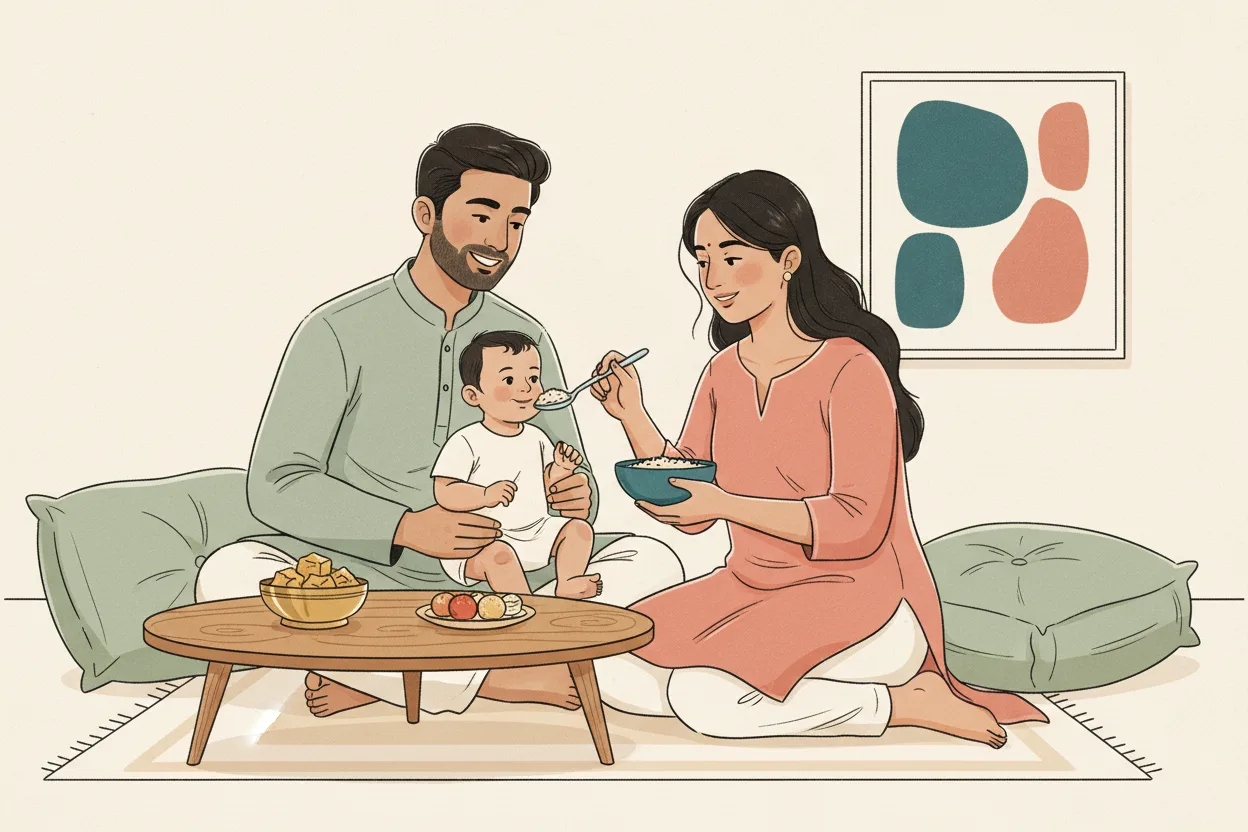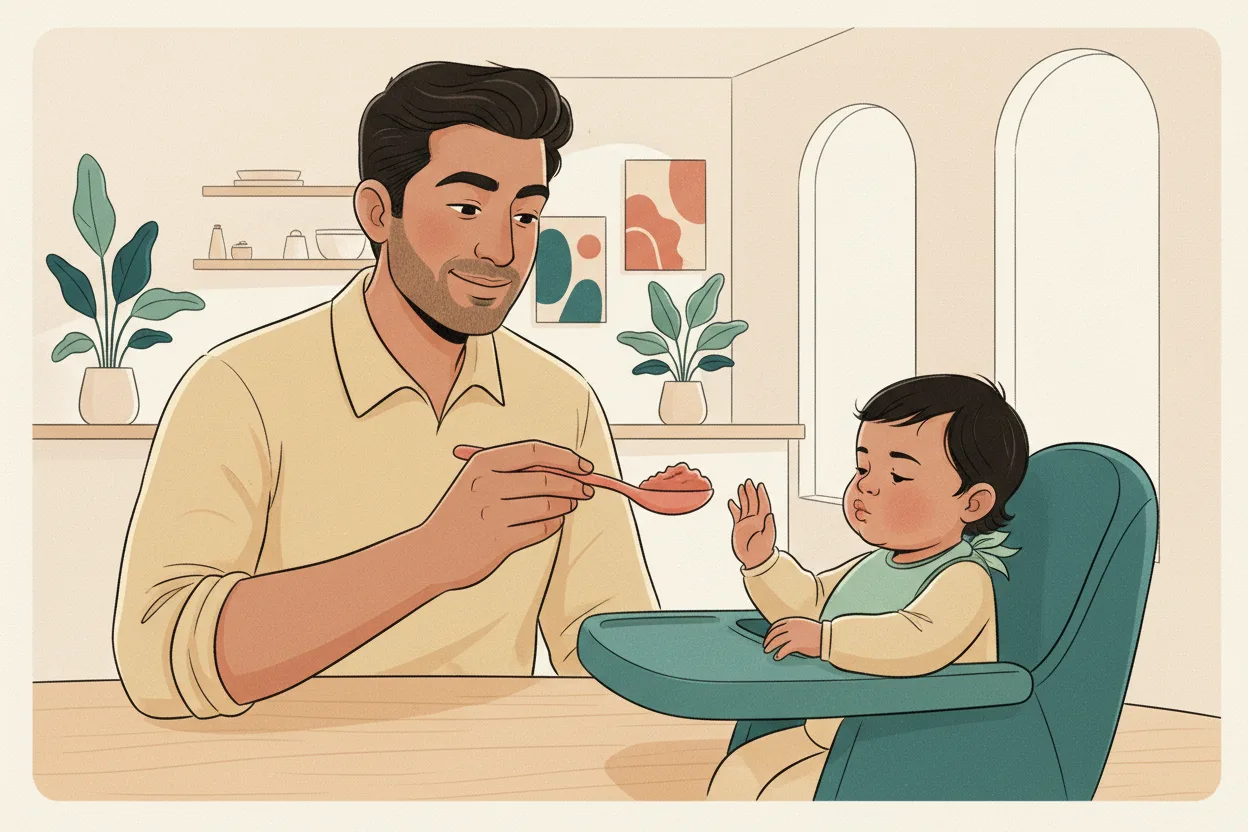

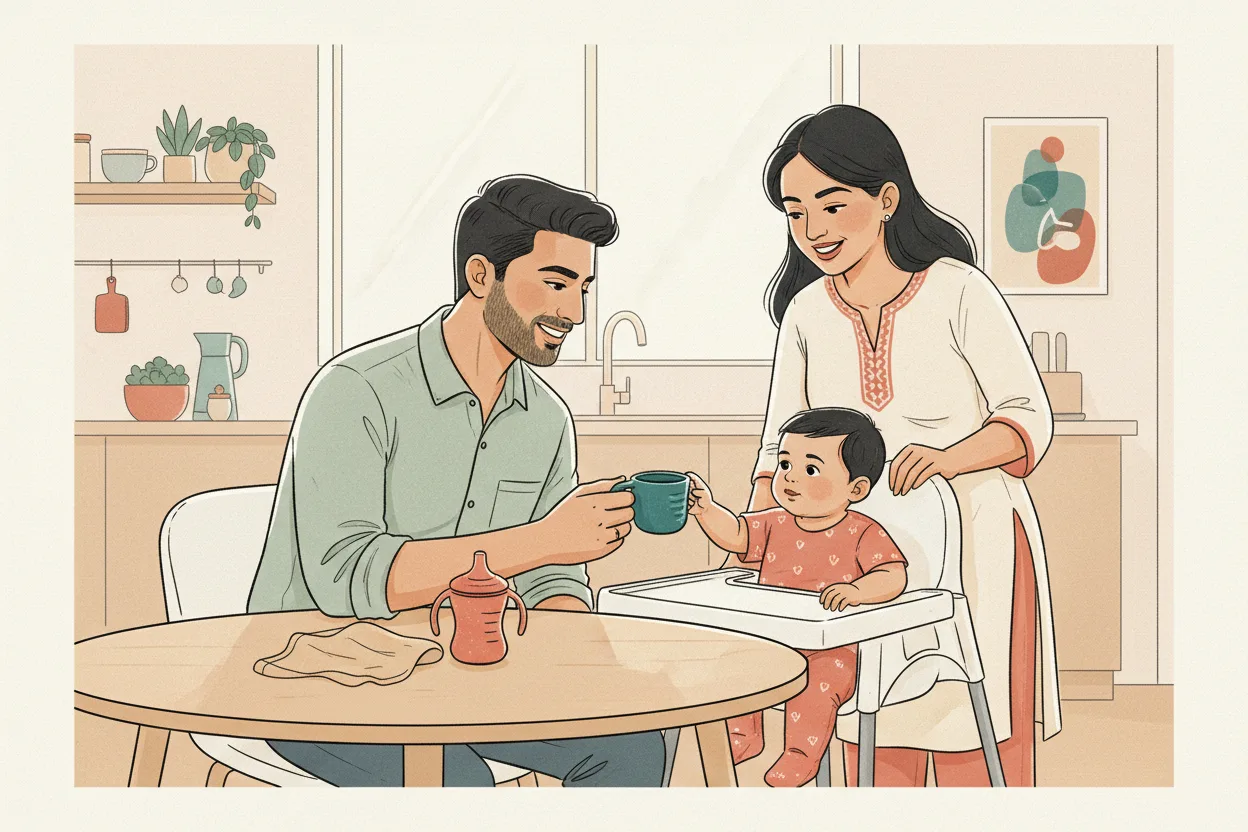
If your baby splutters, gags, or clamps their mouth shut the moment water touches their lips, you haven't done anything wrong. Depending on their age, this is either expected, or a sign they're not ready yet.
Not medical advice — consult your pediatrician if refusal continues past a few weeks of trying, or if you're ever unsure.
First, Check the Age — It Changes Everything
Under 6 months: ICMR-NIN's Dietary Guidelines for Indians (2024) state that exclusively breastfed babies do not need water at all before 6 months — offering it can reduce breast-milk intake and raise the risk of diarrhea, even in hot weather. A systematic review in PMC (National Library of Medicine) found no evidence that exclusively breastfed infants under 6 months need supplemental water even in hot, humid conditions — directly relevant to a Delhi or Chennai summer.
There's a real risk on the other side too. A case report in PMC (National Library of Medicine) found that giving an infant too much plain water can dilute blood sodium (hyponatremia), which is a common cause of a young baby's first seizure. So if your baby is under 6 months and pushing away a spoon of water at a family function or during a heatwave, that refusal is doing them a favor — resist the urge from well-meaning relatives to "top them up" with extra water before 6 months.
6 months and older: this is a different story. The Indian Academy of Pediatrics' parental guideline states that complementary feeding — solids, and water alongside them — should begin soon after your baby completes 6 months, not earlier. Refusal at this stage is usually not a health issue; it's a brand-new sensation your baby hasn't learned to handle yet.
How Much Water Your Baby Actually Needs
The American Academy of Pediatrics' HealthyChildren.org guidance states you can start offering a little water once your baby is around 6 months old — about 4-8 oz (roughly 120-240 ml) a day, offered in an open, sippy, or straw cup alongside meals. That is the daily ceiling, not a target to chase on day one. A few sips at each meal is plenty to start with, and most of your baby's fluid is still coming from breast milk.
There's no need to force the full amount, and there's no benefit to more than that — going well past it is exactly the "too much water" scenario the hyponatremia research above warns about, so more is not better here.
Gagging Is Not the Same as Choking
This is the part that scares parents most, so it's worth separating clearly.
A physiology review on NCBI Bookshelf (National Library of Medicine) states that the gag reflex is believed to be an evolutionary reflex that developed to prevent swallowing foreign objects and prevent choking — gagging on a new taste or texture like water is a normal, protective response, not a sign your baby dislikes water or that anything is wrong. The same review notes the reflex diminishes starting around 6 or 7 months of age, so gagging that feels intense in month 6 often eases within a few weeks of practice.
True choking looks very different. The American Academy of Pediatrics' HealthyChildren.org guidance states that a choking child can't breathe, is gasping or wheezing, can't talk, cry or make noise, turns a bluish color, grabs at their throat or waves their arms, appears panicked, or becomes limp or unconscious — that combination needs immediate emergency action. Ordinary spluttering, a scrunched-up face, or a cough or two while swallowing water is not choking, and does not need an ambulance.
Getting Water In Without a Daily Fight
A few things that make the early attempts go smoother:
- Slow the flow. Nemours KidsHealth advises that if your baby gags or chokes while taking a bottle, switching to a slower-flow nipple and practicing "paced" feeding — pausing every few sips — reduces the gagging. The same idea works with an open cup: pour a very small amount, let your baby control the sip, and pause between attempts rather than tipping a full cup at once.
- Room temperature, not fridge-cold. Indian kitchens default to chilled fridge water; a cold shock on top of an unfamiliar texture is a lot for a first try. Boiled-and-cooled water at room temperature is easier to accept.
- Offer it after a few bites of food, not on an empty stomach. A baby already mid-meal, spoon in hand, tends to accept a follow-up sip more easily than a cold start.
- Let both parents try, at different mealtimes. If dad offers the cup at breakfast and mum offers it at dinner, your baby learns water isn't tied to one person or one mood.
- Expect more spills than sips at first. A washable mat under the high chair saves the cleanup stress — often what makes parents give up on the cup and go straight back to a bottle.
Sudden Refusal? Check for Teething First
If a baby who was happily taking sips suddenly clamps their mouth shut, teething is a very common, temporary explanation. The American Academy of Pediatrics' HealthyChildren.org symptom guide states that if a teething baby refuses nipple feedings, trying a cup, spoon, or syringe for a short time can help — sore gums often make sucking uncomfortable, while sipping from a cup is not. This tends to pass within a few days as the tooth comes through, so a sudden refusal on its own isn't a reason to panic.
When Refusal Becomes a Red Flag: Signs of Dehydration
Occasional refusal of a sip of water is normal and not a concern on its own, since most of a baby's fluids still come from breast milk or formula. But if a baby is also refusing feeds generally, or has an illness like diarrhea or vomiting alongside it, watch for dehydration. The American Academy of Pediatrics' HealthyChildren.org guidance states that fewer than six wet diapers a day, a dry mouth, fewer tears when crying, a sunken soft spot (fontanelle), and playing less than usual are warning signs of dehydration, and parents should notify the pediatrician immediately if any of these develop.
Cup and Spoon Options Worth Trying
| Type | Best for | Typical Price (India) | Where to Look |
|---|---|---|---|
| Open training cup (small, two-handled) | First attempts, parent-guided sips | Rs. 150 – Rs. 400 | Amazon.in / FirstCry |
| Soft-spout sippy cup | Babies who gag on a hard spout or fast flow | Rs. 250 – Rs. 600 | Amazon.in / FirstCry |
| Straw cup (weighted straw) | 8+ months, building independent sipping | Rs. 300 – Rs. 700 | Amazon.in / FirstCry |
| Feeding spoon (soft-tip, shallow bowl) | Offering a few drops before moving to a cup | Rs. 100 – Rs. 300 | Amazon.in / FirstCry |
None of these need to be expensive or imported — a plain steel katori and a soft spoon you already own work just as well. The point is a slow, controllable flow, not a specific product.
Water and the Move Off the Bottle
There's a bigger-picture reason to keep practicing with a cup even if the first few tries are mostly spills. The American Academy of Pediatrics' HealthyChildren.org guidance states that offering a cup from around 6 months, when solids start, helps babies learn to sip and eases the transition off the bottle by 12 to 18 months. Practicing with plain water now, even if your baby only manages a few drops at a time, is useful skill-building you'll be glad you started early.
Frequently Asked Questions
My 4-month-old gagged on a spoon of water at a family function — should I worry? No. ICMR-NIN's guidelines and research reviewed on PMC both find exclusively breastfed babies under 6 months don't need water at all, even in Indian heat, so there's nothing to fix. Politely decline the water for now — you're not being overcautious.
How much water is too much for a 7-month-old? Past the 4-8 oz (120-240 ml) a day range, you're not adding benefit, and large volumes of plain water carry the hyponatremia risk noted above. Stick to small sips through the day rather than one big serving.
Is gagging on water the same as choking? No — and the physiology explains why: gagging is a normal reflex that fades around 6-7 months. Choking looks distinctly different — no breath, no cry, no noise, or a bluish color — and needs immediate action. A splutter or a scrunched face is not that.
My baby only takes water from a bottle, not a cup — is that a problem? Not urgently, but it's worth practicing the cup anyway. The AAP notes that cup practice from 6 months makes the eventual move off the bottle by 12-18 months much easier — a few minutes a day now saves a harder battle later.
We tried a sipper but the flow is too fast and the baby chokes on it — what now? Switch to a slower-flow spout or an open cup with tiny, parent-controlled pours. Slowing the flow and pacing the sips is the standard fix for gagging on a bottle or sipper, and the same logic applies here.
Does Indian summer heat mean my baby needs water earlier than 6 months? No. Both ICMR-NIN and the PMC review on infant hydration are explicit that hot weather does not change the 6-month timeline for exclusively breastfed babies. Frequent breastfeeding covers their fluid needs, heat included.