
If your baby is still on rice and mashed dal while an Instagram Reel shows a 6-month-old eating fifteen different ingredients, you are not behind. The WHO Guideline for complementary feeding of infants and young children 6–23 months of age states that infants should be introduced to complementary foods "at 6 months (180 days) while continuing to breastfeed" — that's the whole benchmark. Everything after that starting point is a gradual process, not a race.
Not medical advice — consult your pediatrician about your baby's individual feeding plan.
Why the Feed Makes It Feel Like a Countdown
Scroll through parenting content for ten minutes and you'll see color-coded food charts, "50 foods before 1 year" trackers, and reels of babies eating things yours hasn't touched yet. It's designed to be watchable — variety, colour, a tidy plate — not to represent an average week. Most families skip filming the days their baby pushed the bowl away or ate only banana for three days straight. When you compare your baby's actual Tuesday to someone else's highlight reel, you're comparing two different things and losing every time.
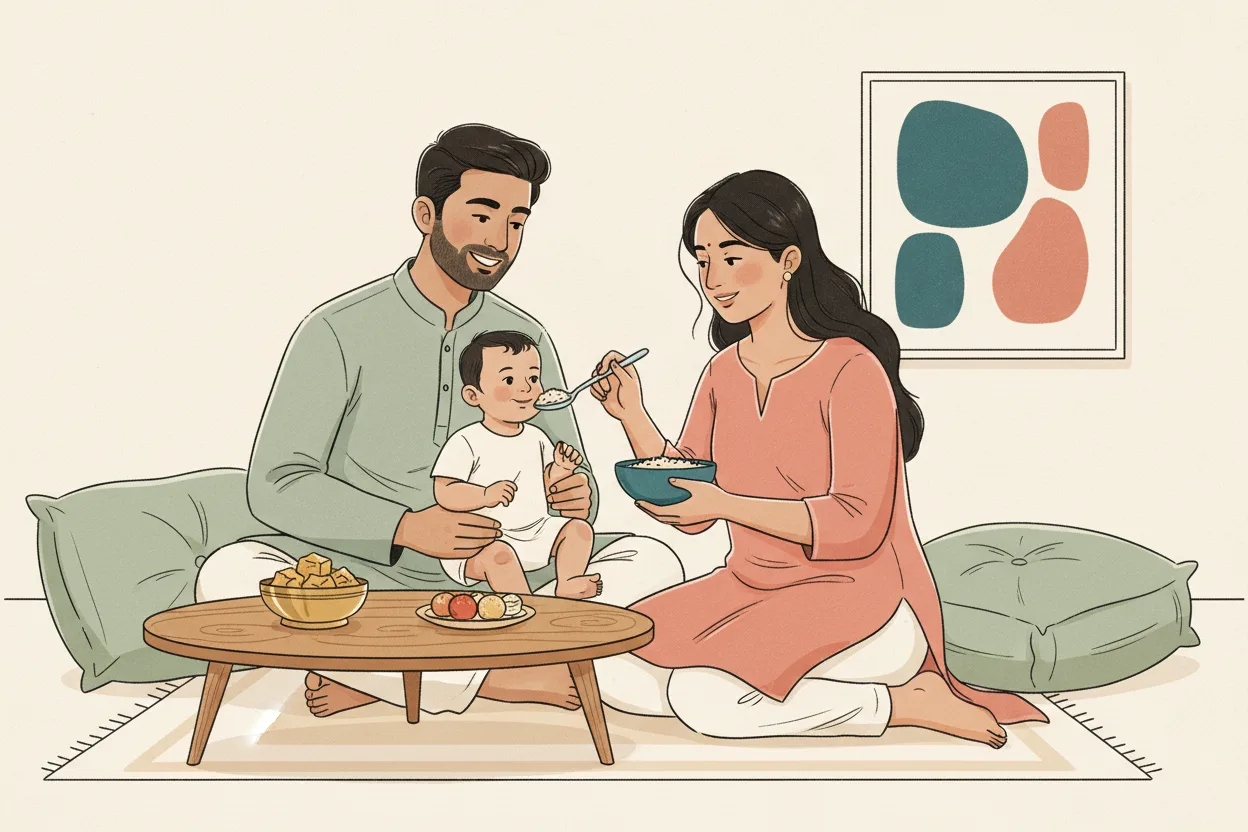
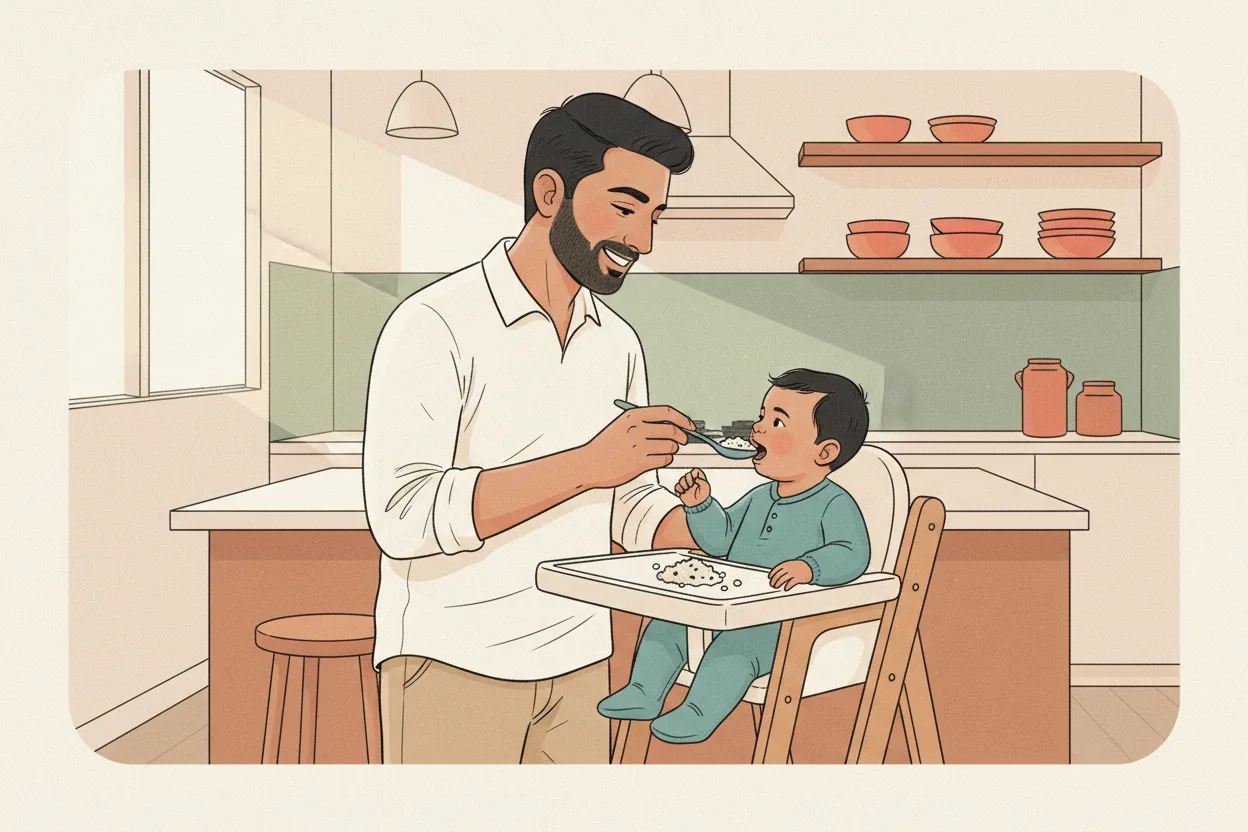
This pressure lands on both parents. If you and your partner are dividing feeding duties — one of you doing the weekday lunch, the other weekend meals — it's worth agreeing together that the goal is a relaxed, low-stress start, not matching a stranger's grid.
What "On Pace" Actually Looks Like at 6–7 Months
At this stage, a baby's job is to learn to eat — not to consume a nutritionally complete, varied diet by Friday. HealthyChildren.org (AAP) states that "a new eater only needs 1-2 tablespoons of each food and will gradually increase to 3-4 tablespoons as she gets older." That's it — a spoon or two, not a full bowl of five ingredients.
There is a nutritional reason solids start around six months at all, and it isn't about variety. A review on complementary feeding and iron status found that a baby's "iron stores become gradually depleted at about this time, and breast milk alone can no longer meet the infant's iron requirements." That's why an iron-rich first food — ragi, dal, a little mashed egg, or an iron-fortified cereal — matters more early on than how many different vegetables are on the plate.
There's No Correct Order, and No One "Right" Method
A lot of comparison anxiety comes from an implied rulebook — vegetables before fruit, purees are "behind," baby-led weaning is "ahead." None of that holds up.
HealthyChildren.org, the American Academy of Pediatrics' parenting site, notes "there is no evidence that your baby will develop a dislike for vegetables if fruit is given first." Start with whatever's easiest to prepare and whatever your baby tolerates first.
The same goes for method. HealthyChildren.org (AAP) advises that "pureed foods can be nutritious, too, and they're easy to make from fresh ingredients... you can flex the baby-led concept to fit your family. For example, if you choose to feed your baby with a spoon for a few days or weeks, don't worry — they will still learn to eat independently." Spoon-feeding mashed khichdi is not a lesser approach than a baby-led weaning platter — it's an equally valid one.
| What the internet implies | What's actually true |
|---|---|
| A wide, colourful plate by 6 months means "ahead" | 1–2 tablespoons of one food is a normal serving at this age, per the AAP |
| Vegetables must come before fruit | No evidence that food order affects later preferences, per the AAP |
| Baby-led weaning is the "correct" modern method | Purees are equally nutritious; the AAP says either approach works |
| Refusing a food once means dislike | It typically takes 8+ exposures to build acceptance |
A Baby Refusing a Food Isn't a Final Verdict
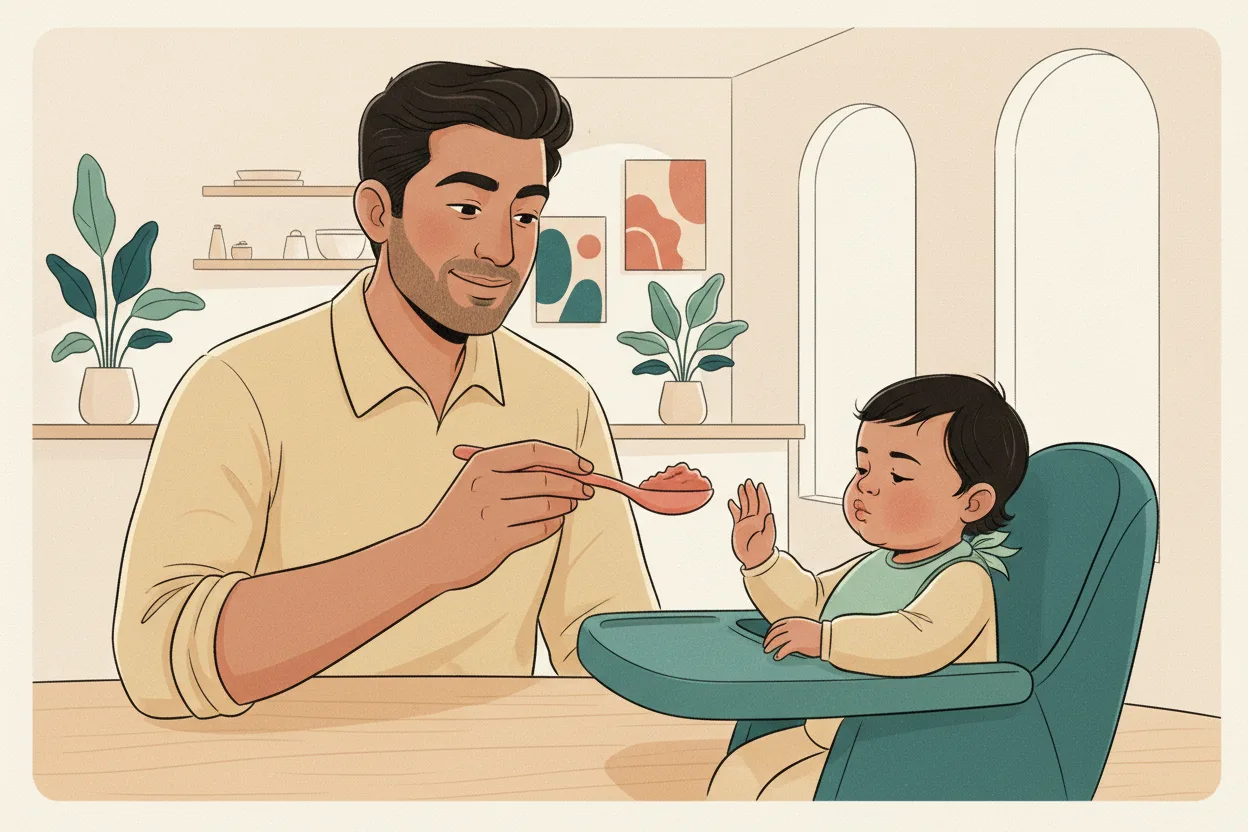
Spitting out mashed carrot on day one doesn't mean your baby dislikes carrot forever — it usually just means "not yet." A systematic review on the NCBI Bookshelf, prepared for the Dietary Guidelines Advisory Committee, found that "eight or more exposures will lead to an increase in at least one measure of food acceptability." Reoffer the same food across different days rather than concluding it's a lost cause after one or two tries — this is normal, expected, and not something to rush past.
Variety Is a Months-Long Goal, Not a Week-One Target
The "50 foods by 12 months" style checklist implies variety should be front-loaded. It shouldn't be. The WHO Guideline for complementary feeding of infants and young children (executive summary) states that infants "6–23 months of age should consume a diverse diet," with "animal source foods, including meat, fish, or eggs" and "fruits and vegetables" consumed daily — but that target spans the entire window from 6 months up to 2 years, not the first weeks of starting solids.
So if your 6- or 7-month-old is still working through five or six familiar foods, that's inside what the WHO guideline treats as normal progress, not a diversity deadline you've missed. The goal is to keep gradually adding new foods over the coming months, not to have covered the whole spectrum by month two.
Gear That Actually Helps (Without the Pressure)
A colour-matched feeding set isn't required to do this well. A few basics make the actual mechanics easier:
| Item | Price Range (INR) | Where to Buy |
|---|---|---|
| Silicone-tipped weaning spoons | ₹250 – ₹500 | Amazon.in / FirstCry |
| Suction-base weaning bowl | ₹350 – ₹800 | Amazon.in |
| Full-coverage silicone bib | ₹300 – ₹600 | FirstCry |
None of these change how fast your baby should progress — they just make the mess and the mealtime logistics easier for whichever parent is on duty that day.
Frequently Asked Questions
My baby is 7 months old and still only eats 3–4 foods. Is that a problem? Not on its own. The AAP notes that a new eater needs only 1-2 tablespoons of each food at this stage, gradually increasing with age. Keep offering new foods alongside the familiar ones, without needing to hit a specific count by a certain week.
Should I worry that we started with fruit instead of vegetables? No. HealthyChildren.org (AAP) states there's no evidence that giving fruit first causes a later dislike of vegetables. Order doesn't matter here.
Do we need to try baby-led weaning to be "doing it right"? No. The AAP is explicit that purees are just as nutritious, and that you can mix spoon-feeding and self-feeding however suits your family.
My baby refused dal twice — should we stop offering it? Keep trying. Research reviewed on the NCBI Bookshelf found it often takes eight or more tries before acceptance improves. Two refusals is well within the normal range.
By when should my baby be eating a wide variety of foods? There's no early deadline. WHO's guideline frames dietary diversity — including daily animal-source foods, fruits, and vegetables — as a goal across the full 6–23 month window, not something to achieve in the first weeks of starting solids.
Is there any real medical reason to start solids around 6 months rather than later? Yes — timing does matter, even if variety doesn't need to rush. A PMC review notes that a baby's iron stores are typically depleted by around 6 months, which is why iron-rich complementary foods should start then rather than being delayed.