If you are producing more milk than your baby needs and you want it to go somewhere useful, the place to take it is a human milk bank — in India, usually a Comprehensive Lactation Management Centre attached to a hospital. India's MoHFW National Guidelines on Lactation Management Centres (2017) define a donor as a lactating woman donating voluntarily after screening and approval, state that a donor shall not receive remuneration for her milk, require informed written consent, and say plainly that donated human milk cannot be used for any commercial purpose — it is dispensed to newborns admitted at the facility where the centre sits.
That paragraph is the whole test. Any outfit offering to collect your milk can be measured against it, and most of your questions answer themselves once you know what the standard looks like.
Not medical advice — talk to your paediatrician, or the neonatologist in charge of the milk bank, about anything specific to you or your baby.
Why your extra milk is worth this much paperwork
WHO's recommendation is that low-birth-weight infants, including those with very low birth weight, who cannot be fed mother's own milk should be fed donor human milk, in settings where safe and affordable milk-banking facilities are available or can be set up.
The reason is specific rather than sentimental. A 2024 Cochrane review concluded that donor human milk reduces the risk of necrotising enterocolitis — a severe gut illness of premature babies — by about half in very preterm or very low birthweight infants, compared with formula.
Indian banks aim that milk at the smallest patients. Clinicians running a milk bank at a Delhi medical college describe pasteurised donor milk as gap support for the most vulnerable preterm infants — under 1500 g and under 32 weeks' gestation — when the mother's own milk is not available.
Where you donate matters as much as that you donate. WHO's implementation guidance puts it in one line: when mother's own milk is not available, donor human milk for preterm or low-birth-weight infants is preferably supplied through an established human milk bank.
So a freezer shelf of surplus milk in a Mumbai or Bengaluru flat is not a sentimental gesture. It is a clinical supply for babies in a nearby NICU — which is exactly why the handling of it is tightly specified.
What a real milk bank does with your milk
| Step | What a legitimate bank does |
|---|---|
| Screening | Medical history, lifestyle questions and a physical examination, plus serology — HIV, Hepatitis B and syphilis/VDRL are mandatory under India's guidelines; an NHS hospital milk bank lists HIV, Hep B&C, syphilis and HTLV |
| Consent | Informed written consent before the first donation, in a language you actually read |
| Pasteurisation | The Holder method — 62.5°C held for 30 minutes, then rapid cooling |
| Testing | Cultures before and after heat treatment; an NHS bank states that bottles with bacteria above safe levels are discarded |
| Traceability | WHO standards expect track-and-trace systems that follow milk from donor to recipient and back again |
| Destination | Admitted newborns, on a prescription from the treating doctor — never any commercial purpose |
| Payment | No financial incentives to donors — reimbursement of genuine costs only, kept financially neutral |
Two of those rows matter more than the rest when you are sizing up an organisation: traceability and destination. A bank that can trace a bottle back to you is a bank that is accountable for it, and a bank that knows which babies it feeds can tell you.
What a legitimate process will and will not ask of you
It will:
- Ask for your antenatal records, or send you for blood tests, before your first donation — India's guidelines treat HIV, Hepatitis B and syphilis/VDRL screening as mandatory where recent antenatal reports are unavailable.
- Take a medical and lifestyle history and examine your breasts, and take informed written consent.
- Ask about medicines you take, because WHO's standards exclude donors taking drugs or alcohol, or medication passed into milk and contraindicated in breastfeeding.
- Put your own baby first: the Indian guidelines say a mother donates after providing for her own baby, with no compromise on his or her satiety.
It will not:
- Pay you per bottle or per litre. WHO's standards say financial incentives should not be offered to milk donors — reimbursement of actual costs, such as transport or pump consumables, is the only money that changes hands.
- Be vague about where the milk ends up. A bank funded to feed admitted babies can name the unit it supplies, because that is the use its own rulebook permits.
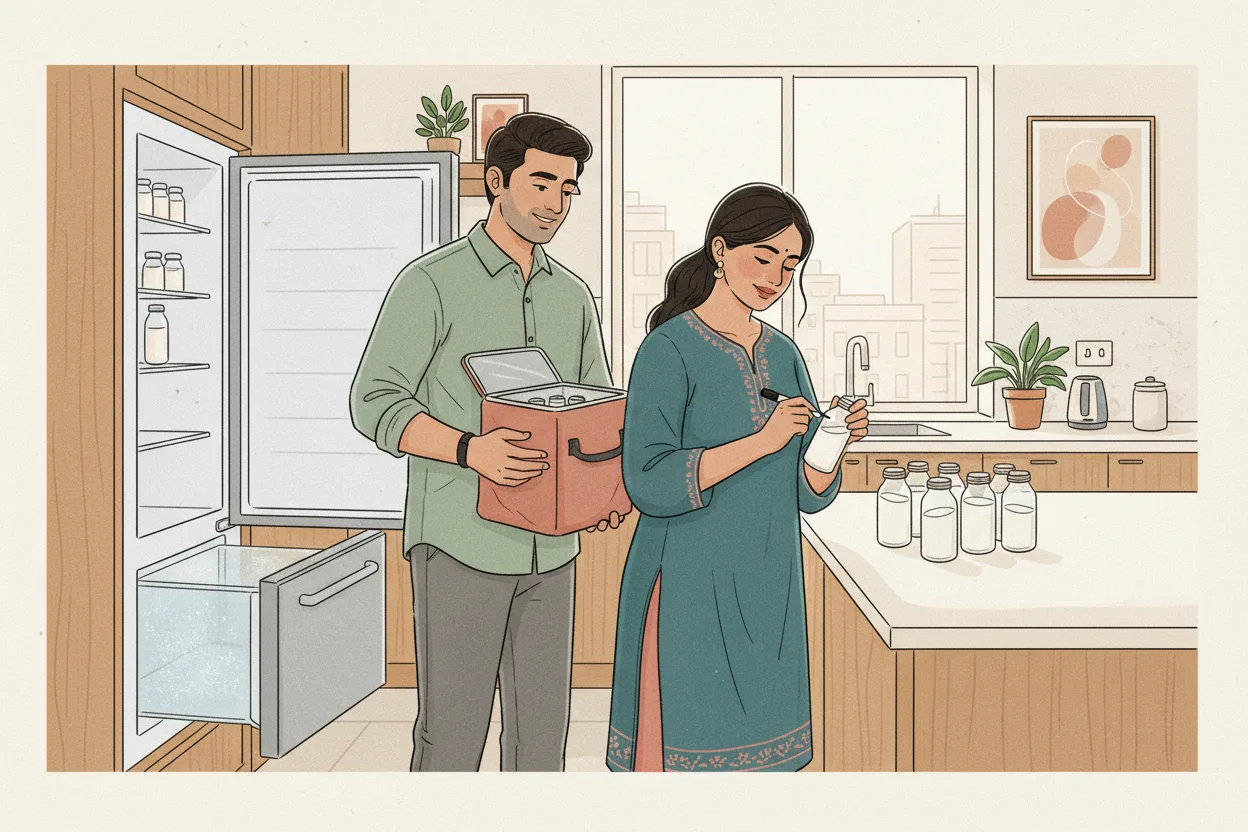
This is also a good moment to involve your partner. Fathers tend to end up doing the logistics — the freezer bags, the cold chain to the hospital, the paperwork — and reading a consent form is a two-person job.
The clauses worth reading twice
A donation consent form is a contract. Read it in full, slowly, and get a copy to keep. These are the clauses that carry the most weight:
| Clause | What to look for |
|---|---|
| Purpose of use | Does it say the milk feeds admitted newborns, or does it also permit research, "product development", or manufacture? |
| Onward transfer | May the milk, or samples of it, be transferred, supplied or sold to a third party or a company? Is that party named? |
| Commercial processing | Is there wording that allows processing into a manufactured product, such as a human-milk-based fortifier? |
| Payment and inducements | Cash, gift vouchers, free consultations or "reimbursement" beyond real costs — WHO's benchmark is financial neutrality, not reward |
| Data and sample retention | How long are your records and blood samples kept, by whom, and for what? |
| Withdrawal | Can you stop donating at any time, and ask for your records to be dealt with? |
| Traceability | Can the organisation trace a batch back to you if something goes wrong — the donor-to-recipient-and-back standard? |
If a clause signs your milk over for a purpose you did not intend, that is not a formality to wave through. Ask for it to be struck out, or donate elsewhere. A form you are asked to sign at a home visit, with no copy for you, is worth pausing on.
Non-profit, hospital-attached or commercial: a fair question
It is reasonable to ask an organisation what it is, and to expect a straight answer. The international picture is genuinely unsettled.
A 2021 paper in the Bulletin of the World Health Organization noted that there are no minimum quality, safety and ethical standards for donor human milk and no coordinating global body to inform national policies, and set out ethical concerns about commercialisation and potential exploitation of women — adding that such risks may be exacerbated by the growth of commercial use of human milk by for-profit companies.
WHO's own implementation guidance on milk banking says it emphasises non-profit milk bank systems and does not address the complexities of for-profit systems or the commodification or commercialisation of human milk.
Products made from human milk do exist in neonatal care. A Cochrane review notes that a human milk-derived multi-nutrient fortifier is now available, while concluding that there is insufficient evidence evaluating it against a bovine milk-derived fortifier. That is the current state of the science, not a verdict on any company.
Read all of that honestly: human milk being used in commercially manufactured products is a real, internationally debated practice, and the published evidence about how it affects donors is thin. That is a reason to read the paperwork carefully and ask for answers in writing. It is not a reason to assume bad faith about a particular organisation — and in India, the public framework is unambiguous that donated milk is for admitted babies and not for commercial use.
WhatsApp groups and milk sharing between friends
Lots of Indian mothers do this, so here is the straight answer rather than a shrug.
The American Academy of Pediatrics advises against internet-based or informal human milk sharing, because those sources of human milk carry the risk of bacterial or viral contamination, or exposure to medications, drugs, herbs or other substances.
A 2013 study in Pediatrics tested milk obtained through a milk-sharing website: 74% of samples were colonised with Gram-negative bacteria and 21% were cytomegalovirus DNA positive, and the authors concluded that infants consuming such milk are at risk of negative outcomes, particularly if born preterm or medically compromised.
The missing ingredients in a WhatsApp handover are the ones a bank supplies: serology, a medical history, pasteurisation and a record trail. If a friend's baby needs milk and your instinct is to help, the safest version of that generosity is to register as a donor at a bank and let the clinical team decide where it goes.
You are not unusual for wanting to do this
A 2021 systematic scoping review in Public Health Nutrition found that the common reasons for donating are altruism, having excess milk, and avoiding waste. Nothing exotic, in other words — just a lot of milk and a wish not to pour it away.
Questions worth asking on the first phone call:
- Which hospital or NICU does the milk go to, and is it dispensed on a doctor's prescription?
- Are you registered as a lactation management centre or milk bank, and under whose licence?
- Where is the pasteurisation done, and what temperature and time do you use?
- Can you trace a batch back to me, and will you tell me if a batch is discarded?
- May I have a copy of the consent form to read at home before I sign?
A hospital-attached bank will find these ordinary questions. An organisation that gets evasive about the destination of the milk has told you something useful.
The bottom line
Donate. Preterm babies in Indian NICUs need this, and the evidence that donor milk halves the risk of necrotising enterocolitis compared with formula is about as solid as neonatal evidence gets. Just donate through a bank that screens you, pasteurises the milk, can trace it, and can name the babies it feeds — and read the consent form before you sign it, not after.