
A flat patch on the back or side of your baby's head is almost always a side effect of safe back-sleeping, not something you did wrong. Cleveland Clinic explains that flat head syndrome became far more common once babies started sleeping on their backs, because a soft newborn skull can flatten under sustained pressure from spending a lot of time in the same position. The fix is not to stop back-sleeping — it's supervised repositioning while baby is awake.
Not medical advice — consult your pediatrician if you're worried about your baby's head shape.
Why This Comes Up So Often in Indian Homes
Newborns in India spend a lot of time being carried, rocked, and settled by more than one person — you, your partner, and often a grandparent — and a lot of that settling happens in a cloth cradle (jhula, jhoola, or paalna) that swings gently, alongside a cot or crib. None of that is a problem on its own. What matters is which way baby's head is turned while they're lying down, whether that's in the jhula, the crib, a bouncer, or the car seat — and whoever is doing the settling that day should get into the habit of alternating sides.
Back to Sleep, Every Time — No Exceptions
Whatever you do about head shape, keep baby on their back for every sleep, every time. The AAP states that babies who sleep on their backs are much less likely to die suddenly and unexpectedly than babies who sleep on their stomachs or sides. Simple positional flattening in an otherwise back-sleeping baby is a cosmetic issue, not a dangerous one, while back-sleeping is the single biggest thing you can do to protect your baby overnight — so it is never worth trading away.
What Actually Prevents and Improves It
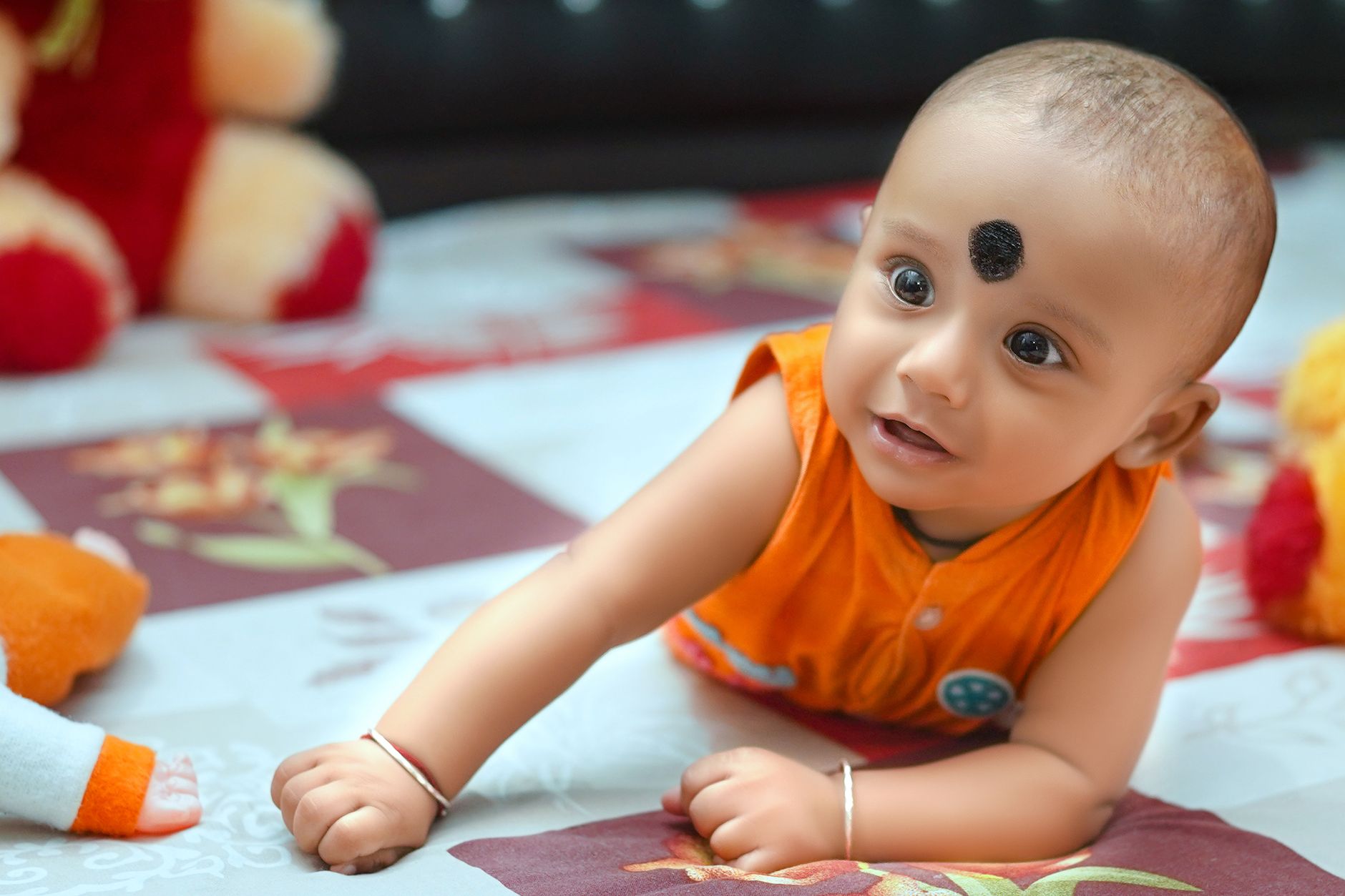
Awake, supervised tummy time — starting from day one. A PMC clinical commentary notes that regular supervised tummy time for play, along with limited use of supine positioning devices, can help prevent or lessen the severity of deformational plagiocephaly. A firm play mat, with you or your partner right there, is enough to start — you can build up as baby gets stronger. Cleveland Clinic advises starting with two or three short sessions of three to five minutes each in the newborn stage, building up to at least 15–30 minutes total a day by 2–3 months, and to 60–90 minutes a day by 6 months until baby starts crawling.
Skipping tummy time isn't just a missed nicety — it's linked to worse outcomes. A matched case-control study on PubMed Central found that little tummy time when awake carried a large jump in the odds of more severe (not just mild) head flattening. If tummy time is a daily struggle and baby cries through every attempt, that's worth mentioning to your pediatrician rather than quietly giving up on it.
Cut down time in gear that locks baby's head in one position. HealthyChildren.org (AAP) advises reducing sleep time in places where a baby's head can't move freely, such as curved baby swings or car seats that restrict movement, outside of actual car travel. A bouncer or swing is fine for short stretches while you get things done, but it shouldn't become a default nap spot.
Alternate the direction baby faces. Change which end of the crib baby's head points to every few days, and alternate which arm you carry and feed from. This spreads out the pressure instead of letting it settle on the same spot day after day.
Mustard Seed (Rai) Pillows and Cloth Cradles: What's Actually Safe
The rai/mustard-seed pillow, custom-molded to a baby's head shape, is a well-known tradition in many Indian families, often recommended by grandparents as a way to keep the head "round." It's worth understanding why pediatric guidance doesn't support this. NICHD's Safe to Sleep campaign states that a baby's sleep space should have nothing soft or squishy in it — the same category as pillows, stuffed toys, and crib bumpers — because loose, soft filling is a suffocation risk. A mustard-seed pillow is exactly this kind of loose-filled, squishy item, so it doesn't belong in the crib or jhula during sleep, no matter how it's marketed.
The same logic rules out foam "head-shaping" wedges and donut-style positioners sold online for flat head — they're soft positioning devices in a sleep space, which is the thing to avoid. A cloth cradle or jhula itself is fine to use for supervised naps; the issue is never the cradle, it's adding soft filler underneath baby's head inside it.
When It's More Than Cosmetic
Most flat spots are simple positional flattening and nothing to worry about — and if you're quietly wondering whether it affects your baby's brain, not your baby's looks, here's the reassurance: a prospective cohort study in Pediatrics (via PMC) found that school-aged children with moderate-to-severe head flattening in infancy scored lower on cognitive and academic measures than peers, but the same link was negligible for children whose flattening had been mild — which is what conservative repositioning and tummy time are aimed at catching early. Beyond that reassurance, there are two things worth actively ruling out.
Check for a tight neck. HealthyChildren.org (AAP) reports that an estimated 85% of babies with torticollis — a condition where the neck muscles are tight or imbalanced — also have a positional skull deformity. If baby strongly prefers turning their head to only one side even when you try to redirect them, ask your pediatrician about a torticollis check; it usually needs its own stretching routine or physiotherapy, not just repositioning.
Repositioning is the first-line treatment, not a helmet. A National Institutes of Health (StatPearls) clinical review states that helmets become necessary only when infants do not show improvement with repositioning techniques, and they tend to work best when started around 5–6 months of age. Most babies never need one — repositioning plus tummy time resolves the great majority of cases.
Know the difference between flat head and a fused-suture condition. An AAP clinical report explains that children with craniosynostosis — a structural condition where the skull's growth sutures fuse too early — should be referred early to surgical specialists for surgical repair. This is a different, much rarer condition from simple positional flattening, and it's the real reason to flag a persistent or unusual head shape to your pediatrician rather than trying to fix it at home indefinitely.
What's Worth Buying
| Item | What it's for | Price range | Where to buy |
|---|---|---|---|
| Firm play mat | Supervised tummy time on a stable, washable surface | Rs. 800 – Rs. 2,500 | Amazon.in / FirstCry |
| Firm, flat crib mattress + fitted sheet | The sleep surface itself — no wedges or pillows needed under it | Rs. 1,500 – Rs. 4,000 | FirstCry |
| Baby-safe mirror or hanging toy | Encourages baby to turn their head both ways during play | Rs. 300 – Rs. 900 | Amazon.in |
Skip anything marketed as a "flat head correction pillow" or head-shaping cushion for the crib — loose-filled and soft positioning items don't belong in a baby's sleep space.
Frequently Asked Questions
Is a mustard seed (rai) pillow safe for my baby's crib? No — for sleep, avoid it. NICHD lists soft, squishy items like pillows among the things that shouldn't be in a baby's sleep space because of suffocation risk, and a rai pillow is a loose-filled pillow.
Will my baby's flat spot go away on its own? Often, yes, especially if you catch it early and stay consistent with repositioning and tummy time — repositioning is the first-line approach, and most babies improve without needing a helmet.
How much tummy time does my baby actually need? Supervised tummy time from birth is the main thing shown to help, and skipping it is linked to more severe flattening. As a concrete target, Cleveland Clinic suggests a few minutes at a time in the newborn weeks, working up toward 15–30 minutes a day by 2–3 months and 60–90 minutes a day by 6 months — spread across the day rather than saved for one sitting.
My mother-in-law wants baby to sleep on a mustard-seed pillow every nap. What do I say? You can explain that pediatric guidance is clear that nothing soft or loose-filled belongs in the sleep space — it's a suffocation risk, not a judgment on tradition. The jhula or cot itself is fine; it's what's underneath baby's head during sleep that needs to change.
When should we actually see a doctor about head shape? If baby strongly favors turning to one side, torticollis is worth ruling out; if the head shape looks unusual rather than simply flat on one side, or isn't improving with a few weeks of consistent repositioning, ask your pediatrician — they can tell simple positional flattening apart from rarer structural conditions that need a specialist.
Does back-sleeping cause flat head, so should we let baby sleep on their tummy instead? No — never put baby to sleep on their tummy to avoid a flat spot. Back sleeping cuts the risk of sudden infant death, and that protection matters far more than a cosmetic flat spot, which repositioning while awake can address instead.