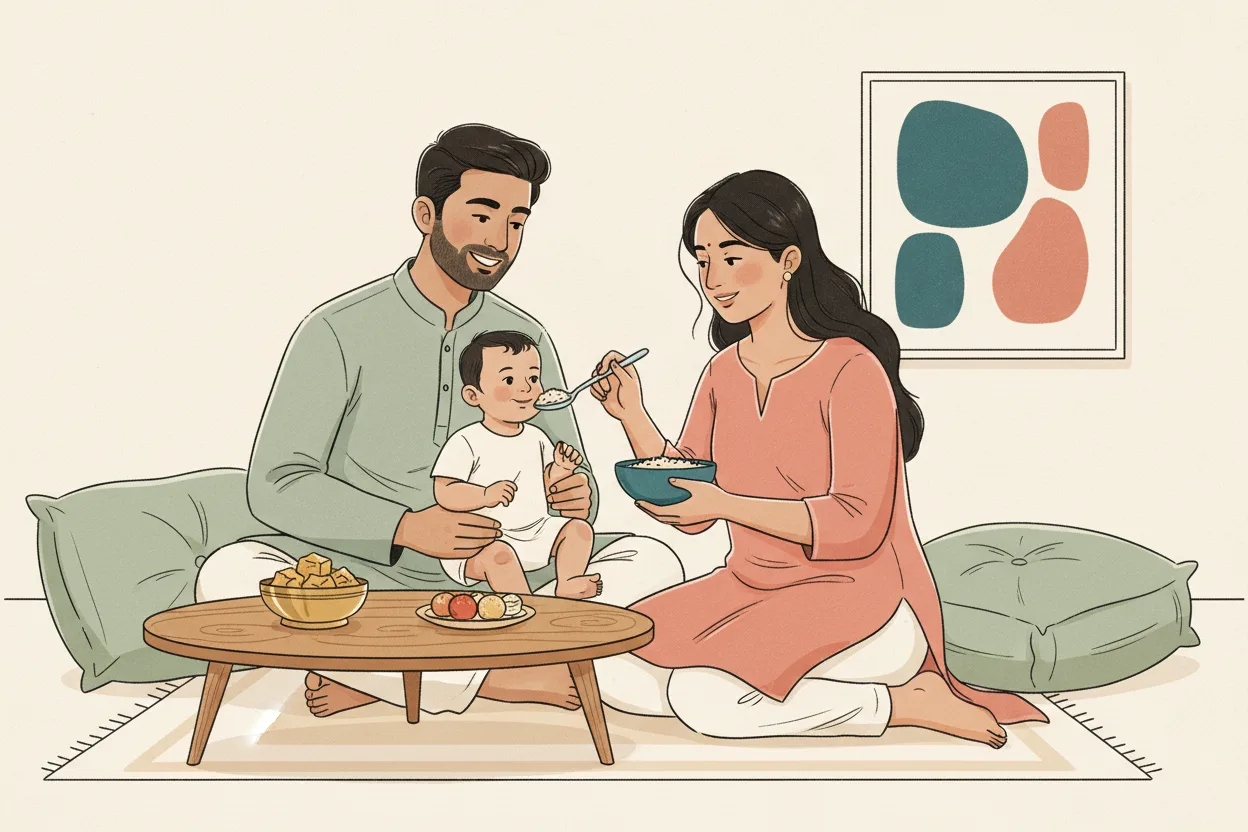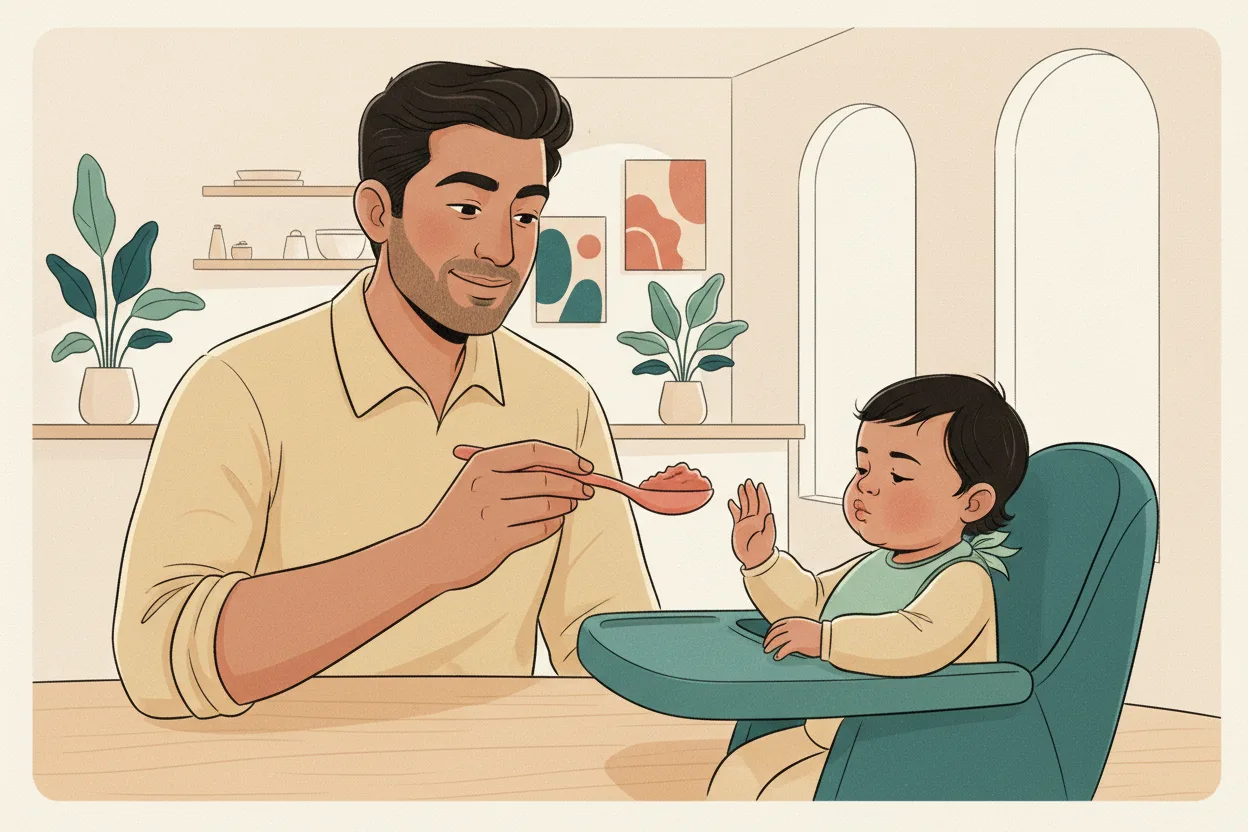

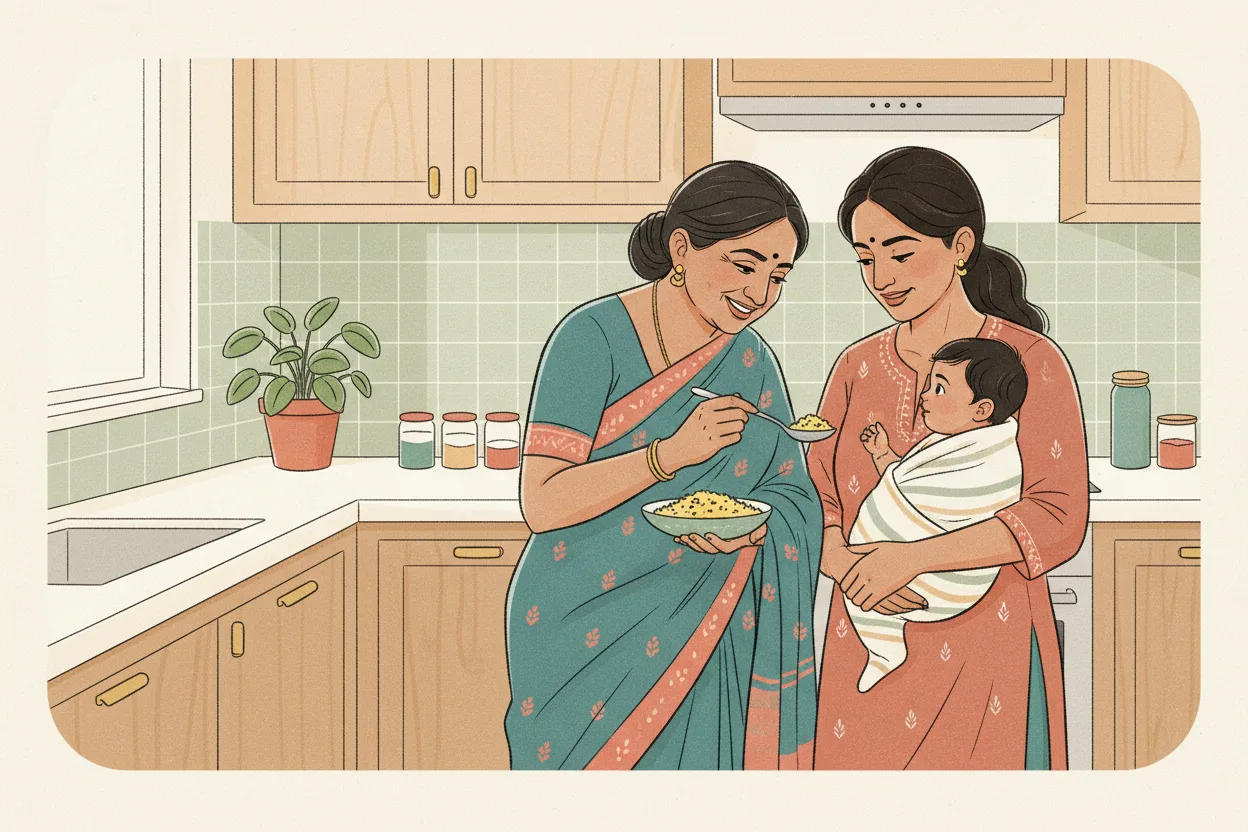
Your mother or mother-in-law fed your baby a taste of something — dal water, an almond, a spoon of kheer — without checking first, and now you're trying to figure out how worried to be. Some of what grandparents do is genuinely fine. A few things are genuinely risky. This guide separates the two, so you can set the right boundary without a fight over everything.
Not medical advice — consult your pediatrician for guidance specific to your baby.
Why This Happens So Often in India
In most Indian homes, grandparents are active caregivers, not occasional babysitters — they may look after the baby alone for long stretches. Their instinct to "just give the baby a little taste" comes from love and from how they fed their own children decades ago, when guidance was different. The fix isn't to shut grandparents out of feeding; it's a short, clear list of what's off-limits and why, so everyone works from the same rules.
What the Evidence Actually Says About Timing
WHO's complementary feeding guideline recommends that solid foods start at around 6 months of age, while breastfeeding continues. That timing isn't arbitrary — a peer-reviewed review in Current Developments in Nutrition/PMC states that a baby's iron stores from birth are largely used up by around 6 months, which is one reason iron-rich complementary foods matter starting then, not earlier. If a grandparent has started solids well before 6 months, that's the first thing worth raising, calmly, with the "why."
The Allergen Question: Grandparents May Actually Have the Right Instinct
Here's a twist: giving a baby a taste of egg or nut paste early isn't automatically the mistake it used to be considered. AAP guidance reported by HealthyChildren.org states that introducing infant-safe forms of peanut as early as around 6 months, after other solids are tolerated, can actually help prevent peanut allergy rather than cause it. So a grandmother who offers a taste of peanut or egg once your baby is on solids isn't necessarily doing something dangerous — she may be doing something the current evidence supports.
The real issue isn't whether allergens are introduced early — it's how. HealthyChildren.org (AAP) advises giving one new food at a time and waiting at least a day before starting another. If a grandparent mixes a new allergen into a multi-ingredient dish without telling you and your baby reacts, you have no way to trace which ingredient caused it. That's the boundary worth insisting on: one new food at a time, and you're told what's being introduced and when.
In India specifically, the Indian Academy of Pediatrics' parental guideline notes that cow's-milk protein and soya protein are among the foods a baby may be allergic to — relevant given how often Indian family feeding includes milk-based sweets, curd, and paneer — though it adds that such allergies are not very common in Indian children, and that a pediatrician should be consulted if a reaction is suspected.
What a Reaction Actually Looks Like — And When It's an Emergency
Knowing to "watch for a reaction" only helps if you know what a reaction looks like. HealthyChildren.org (AAP) states that allergic reactions can show up as skin problems (hives, itchy rashes, swelling), breathing problems (wheezing, throat tightness, coughing), or stomach symptoms (vomiting, diarrhea, abdominal pain) after a new food. A single mild symptom, like a few hives, is usually one to monitor closely and mention to your pediatrician.
It's a different situation if symptoms show up together, or breathing is affected. HealthyChildren.org (AAP) states that anaphylaxis — a rapid, severe allergic reaction — is a life-threatening emergency that can happen to children at any age, including infants, and can be deadly without immediate medical help. If your baby has trouble breathing, swelling of the lips or face, or vomiting together with hives after a new food, treat it as an emergency and get medical help immediately rather than waiting to see if it passes.
What's Actually Non-Negotiable
Unlike allergen timing, these are settled safety rules, not judgment calls.
| Food/Practice | Why it's a hard rule | Source |
|---|---|---|
| Honey before 12 months | Risk of infant botulism | HealthyChildren.org (AAP) |
| Cow's milk as a main drink before ~12 months | Not appropriate as a primary drink at this age | HealthyChildren.org (AAP) |
| Whole nuts, whole grapes | Choking hazards unless cut up or modified | HealthyChildren.org (AAP) |
| Added salt or sugar in a baby's food | Not needed, and best avoided during weaning | NHS |
HealthyChildren.org (AAP) states that honey is a source of botulism spores and should be avoided in babies under 12 months — this includes a lick of honey in a home remedy or on a pacifier, a practice some elders still use to soothe a fussy baby. HealthyChildren.org (AAP) also lists whole grapes and nuts and seeds among foods to avoid or modify for young children — a whole almond handed to a baby who isn't yet chewing well is a choking risk, not just an early-allergen question. And NHS guidance states a baby's food shouldn't have salt or stock cubes added, and doesn't need sugar — worth flagging if a grandparent's cooking for baby comes straight from the family pot.
How to Set the Boundary Without a Fight
Lead with a short, written list, not a lecture. A one-page note repeating the points above — solids from 6 months, one new food at a time and tell me which, hold off until 12 months on honey and cow's milk as a drink — is easier to follow than a conversation they'll only half-remember. Stick it inside a kitchen cabinet if that helps.
Loop in your partner as an equal voice. When dad states the same boundary to his parents or hers, it reads as a shared parenting decision, not one partner being difficult with the other's family.
Say what to do, not just what to skip. "Please give me a heads-up before trying a new food, so I can watch for a reaction" invites cooperation. Banning all family feeding outright tends to invite resentment and secrecy instead.
Separate preference from safety. A skipped vegetable is a preference — let it go. Honey, added salt, or a whole nut is a safety conversation, worth having promptly, citing the "why" rather than just the "no."
Frequently Asked Questions
My baby's grandmother gave a taste of almond paste at 7 months without asking. Should I panic? No. Your baby is past the recommended 6-month start for complementary foods, and nut-based foods around this age are actually supported by AAP guidance as allergy-prevention. Watch for a reaction over the next couple of hours, and ask that the next new food be introduced one at a time with you informed first.
Is it true that starting solids early "toughens up" a baby's stomach? There's no good evidence for that idea. What's well-supported is starting complementary foods around 6 months, not earlier and not much later, alongside continued breastfeeding.
What if grandparents say "we fed you sugar/honey/cow's milk and you turned out fine"? Acknowledge that guidance has changed. Honey under 12 months carries a specific botulism risk, and cow's milk isn't recommended as a baby's main drink before about 12 months — current safety rules, not a judgment on how anyone was raised.
How do I bring this up without it turning into a fight? Frame it as information, not accusation: "I read this and wanted to share it with you" lands better than "you did something wrong." A written note keeps the rule from feeling personal.
Do I need to be this strict about every single food? No — most foods are a matter of taste and family tradition, not safety. The genuinely non-negotiable items are honey and cow's milk as a main drink before 12 months, whole nuts or whole grapes, added salt or sugar, and new foods introduced one at a time so a reaction can be traced.