
Long wake windows plus Indian summer heat mean your baby spends hours indoors at a stretch. Fill that time with floor-based play, reading, and simple games rather than a screen — it's what your baby's development actually needs right now.
Not medical advice — consult your pediatrician for guidance specific to your child.
Why Indian Summers Make This Harder
A newborn's wake windows are short enough that heat barely matters. That changes fast: Cleveland Clinic's wake-window guidance shows that a baby's stretch of awake time between sleeps lengthens from roughly 2.5–4.5 hours around 7–10 months to about 3–6 hours by 10–12 months. Once your baby is crawling, cruising, curious, and awake for that much longer between naps, an idle stretch indoors gets boring fast. In most of India, April to June (and often well into the monsoon's humid spells) rules out a midday walk, a balcony sit, or park time for a big chunk of the day. That leaves you covering long stretches of wake time inside a flat, often without a joint-family member free to tag in.
The instinct to hand over a phone is completely understandable at hour two of a heatwave afternoon. The American Academy of Pediatrics recommends that parents and caregivers limit screen time for infants and make sure it doesn't replace other educational and recreational activities like play time — so the goal isn't to entertain baby every waking minute, it's to have a rotation of screen-free options ready so reaching for a screen isn't the default.
Screen-Free Activities That Actually Work
WHO's guidelines for infants under 1 state that babies should be physically active several times a day in a variety of ways, particularly through interactive floor-based play, and that more is better — which is a useful reframe: floor time isn't a way to pass time until the heat breaks, it's the actual activity your baby needs most right now.
Reading together. Keep 4–5 sturdy board books in a low basket your baby can reach. The AAP's early literacy guidance states that reading together with infants and young children significantly strengthens their relationships with parents and caregivers while promoting early brain development — a few short sessions through the day count, not just one bedtime story.
Peekaboo and hide-and-find games. These feel like filler, but they're not. Healthline reports that games like peekaboo help a baby learn that you're definitely coming back, just like you always have before — because object permanence is developing right around this age. Hide a toy under a cloth or behind your back and let baby find it; this is genuinely stimulating play, not a stalling tactic.
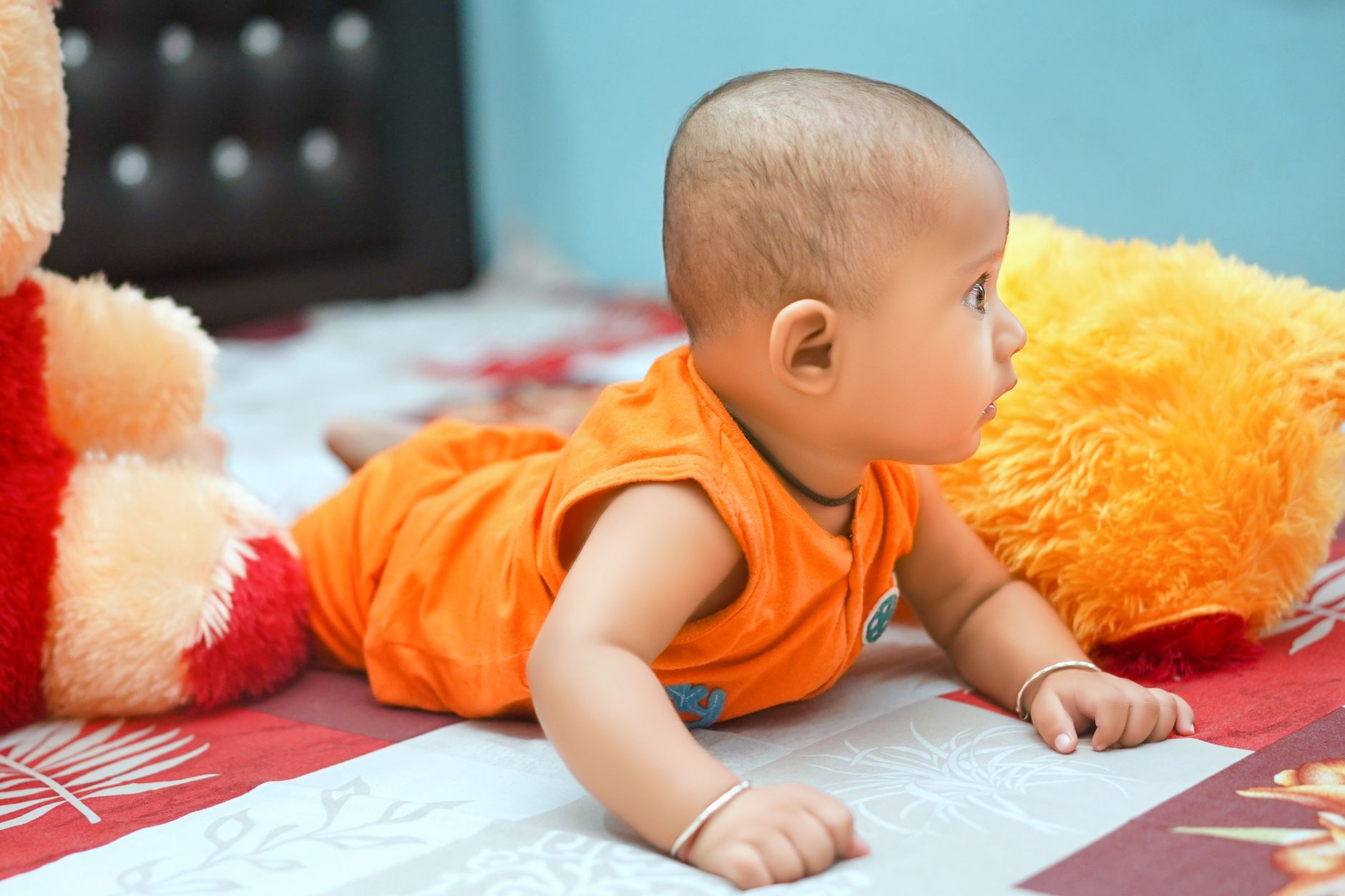
Supervised floor exploration. Clear a section of floor — a rug, a play mat, the living room — and let baby crawl, pull up on furniture, and explore. HealthyChildren.org (AAP) advises giving your baby cleared, supervised space at this stage because babies this age explore small objects on the floor, under the couch, or wherever they can find them — so do a sweep for coins, button batteries, and small toy parts before you set baby down.
Sensory and stacking play. Fabric with different textures, a basket of safe kitchen containers, stacking cups, and rattles all reward the same crawl-reach-grab-drop loop your baby is practising all day. None of it needs to be fancy or bought new.
Managing the Heat While You Play
Long indoor stretches in Indian summer bring their own risks worth watching for.
Heat rash. Babies get prickly heat easily in hot, humid weather, especially with active play that works up a sweat. HealthyChildren.org (AAP) advises using fans or air conditioners to keep your child's skin cool and dry on hot days — run a fan or the AC during active play sessions, and dress baby in light, breathable cotton. For a concrete AC or fan setpoint, NHS guidance states that the room should stay between 16–20°C, since anything hotter raises the risk of overheating.
Vitamin D while baby is indoors more. Keeping baby out of the midday sun during a heatwave doesn't leave a gap in their vitamin D. HealthyChildren.org (AAP) advises that all infants get a vitamin D supplement of 400 IU a day (unless they're drinking more than 27 oz of fortified formula daily) — supplementation covers the need regardless of how much sun exposure baby gets, so there's no reason to trade heat safety for sun time.
Hydration and heat-illness signs. HealthyChildren.org (AAP) advises encouraging children to drink water frequently and having it readily available even before they ask for it — for a breastfed or formula-appropriate-age baby past 6 months, offer sips of water between milk feeds during hot spells, and call your pediatrician if baby seems unusually lethargic, feverish, or isn't producing wet nappies as usual.
Babyproofing the play zone. Once a baby starts pulling up and cruising — common in this 8–12 month window — the floor space you've cleared needs real boundaries. HealthyChildren.org (AAP) recommends using gates on stairways and doors once your baby becomes mobile, so the same room that's your indoor playground during a heatwave afternoon stays a safe one.
Gear Worth Having on Hand
| Item | What it's for | Price range | Where to buy |
|---|---|---|---|
| Foldable play mat / gym | Padded, washable floor surface for daily play | Rs. 800 – Rs. 2,500 | Amazon.in / FirstCry |
| Board book set | Reading together, chew-proof pages | Rs. 300 – Rs. 900 | Amazon.in |
| Stacking cups / rings | Sensory and cause-effect play | Rs. 250 – Rs. 600 | FirstCry |
| Safety gate | Blocks stairs and doorways once baby is mobile | Rs. 1,500 – Rs. 4,000 | Amazon.in |
None of this is essential to buy new — a folded cotton dohar on the floor, steel katoris and a wooden spoon, and books borrowed from a friend do the same job as their branded equivalents.
Frequently Asked Questions
How much floor time does my baby actually need each day? WHO's guidance is to be physically active several times a day through interactive floor-based play, with more being better — so aim for several shorter sessions spread across the day rather than one long one, which also fits better around naps and heat.
Is it okay to let my baby have some screen time on a really long, hot afternoon? The AAP's position is to limit screen time for infants and keep it from replacing play and other recreational activities — video-calling a grandparent is fine, but treat a show as the exception, not the afternoon's main activity.
My baby seems extra fussy and sweaty during indoor play in summer — what should I check? Watch the skin for prickly heat and keep the room cool with a fan or AC, since heat rash is common in hot, humid weather. Also offer water frequently and call your pediatrician if baby seems unusually lethargic or feverish.
Do I need to babyproof the whole flat or just the play area? Start with wherever baby actually spends floor time. HealthyChildren.org (AAP) recommends gates on stairways and doors once your baby is mobile — extend room by room as baby's range increases.
Are games like peekaboo actually useful, or just cute? Genuinely useful. Healthline explains that peekaboo-style games help your baby learn you always come back, which lines up with object permanence developing around this age — it's real cognitive practice, not just a cute distraction.
What if my baby puts everything on the floor in their mouth? Expected at this stage. The AAP notes that babies this age explore small objects on the floor and in hard-to-see spots — so before each play session, do a quick sweep of the area for anything smaller than a golf ball.