
Book the bassinet bulkhead seat the moment your ticket is confirmed, feed your baby during takeoff and landing, and plan your first two days in India around daylight, not the clock. Those three moves make the difference between a rough 10+ hour sector and one you can actually manage.
Not medical advice — consult your pediatrician before your baby's first long-haul flight, especially if they were premature or have a heart, lung, or chronic condition.
Why the NRI Long-Haul Sector Is Different
A 10–15 hour nonstop from the US, UK, Canada, Australia, or the Gulf is a different animal from a 90-minute domestic hop: one long feeding-and-sleep cycle, a multi-hour time-zone jump on landing, and often a connecting flight on top. The seat you book and your recovery plan afterward need more thought than a short domestic trip does.
How Young Is Too Young for This Flight?
Newborns can technically fly as early as 7 days old, but Cleveland Clinic pediatrician Dr. Lisa Diard advises waiting until a baby is at least 3 months old for a flight where possible — by that age they typically have had their first round of vaccinations and a somewhat more developed immune system. For a 10+ hour NRI sector with a connection on top, that extra margin is worth planning around if your dates are flexible; if they're not, loop your pediatrician in early rather than deciding this on your own.
Booking the Bassinet Bulkhead Seat
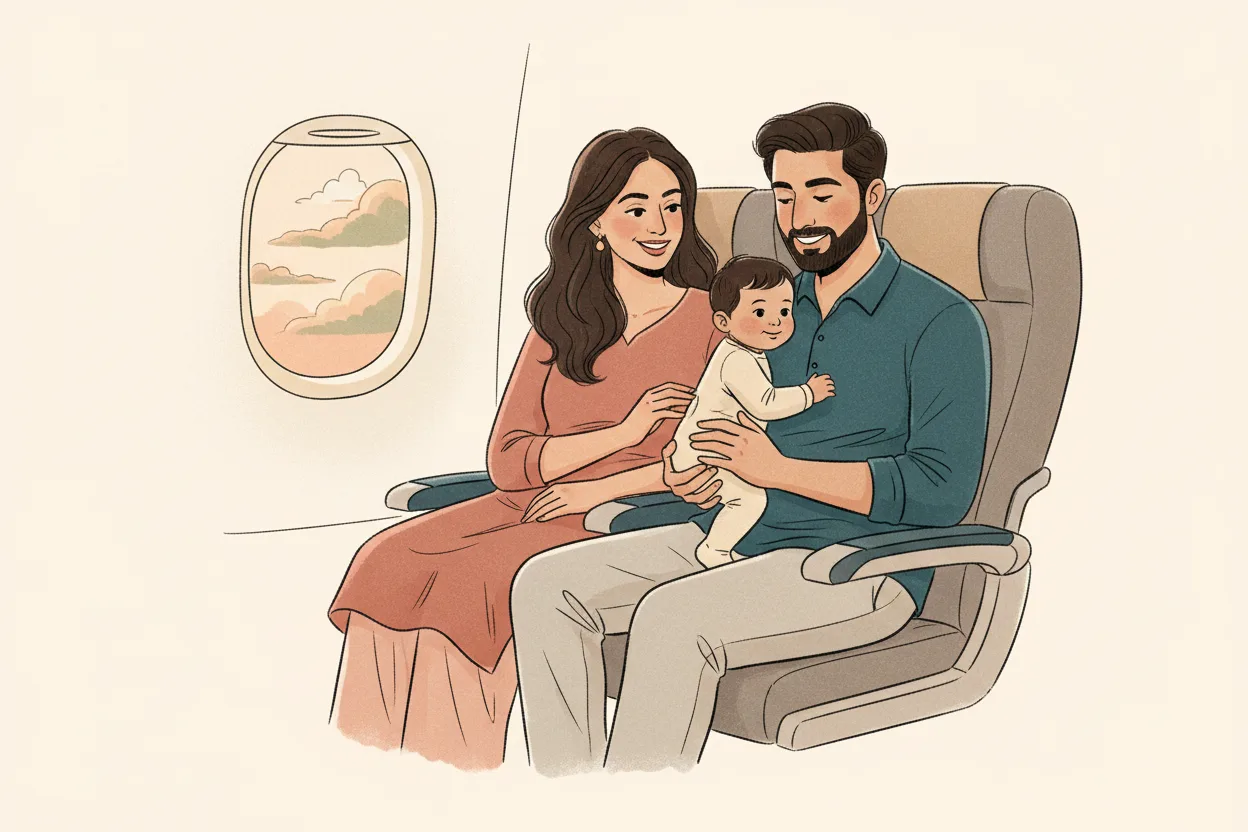
Call the airline directly (or use the "special assistance" / infant option in booking) as soon as your baby's date of birth is on the ticket — bassinet bulkhead rows are limited to just a few per aircraft, and go to whichever parents call first. Airlines flying long-haul to India (Air India, Emirates, Etihad, Qatar Airways, Lufthansa, British Airways, Singapore Airlines) offer bassinets for infants under a weight and length limit set by the aircraft type — confirm the exact cutoff when you call, since it varies by airline and aircraft.
If your baby doesn't qualify, or you'd rather have them secured in their own seat, you'll need a certified car seat. The AAP and FAA jointly recommend that children less than 40 pounds be securely fastened in certified child restraints when flying, rather than held on an adult's lap. Check that your car seat is FAA/CRS-certified and confirm with the airline it's approved for that aircraft before you fly.
Surviving Takeoff and Landing: The Ear Pain
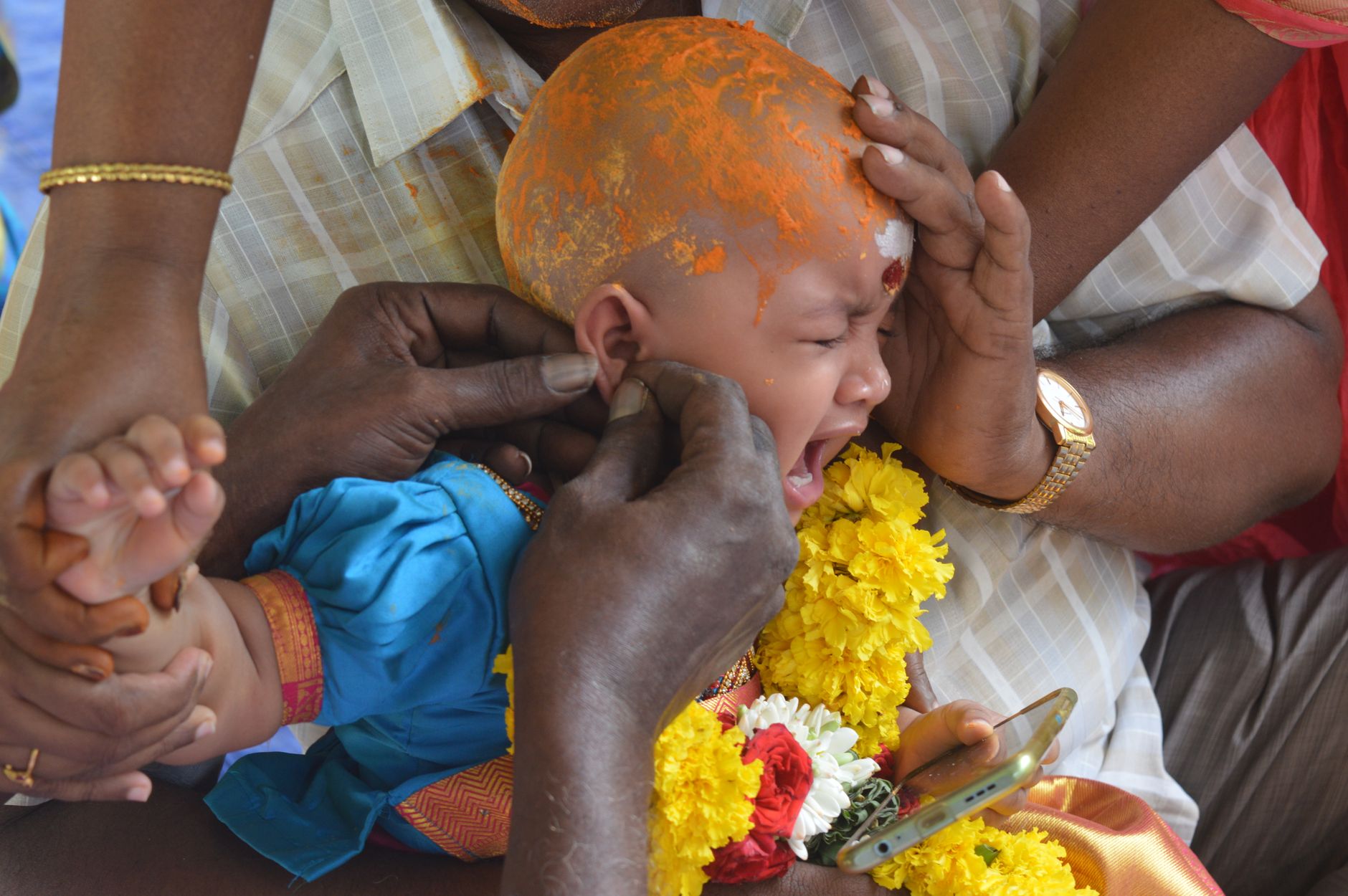
The most common reason a baby cries hard on a flight isn't hunger or tiredness — it's ear pressure during ascent and descent. Nemours KidsHealth explains that in children, the relatively narrow eustachian tubes might not equalize pressure as well as an adult's, especially if they're clogged with mucus from a cold or blocked by swollen adenoids. Swallowing is what helps open the tubes and relieve that pressure.
That's why timing feeds matters. The AAP's HealthyChildren.org advises that having babies drink from the breast or a bottle, or suck on a pacifier, during takeoff and landing can ease the discomfort. Ask the cabin crew for a heads-up before descent so you can start the feed a few minutes before the pressure change, not after your baby is already crying.
A cold or blocked nose in the days before you fly makes that pressure-equalizing problem worse, not better — worth keeping in mind when you pick your travel dates.
That ear discomfort isn't limited to the few seconds of touchdown. An NCBI Bookshelf review of FAA cabin pressurization regulations states that pressurized cabins are required to stay at a pressure equivalent to no more than 8,000 feet of altitude during normal flight — so the pressure (and your baby's ears) keeps shifting gradually through the whole climb and the whole descent, not just at the moment of takeoff or landing. That's why a single feed right at touchdown is often too late; start it as the plane begins its descent.
Before You Fly: A Vaccine and Health Check
Talk to your pediatrician a few weeks before departure, not the night before. The CDC Yellow Book states that infants 6–11 months old should receive one MMR vaccine dose before international travel — earlier than the routine schedule, which starts MMR at 12 months. If your baby falls in that window, ask your doctor about it well ahead of your trip date.
The CDC Yellow Book also states that air travel is generally safe for most healthy infants, but children with chronic heart problems, lung problems, or sickle cell disease might be at risk for hypoxia (low oxygen) during flight, and caregivers should consult a healthcare professional before travel. If your baby has any of these conditions, get your pediatrician's sign-off before you book.
Cabin Air, Hydration, and Comfort on a 10+ Hour Sector
Long-haul cabins are drier than any room your baby has been in. An NCBI Bookshelf review of airliner cabin air quality reports that the relative humidity in most aircraft cabins is low, typically from 10 to 20% — well below a comfortable indoor environment — which can dry out mucous membranes and irritate eyes over a long flight. Offer the breast, bottle, or water more often than at home, and pack a small saline nasal spray and lip/nipple balm for both of you.
Dress your baby in soft, breathable layers rather than one heavy outfit — cabin temperature swings between boarding, cruise, and descent — and pack a full spare outfit in your seat-back bag, not the overhead bin.
Jet Lag: Resetting Baby's Clock After You Land
A long-haul flight usually crosses several time zones, and your baby's body clock doesn't know it's landed. Sleep Foundation explains that light is the most powerful influence on the circadian rhythm, and strategic light exposure may help adjust the internal clock to avoid or reduce jet lag. In practice: get your baby outside in daylight during India daytime hours from day one, and keep the room dim and quiet in the evening so their body links bright light with "awake" and dark with "sleep" on India time. Expect a few rough nights before this settles — that's normal, not a sign anything is wrong.
Sleep Safety On Board and at Your Destination
Whether your baby naps in the airplane bassinet, on a relative's bed during a stopover, or in a travel cot once you land, the same rule holds. The AAP's HealthyChildren.org states that babies should always sleep alone in a crib or bassinet, on their back, without soft toys, pillows, blankets, or other bedding — that includes the airplane bassinet and any cot set up at a relative's home in India. Bring your own fitted sheet for the bassinet if the airline allows it, and check any cot at your destination is firm and free of loose bedding.
What to Pack: Gear Worth Bringing
| Item | Why it helps | Where to buy |
|---|---|---|
| Ear-friendly pacifier / nursing plan for takeoff-landing | Gives baby something to suck through both pressure changes | Amazon.in |
| Compact travel cot / bassinet sheet | Fits the airplane bassinet or a relative's cot with safe, familiar bedding | FirstCry |
| Saline nasal spray + baby-safe lip/nipple balm | Counters the dry cabin air on a long sector | Amazon.in |
| Baby carrier for the airport | Keeps hands free through immigration and baggage claim with a jet-lagged baby | FirstCry |
| Blackout travel curtain / cloth | Helps keep the room dark in the evening while resetting baby's clock | Amazon.in |
Frequently Asked Questions
How early should I book the bassinet seat for a flight to India? As soon as your baby's date of birth is on the booking. Bassinet rows are limited and go on a first-come basis, so call the airline directly rather than waiting until check-in.
My baby has a cold — should I still fly long-haul? Talk to your pediatrician before the trip. A blocked nose makes the ear-pressure problem on takeoff and landing worse, and if your baby has any chronic heart, lung, or blood condition, the CDC Yellow Book advises checking with a doctor before flying at all.
Does my baby need any extra vaccines before an international flight to India? If your baby is between 6 and 11 months old, the CDC Yellow Book notes they should get one MMR dose before international travel, ahead of the routine 12-month schedule. Ask your pediatrician a few weeks before you fly.
How do I stop my baby's ears from hurting during takeoff and landing? Start a breastfeed, bottle, or offer a pacifier a few minutes before descent begins, not after the crying starts — per the AAP, the sucking and swallowing motion is what eases the pressure.
How long will it take my baby to adjust to India time after we land? It varies, but getting your baby into daylight during India's daytime hours from day one — and keeping evenings dim — is the most effective lever you have, since light exposure timing is the strongest influence on resetting the body clock. Expect the first two to three nights to be the hardest.
How young is too young for a 10+ hour flight to India? Newborns can technically fly from 7 days old, but Cleveland Clinic pediatrician Dr. Lisa Diard advises waiting until at least 3 months old where you have the flexibility, since by then your baby has typically had their first round of vaccinations and a somewhat more developed immune system.
Can my baby sleep in the airplane bassinet the whole flight? Yes — just keep it to AAP safe-sleep basics: baby alone, on their back, with no loose blankets, toys, or padding, the same as at home.