

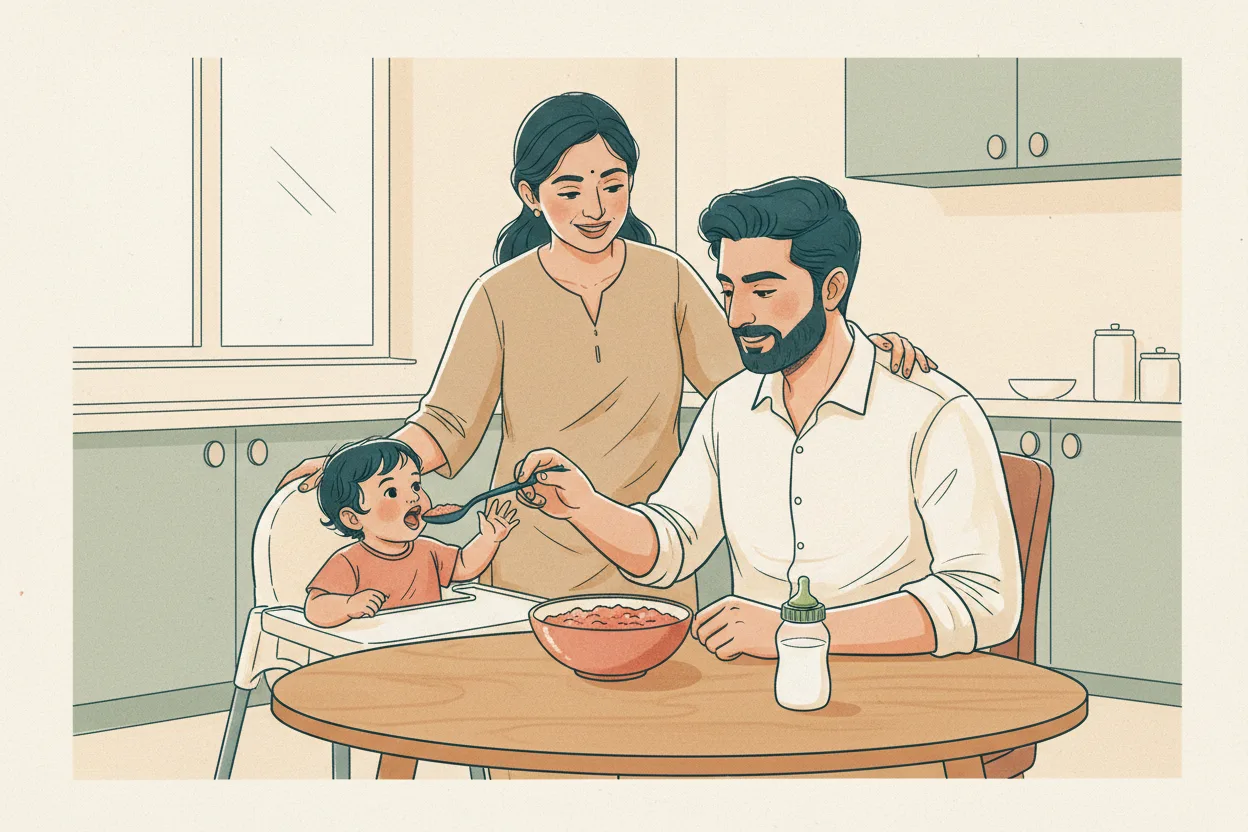
There's no fixed number of hours you must wait between a milk feed and a meal of solids — it depends on your baby's age and appetite. What matters more than watching the clock is whether your baby arrives at mealtimes hungry, and whether they're still getting enough milk and solid food across the whole day.
Not medical advice — consult your pediatrician for guidance specific to your baby.
Why the "2–3 Hour Rule" Doesn't Fit Every Baby
Many Indian pediatricians suggest a fixed two-to-three-hour gap between a milk feed and a solid meal, so baby is properly hungry by the time food arrives. It's a sensible starting structure for shaping a routine — but it isn't a rule your baby's body follows to the minute.
WHO's minimum meal frequency indicator guidance states that breastfed babies aged 9–23 months should receive complementary foods 3–4 times a day, with 1–2 additional nutritious snacks — more often than the 2–3 times a day typical at 6–8 months. That's the real reason pediatricians push more frequent meals as your baby grows: total daily intake matters, not a strict clock between feeds.
When Baby Naturally Drops a Daytime Milk Feed
Around the time solids properly take hold, many babies start turning away from a daytime milk feed on their own — not because something is wrong, but because they're genuinely full from meals. CDC's infant nutrition guidance states that swallowing food rather than pushing it back out with the tongue is a developmental milestone your baby reaches in its own time, not on a fixed timetable. The same is true for how much milk a baby wants once solids increase — it varies baby to baby.
Dropping one daytime feed does not mean it's time to wean off milk altogether. WHO's guidance on continued breastfeeding states that infants should keep receiving nutritionally adequate solids alongside continued breastfeeding up to two years of age or beyond. A daytime feed fading out is expected; milk staying part of the day or night for many months more is entirely normal.
Don't Force It — Follow Your Baby's Cues
When a baby who used to nurse reliably in the late morning suddenly refuses, the instinct is to offer again, then top them up before the next meal. HealthyChildren.org (AAP) explains that babies have all kinds of ways to tell you when they're hungry and when they've had enough — following those cues, rather than a fixed schedule, is the better approach for both parents to share.
Pushing past a clear "no" can backfire. A peer-reviewed review of parental feeding practices research states that pressuring a baby to finish milk or food after they've shown fullness cues may impair their ability to self-regulate and respond to their own hunger and satiety signals. If your baby turns their head, purses their lips, or pushes food away, that's information, not a problem to override.
Iron, Growth, and the Cow's Milk Question
Solids can't just be delayed indefinitely, even if a baby seems content on milk alone: a 2021 review in Current Developments in Nutrition states that by around six months, infants require an external source of iron apart from human milk, because their inborn iron stores from birth are running low by then. Iron-rich foods — dals, ragi, meat, egg yolk, iron-fortified cereal — matter more past this age, whatever the feeding gap.
If you're worried your baby isn't getting enough because of dropped feeds, the standard way to check isn't counting hours between feeds — it's tracking growth. CDC's growth chart training guidance (based on WHO Child Growth Standards) states that these standards describe how healthy infants and young children grow under the best environmental and health conditions, including breastfeeding and adequate nutrition. Ask your pediatrician to plot weight and length on the growth chart at each visit — a steady curve beats any feeding schedule as a sign of adequate intake.
Some families reach for cow's milk to fill a skipped daytime feed. NHS guidance states that cow's milk can be used in cooking or mixed with food from around six months but should not be given as a baby's main drink before they turn 12 months old. Use breast milk, or small amounts of water with meals past six months, instead.
A Flexible Day, Not a Fixed Clock
The exact clock matters less than the overall shape of the day:
| Age | Solid meals/day | Snacks/day | Milk during the day |
|---|---|---|---|
| 6–8 months | 2–3 | — | Still the main source of nutrition |
| 9–23 months | 3–4 | 1–2 | Continues alongside solids |
Use this as a shape to aim for, not a schedule to enforce feed by feed. A big lunch followed by a skipped milk feed is the pattern working, not failing.
Portion size is a common worry once a feed drops: is the solid meal actually replacing what was lost? The Indian Academy of Pediatrics' parent guideline on complementary feeding states that a 6–8 month old's meal can start at just 2–3 tablespoons, growing to about half a cup (125 mL) per meal by 9–11 months, and 3/4 to a full cup (250 mL) by 1–2 years. A dropped milk feed being replaced by a couple of tablespoons of khichdi at 7 months isn't a shortfall — that's roughly the portion size guidance already expects at that age.
When to Loop In Your Pediatrician
A kitchen weighing scale (₹400–₹900 on Amazon.in or FirstCry) and a shared feeding log app help both parents track patterns instead of guessing — neither replaces the growth chart, but both make the day-to-day easier to manage together.
Beyond growth charts, there's one concrete red flag worth watching for day to day: HealthyChildren.org (AAP) lists fewer than six wet diapers a day as a sign of dehydration in an infant. If dropped feeds come with poor weight gain, unusual lethargy, that wet-diaper drop-off, or you're simply unsure, loop in your pediatrician — that's exactly what routine growth-tracking visits are for, and CDC's growth chart guidance is the tool they'll use to confirm your baby is on track.
Frequently Asked Questions
My baby dropped their midday milk feed but still nurses fine at night — is that a problem? Not necessarily. CDC's infant nutrition guidance states that taking more of a meal in solids is a developmental milestone your baby reaches at its own pace — a dropped daytime feed while night feeds continue is often just that, happening at a different rate across the day.
Should I stop breastfeeding once my baby is eating three solid meals a day? No. WHO recommends continuing breastfeeding alongside solids up to two years of age or beyond. Eating more solids is not a reason to wean.
Can I give cow's milk during the day instead of breastfeeding, once my baby is eating more solids? Not as the main drink before 12 months. NHS guidance states cow's milk shouldn't replace breast milk or formula as a baby's main drink until 12 months, even though it's fine mixed into food from around six months.
How do I know if my baby is getting enough despite skipping feeds? Track growth, not feed count. CDC's growth chart training guidance states that plotting weight and length on the growth standards confirms a baby is thriving on adequate nutrition — ask your pediatrician to do this at every visit rather than counting hours or feeds yourself.
My baby turns away from the bottle or breast before the "3-hour gap" is up — should I make them wait it out? No. HealthyChildren.org (AAP) explains that babies show hunger and fullness cues you can follow instead of the clock, and a peer-reviewed review of parental feeding practices finds pushing a baby past those cues can undermine their own ability to self-regulate intake. If baby is clearly done, let them be done.