
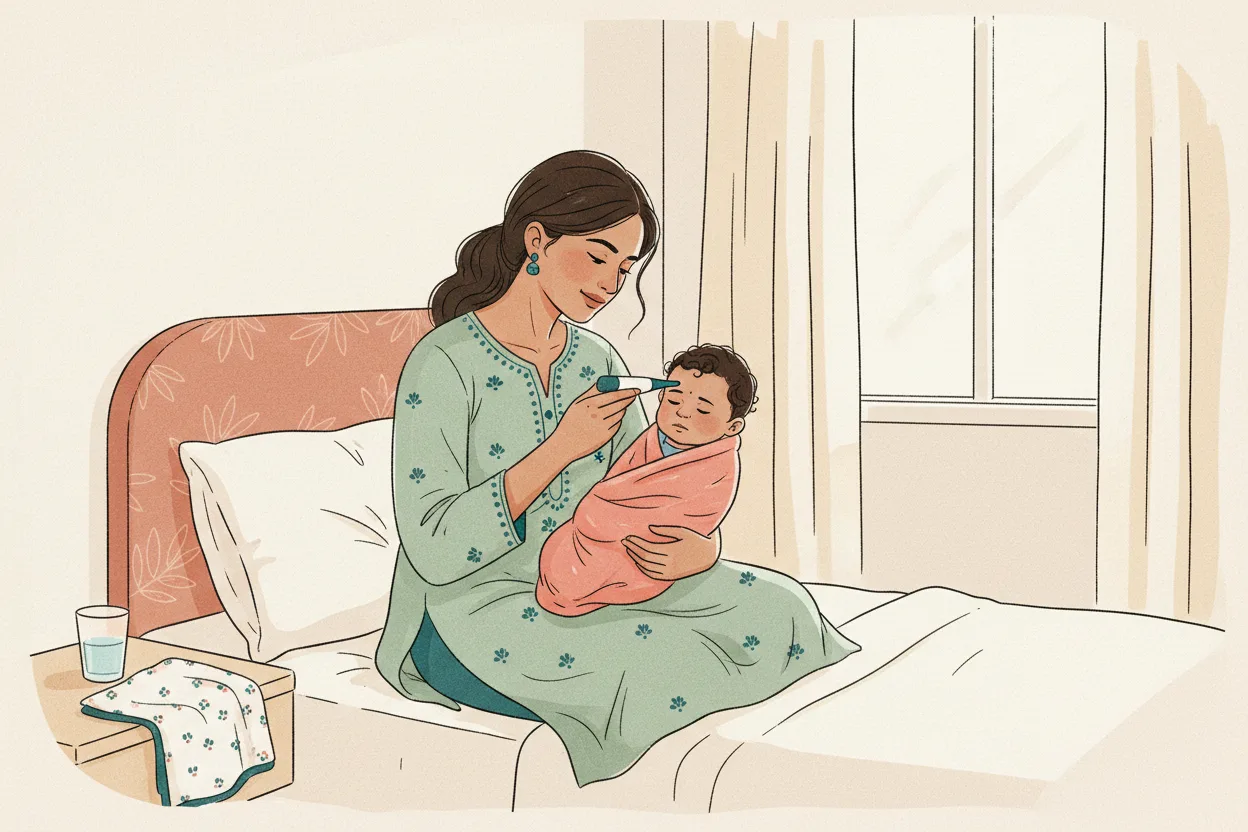
A fever after the MMR shot is normal, and it shows up later than most parents expect. The NHS states that MMR reactions like a raised, blotchy rash and a high temperature typically appear around 7 to 11 days after the vaccination, and common side effects usually last only 2 to 3 days. If your baby spikes a fever the same evening as the injection, it's more likely a coincidence than the MMR — this vaccine's fever runs on a delayed timeline.
Not medical advice — consult your pediatrician for guidance specific to your baby.
Why This Catches Indian Parents Off Guard
Many parents brace for a fever the same night as the shot, the way it often goes with other vaccines. MMR doesn't work that way — the NHS places the fever window around 7 to 11 days after the injection. Because it can turn up more than a week later — well after the clinic visit is behind you — it's easy to not connect the dots, or to worry that something unrelated is wrong. Knowing this delayed window in advance means you can recognize it for what it is and respond calmly instead of rushing to the emergency room.
It also helps to know where MMR sits in your baby's overall schedule. The Indian Academy of Pediatrics' parent information sheet states that MMR vaccine is given as three doses — the first at nine months of age, the second at 15 months, and the third at four to six years. The fever pattern described here applies after each of these doses, though it's most often discussed around the first dose at 9 months, when parents are newer to the process.
Fever after a shot isn't unique to MMR, either. The Indian Academy of Pediatrics' parent guideline on fever states that postvaccination fever is a recognized, common cause of fever in children, and that in most cases it will resolve on its own, though your pediatrician may prescribe medicines to ease your baby's discomfort.
The Normal Fever Timeline
| Detail | What to Expect |
|---|---|
| When it starts | Around 7–11 days after the shot |
| How long it lasts | Usually 2–3 days |
| What else may appear | A mild, measles-like blotchy rash; general unwellness |
| What it means | A normal immune response, not an infection |
Per the NHS, these reactions are common but mild, and they resolve on their own within a few days. You don't need to do anything beyond keeping your baby comfortable — a light fever after MMR in this window is the vaccine working, not a complication.
Febrile Seizures: Rare, and Not Dangerous Long-Term
A small number of babies have a febrile seizure during the days their body is reacting to the vaccine. CDC vaccine safety data show about 1 additional febrile seizure for every 2,300 doses given, in the 7 to 10 days following vaccination, compared with getting the MMR and varicella vaccines separately. This is genuinely rare, and it happens on the same delayed timeline as the fever itself.
If you witness a seizure, it is frightening, but CDC vaccine safety data show these episodes resolve without lasting effects. Time it, keep your baby safe from hitting anything nearby, and call your pediatrician or go to the nearest hospital — any first seizure needs to be medically evaluated, even though the pattern here is a known, self-limiting one.
Treating the Fever at Home
Paracetamol (acetaminophen). The AAP's HealthyChildren.org states that for children, you should give it every 4 hours while symptoms last, and never give more than 5 doses in 24 hours. Don't give paracetamol to a baby under 2 years without your doctor's guidance on the right dose for their weight. As a reference point only, the AAP's printable acetaminophen dosing chart gives 1.25 mL of Infants' Acetaminophen (160 mg/5 mL) for a 6–11 lb, 0–3-month-old, rising to 2.5 mL for 12–17 lb (4–11 months) and 3.75 mL for 18–23 lb (12–23 months) — but acetaminophen should not be given to children under two years of age without the guidance of a doctor, so confirm the exact amount for your baby's weight with your pediatrician before giving any.
Ibuprofen. The AAP's HealthyChildren.org states that you should not use ibuprofen in children younger than 6 months old unless your child's doctor tells you to. For babies old enough, dosing is typically spaced 6 to 8 hours apart. As a reference point, the AAP's printable ibuprofen dosing chart gives 1.25 mL of Infant's Ibuprofen Drops (50 mg/1.25 mL) for a 12–17 lb, 6–11-month-old, rising to 1.875 mL for an 18–23 lb, 12–23-month-old, dosed no more than every 6 hours and no more than 4 doses in 24 hours — again, confirm the exact amount with your pediatrician based on your baby's weight.
Never aspirin. The AAP's HealthyChildren.org states that you should not give aspirin or any medication containing aspirin to a child or teenager during a viral illness, because of the risk of Reye syndrome. Paracetamol and ibuprofen (age-appropriate) are the safe choices for a vaccine fever — aspirin isn't an option at any age for this.
Non-medication comfort measures. You don't have to reach for medicine right away. The AAP's HealthyChildren.org states that offering more fluids and dressing your baby in a single light layer both help with comfort during a fever. The same source is clear that sponging and alcohol baths are not recommended fever treatments and can have adverse effects — skip the tepid-sponge approach some households reach for, and stick to fluids and light clothing instead.
When to Call the Doctor
A vaccine fever is expected to be mild and short. MedlinePlus (U.S. National Library of Medicine) states that for a baby between 3 and 12 months old, a fever of 102.2°F (39°C) or higher warrants a call to the doctor. Use this as your threshold regardless of what's causing the fever — MMR reaction or otherwise.
Also call the same day if:
- The fever lasts noticeably longer than the 2–3 days typical of an MMR reaction
- Your baby seems unusually lethargic, is feeding poorly, or is hard to console
- You witness any seizure — even a brief one that resolves on its own
Keeping your IAP vaccination card handy when you call helps your pediatrician quickly place the fever within the expected 7-to-11-day window and decide whether it needs an in-person visit.
Frequently Asked Questions
My baby got the MMR shot three days ago and has no fever yet — is that normal? Yes. The NHS places the typical fever window at 7 to 11 days after the injection, so no fever in the first few days is entirely expected. Many babies have no reaction at all.
Can I give paracetamol before the fever even starts, just in case? Don't give paracetamol to a baby under 2 without your doctor's guidance either way — dosing needs your pediatrician's input for a baby this young, whether it's preventive or reactive. Ask your pediatrician at the vaccination visit what they recommend for your baby specifically.
Is the rash after MMR contagious to other family members, including unvaccinated siblings or a pregnant relative in the house? No. The AAP's Measles Infection Prevention and Control FAQ states that babies who develop rash and/or fever after the MMR vaccine are not considered contagious. What's established is that a mild, measles-like rash around 7 to 11 days after the shot is a recognized, mild reaction pattern, not an infection that can spread to others in the household.
How many MMR doses will my baby need in total? Three. The IAP schedule gives the first dose at 9 months, the second at 15 months, and a third booster between 4 and 6 years.
Should I be more worried about a febrile seizure with MMR than with other vaccines? The added risk is small. CDC data put it at about 1 additional seizure for every 2,300 doses in the days following vaccination, compared with getting the vaccines separately, and these episodes resolve without lasting effects. It's still worth knowing the 7-to-10-day window so you're not caught off guard.
What temperature counts as a fever I should act on? MedlinePlus advises calling the doctor for a baby 3–12 months old once the temperature reaches 102.2°F (39°C) or higher. Below that, home comfort measures and monitoring are usually enough — but always trust your instincts and call if your baby seems unusually unwell.