You have read every article about wake windows. You know your six-week-old can stay up for about an hour. Nobody told you what goes in that hour — and by 9am on a Tuesday in a Bengaluru flat, with your partner at the office and the baby staring at the ceiling fan, that gap feels enormous.
Here is the reassuring part: the official list is very short. WHO's guidance for under-ones asks only that babies be physically active several times a day through interactive floor-based play, including at least 30 minutes in the prone position — tummy time — spread through the day while awake. That is essentially the whole curriculum for the first three months.
Not medical advice — consult your pediatrician for guidance specific to your baby.
How much awake time are we actually talking about?
Less than it feels like. WHO's recommendations put babies aged 0 to 3 months at 14 to 17 hours of good-quality sleep including naps, and add that a baby should not be restrained for more than an hour at a time in a pram, seat or carrier.
That second line matters more than it sounds. Between the carrier while you cook and a long hold in a visiting aunt's lap, a baby can spend a whole afternoon upright and supported, rarely put down flat. The floor — a clean bedsheet or a play mat on the rug — is the underrated part of the day.
Your face is the entire toy shop
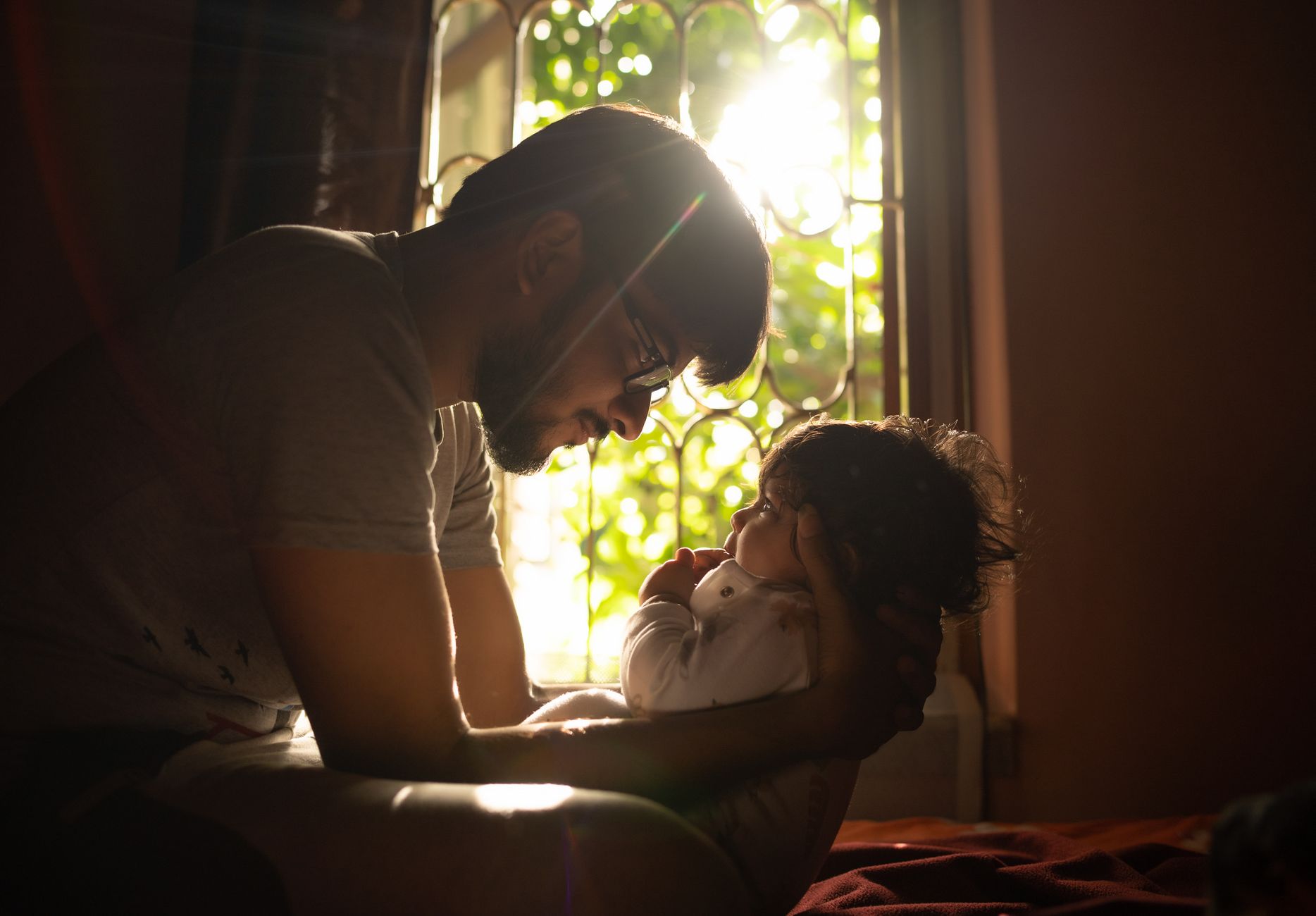
The American Academy of Pediatrics notes that newborns can only see about a foot in front of them at first — just far enough to move their eyes and gaze at a face held near them. A mobile across the room is, functionally, wallpaper.
And that face is what they are looking for anyway. A peer-reviewed study of infant face preference reports that from birth, infants show increased attention to other humans, mainly to their faces, and that recognising a caregiver's face and voice is critical to early social development. The 30cm gap between your face and theirs is where the interesting work happens.
Then it pays off. The AAP describes how, by the second month, a baby's early facial expressions begin to turn into genuine signals of pleasure and friendliness — the first real social smile, aimed at you.
So: hold them facing you, stick your tongue out, raise your eyebrows, wait. Nemours KidsHealth suggests exactly that — smile, stick out your tongue, and make other expressions for your infant to study, learn and imitate. A father doing the evening face-to-face session is not "helping"; he is doing the same developmental work.
Knowing when they have had enough
KidsHealth's guidance for 1- to 3-month-olds is that babies might turn away, close their eyes, or become fussy or irritable when they need a break from stimulation, and that if this happens you should let your little one rest or just try cuddling.
Treat that as your permission slip. Two minutes of face-to-face, a turned head, and you stop. Nothing has gone wrong and nobody has failed the activity.
Tummy time — the only thing with a target
The AAP advises playing and interacting with your baby while they are awake and on their tummy 2 to 3 times each day for a short time of 3 to 5 minutes, starting the day your baby comes home from the hospital, and stresses that tummy time is only for babies who are awake and being watched.
Ways to make it work in a real flat:
- Chest-to-chest. Lie back on the bed or sofa with the baby prone on your chest. It counts, and it is often the easiest version to start with.
- Across your lap. Sit down, lay the baby tummy-down over your thighs, and stroke their back. Useful right after a nappy change.
- On the floor, at eye level. Spread a clean cotton dhurrie or mat and lie down facing them, so there is a face worth lifting their head towards.
- Little and often. Three minutes after each daytime nappy change adds up faster than one heroic session.
Narrate the boring things
There is no need to invent activities. The care you are already doing is the activity, if you talk through it.
Great Ormond Street Hospital's NHS guidance suggests that during everyday activities — feeding, bathing, nappy changes — you talk about what you or your baby are doing, and that you let your baby see and feel your mouth moving, for example by blowing raspberries and letting them touch your lips to feel the vibration.
Practically: narrate the vest change, sing whatever lullaby your mother sang you, read out the grocery list in a silly voice. Two or three languages at once are fine — Hindi from you, Tamil from your mother-in-law, English from the paediatrician's poster. A newborn is collecting sounds, not vocabulary.
What about the TV in the background?
This is the one place to be firm, because it is easy to drift. The Indian Academy of Pediatrics' screen-time guidelines state that children below 2 years of age should not be exposed to any type of screen.
That is a hard line in a joint family with the television on all evening, and the realistic version is not a war: angle the baby away from the screen, keep the volume down, and let a grandparent hold the baby facing them instead.
Malish: keep it, but know what it is for
The evening malish is one of the warmest rituals in Indian babycare, and there is no reason to give it up — just be honest about why.
A Cochrane review of 34 randomised trials of infant massage concluded that all significant results were lost either at later follow-up points or when the reviewers removed the large number of studies at high risk of bias, and that these findings do not currently support the use of infant massage with low-risk groups of parents and infants.
Translation: massage is unlikely to make your baby taller, smarter or a better sleeper. It is twenty unhurried minutes of skin contact, eye contact and your voice — exactly what the rest of this page is about. Do it because it is lovely. And if a vigorous maalishwali technique makes you uneasy, a gentle version with a light oil is entirely reasonable.
Getting out of the flat
A change of scene resets a bad afternoon for the adult as much as the baby, and the balcony counts as an outing. Timing is the Indian variable. The AAP advises keeping babies younger than 6 months out of direct sunlight and finding shade — under a tree, an umbrella or the pram canopy. In a Delhi May or a Chennai September, that means the early-morning or post-6pm window, not the middle of the day. Monsoon week? A slow lap of the corridor or a stand by an open window with the rain sound works.
When "awake time" is mostly crying
Some days there is no activity, only management. That is not a failure of your planning.
A 2022 systematic review and meta-analysis in Child Development pooled parent-reported data across countries and found the highest daily cry-and-fuss duration at 5 to 6 weeks, at about 126 minutes. Two hours of crying a day, at the peak, is within the ordinary range.
For the crying itself, the NHS suggests holding your baby or putting them in a sling so they are close to you, moving about gently, swaying, dancing, talking and singing, and finding something for them to listen to or look at — music, a rattle, or a mobile above the cot.
The sling has real evidence behind it: a peer-reviewed review of babywearing research describes a randomised controlled trial of increased carrying in which infants carried more cried significantly less than infants in the control group. Wearing the baby while you supervise the cooking counts as both the settling and the awake time.
If you are the only adult in the house all day
Maternity leave in an Indian city can be isolating — neighbours at work, an empty lift lobby, a partner back on video calls by week three. A few things that help:
- Anchor the day, not the hour. One walk, one bath, one malish. Three fixed points beat a schedule you will abandon by 11am.
- Do your errands out loud. Folding clothes with the baby on a mat beside you, narrating it, is the language exposure, the floor time and the laundry at once.
- Stack the floor time. Put the mat down once and leave it down. The barrier is usually the setting up, not the doing.
- Say yes to the visitors you like. A mother-in-law offering to hold the baby for an hour is a free hour. Handing over is not losing ground.
- Ask for a named shift, not "help". "You have the baby 7 to 8:30 every evening" is a plan; "help out more" is a fight.
The short version
| Awake-time slot | What it actually looks like | Roughly how long |
|---|---|---|
| Face-to-face | Baby held about a foot from your face, you making expressions and talking | A few minutes, several times |
| Tummy time | On your chest, across your lap, or on a mat | 3–5 minutes, 2–3 times a day |
| Narrated care | Talking through nappy changes, baths, dressing | Whenever they happen |
| Floor time | Baby on a mat, out of pram, seat and carrier | Whenever they are content |
| Outing | Balcony, corridor, park in shade at a cool hour | Once a day, weather allowing |
| Malish | Oil, unhurried, eye contact, your voice | 15–20 minutes |
The black-and-white flashcard sets sold to every new Indian parent are not a con — KidsHealth notes that strong contrasts, curves and symmetry stimulate a baby's developing vision — but they are not the point either. Buy them, or the crinkle book, or the Montessori mobile, if you enjoy them. Your baby will keep looking at your face.
Not medical advice. If your baby is unusually difficult to rouse, feeding poorly, or crying in a way that feels wrong to you, call your pediatrician.