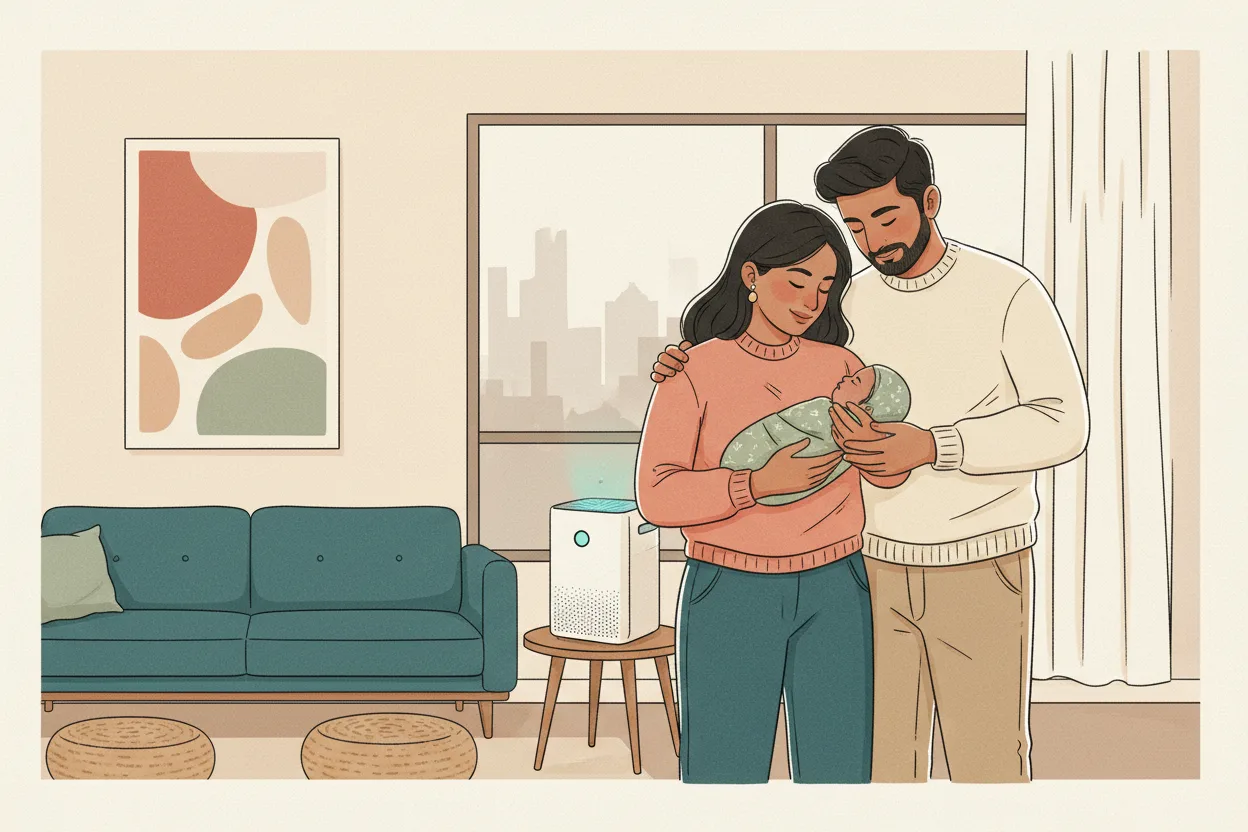
Your newborn can get through a Delhi-NCR winter safely. The plan is simple: run a proper air purifier indoors, treat the worst-AQI days as genuine stay-in days, and handle the pediatrician visits and short errands that are still necessary with basic precautions rather than keeping baby home for three months straight.
Not medical advice — consult your pediatrician for guidance specific to your baby.
Why This Winter Is Different With a Newborn at Home
Every Delhi-NCR household deals with the October–January smog season. What changes with a newborn is how much it matters. WHO explains that children are more vulnerable to air pollution than adults partly because they breathe more rapidly, so they absorb more pollutants for the same time spent in bad air.
That vulnerability starts early. A birth-cohort study hosted on NIH's PMC found that early-life exposure to ambient air pollution — including during pregnancy and the first year of life — is associated with a higher risk of upper and lower respiratory tract infections in infants. This is the reason so many Delhi-NCR pediatricians talk about "smog season precautions" specifically for babies under one, not just for people with existing asthma or heart conditions.
None of this means locking your newborn in a sealed room for four months. It means being deliberate: purifier running where baby actually sleeps and feeds, real awareness of the day's AQI, and sensible handling of the outings that are still necessary.
Reading the AQI Before You Decide Anything
Delhi-NCR's AQI swings hard through winter, and the category matters more than the raw number. CPCB's National Air Quality Index report states that in the "Very Poor" category (301–400), prolonged exposure may cause respiratory illness, and effects are more pronounced in people with existing lung and heart disease. In the "Severe" category (401–500), that same CPCB guidance is clear that even healthy people — not only those with lung or heart disease — can feel respiratory effects.
| AQI Category | Range | What CPCB Says |
|---|---|---|
| Poor | 201–300 | Breathing discomfort on prolonged exposure |
| Very Poor | 301–400 | May cause respiratory illness on prolonged exposure, worse with existing lung/heart disease |
| Severe | 401–500 | Respiratory effects even in healthy people |
A practical rule for a newborn's household: check the AQI each morning (Delhi Pollution Control Committee and SAFAR apps both publish it live). On Poor days, normal indoor life with the purifier on is fine. On Very Poor and Severe days, treat it as a real stay-in day for the baby — CPCB's own report is what flags that range as the one where respiratory harm is likely, not just theoretical.
Timing matters too, if a short outing genuinely can't be avoided. A Ministry of Health and Family Welfare training manual on air pollution and children's health states that air quality is relatively better between 12 pm and 4 pm in the afternoon, and advises avoiding outdoor activity during the early morning or late evening hours, when pollution is at its worst. If a pediatrician visit or essential errand has any flexibility in scheduling, an early-afternoon slot is the better window for it.
Setting Up an Air Purifier the Right Way
An air purifier is the single highest-leverage thing you can do indoors. The US EPA's guide to air cleaners states that portable air cleaners with HEPA filters can reduce indoor air pollution, though they cannot remove all pollutants from the air — so it's a real reduction, not a force field.
A few placement basics matter more than the brand:
- Room, not house. A mid-size purifier rated for a large hall does less for baby than a smaller one running continuously in the actual room baby sleeps and feeds in, with the door mostly closed.
- Keep it running, not on-and-off. Continuous low-to-medium speed through the night beats blasting it for twenty minutes and switching off.
- Change or clean filters on schedule. A clogged HEPA filter stops filtering as effectively — check the manufacturer's replacement interval and actually follow it through the season.
- Seal the obvious gaps. A gap under the door or a window left open at night undoes most of what the purifier is doing.
Breastfeeding, Masks, and the Outings You Can't Skip
Two questions come up constantly in Delhi-NCR parent groups every winter: should you stop breastfeeding to "protect" baby from what you're breathing, and should baby wear a mask for the car ride to the pediatrician.
On breastfeeding: keep going. A 2019 review in the International Journal of Environmental Research and Public Health found that breastfeeding has a protective effect against the respiratory, immune, and under-five mortality harms linked to air pollution exposure. Poor air quality is a reason to double down on breastfeeding, not a reason to stop.
On masks: don't put one on a newborn or infant. The American Academy of Pediatrics states that children under 2 years of age should not wear masks, since they may not be able to remove them without help if they're struggling to breathe. For pediatrician visits and short essential errands, the practical approach is a fully covered stroller or car seat with the windows up, minimal time actually outdoors, and the car's own air conditioning/recirculation running rather than a mask on baby's face.
That covers the trips you genuinely can't skip — vaccination visits, a pediatrician appointment for a fever, a hospital follow-up. There is no need to reschedule those around the AQI; simply manage the exposure window tightly and get back inside.
Purifiers and Gear Worth Having This Season
| Product | Price Range | Where to Buy |
|---|---|---|
| HEPA air purifier (small-to-medium room) | Rs. 6,000 – Rs. 18,000 | Amazon.in / FirstCry |
| Replacement HEPA filter | Rs. 800 – Rs. 2,500 | Amazon.in |
| Fully-covered stroller with rain/wind shield | Rs. 4,000 – Rs. 12,000 | FirstCry |
| Indoor AQI/PM2.5 monitor | Rs. 2,500 – Rs. 7,000 | Amazon.in |
A dedicated indoor monitor is a genuinely useful add-on once the purifier is in place — it tells you whether the room is actually clean, rather than assuming the purifier is doing its job. For a number to aim for, WHO's global air quality guidelines set the PM2.5 benchmark at 15 µg/m³ as a 24-hour average (5 µg/m³ annually) — if the monitor in baby's room is reading well above that, it's a sign to run the purifier higher, check the filter, or seal a gap, not just a number to glance at.
Frequently Asked Questions
Do I need to keep my newborn indoors for the entire winter? No. Treat it as AQI-dependent, not calendar-dependent. On Poor days, ordinary indoor life with the purifier running is fine, and short necessary outings are manageable. CPCB's data is what should decide the tighter days — Very Poor and Severe — not a blanket four-month lockdown.
Should my baby wear a mask in the car or stroller? No. The AAP is explicit that children under 2 should not wear masks, since they may not be able to remove one without help. Cover the stroller or use the car's closed windows and air recirculation instead.
Does breastfeeding actually help against air pollution exposure? There's real evidence for it. A 2019 review found breastfeeding has a protective effect against several of the respiratory and immune harms linked to air pollution. It's a reason to continue, not stop.
Is an air purifier actually worth the cost, or is it placebo? It's a real, measurable reduction, though not a complete fix. The EPA states portable air cleaners with HEPA filters can reduce indoor pollution levels, while noting they can't remove every pollutant. Pair it with a closed room and a filter-change schedule for the best result.
How do I decide day-to-day whether to go out for a pediatrician visit? Check the day's AQI category before you leave. CPCB's own thresholds flag Very Poor and Severe as the ranges where respiratory effects are likely — on those days, keep the outing as short as possible and go straight there and back rather than combining it with other errands.
Why does a newborn need more caution than an older sibling during smog season? WHO notes that children absorb more pollutants than adults because they breathe faster for their size, and infants spend most of their time at home, so the air quality of the room they're actually in matters disproportionately. That's the case for prioritizing the purifier setup over any other single precaution.