
For a long-distance trip, a 2AC train berth tends to be the easiest option for a newborn, a flight works once your pediatrician has cleared travel, and a road trip needs a correctly fitted, rear-facing car seat from the very first kilometre. Which one wins for you depends less on the mode itself and more on timing, hygiene, and how you manage ears, exposure, and heat.
Not medical advice — talk to your pediatrician before any long-distance trip with a newborn, especially about the right age to travel and any condition specific to your baby.
Why Timing Matters More Than the Mode
A Cleveland Clinic pediatrician advises that it's safer to fly once a baby is at least about 3 months old, because by then they typically have their first round of vaccinations and a somewhat more developed immune system. That guidance is written around flying, but the underlying reasoning — vaccination status and immune maturity — applies to any long-distance trip with a one-month-old, whether by train, plane, or car. If your trip can wait a few weeks, waiting reduces risk regardless of which mode you eventually choose. If it can't wait, ask your pediatrician for a same-week check before you travel.
Train, Flight, or Road Trip: How They Compare
| 2AC Train | Flight | Road Trip | |
|---|---|---|---|
| Ear pressure | None | Real, manageable at takeoff/landing | None |
| Infection exposure | Moderate — enclosed coach, more people | Depends on proximity and duration | Lowest — your own vehicle |
| Feeding/changing space | Berth, more room to lie baby down | Cramped, limited privacy | Full control, stop anywhere |
| Car seat / restraint | Not applicable | Bassinet or lap infant, airline-dependent | Rear-facing car seat required |
| Trip length practicality | Good for overnight, multi-hour routes | Best for genuinely long distances | Best broken into short daily legs |
Flights: Ear Pressure and Cabin Exposure
The discomfort babies show during takeoff and landing is real, and it's manageable. HealthyChildren.org (AAP) advises that having a baby nurse, bottle-feed, or suck on a pacifier during takeoff and landing can ease the discomfort — the swallowing motion helps equalize ear pressure. Have your baby latched or feeding in the minutes before wheels-up and again on descent, not mid-flight.
On infection risk, a National Academies report on the airliner cabin environment states that a passenger's risk of catching a respiratory infection on a plane depends on factors like the presence of an infectious person nearby, ventilation and air recirculation, proximity to that person, and how long the exposure lasts. In practice, that means the flight itself isn't automatically risky — a short domestic hop with good airflow and no one visibly unwell close to you is a different exposure than a packed, delayed flight sitting next to someone coughing. Choose a direct flight where you can, and don't hesitate to ask cabin crew about moving seats if you're seated right next to someone symptomatic.
Trains: Comfort Trade-Off for a Longer Journey
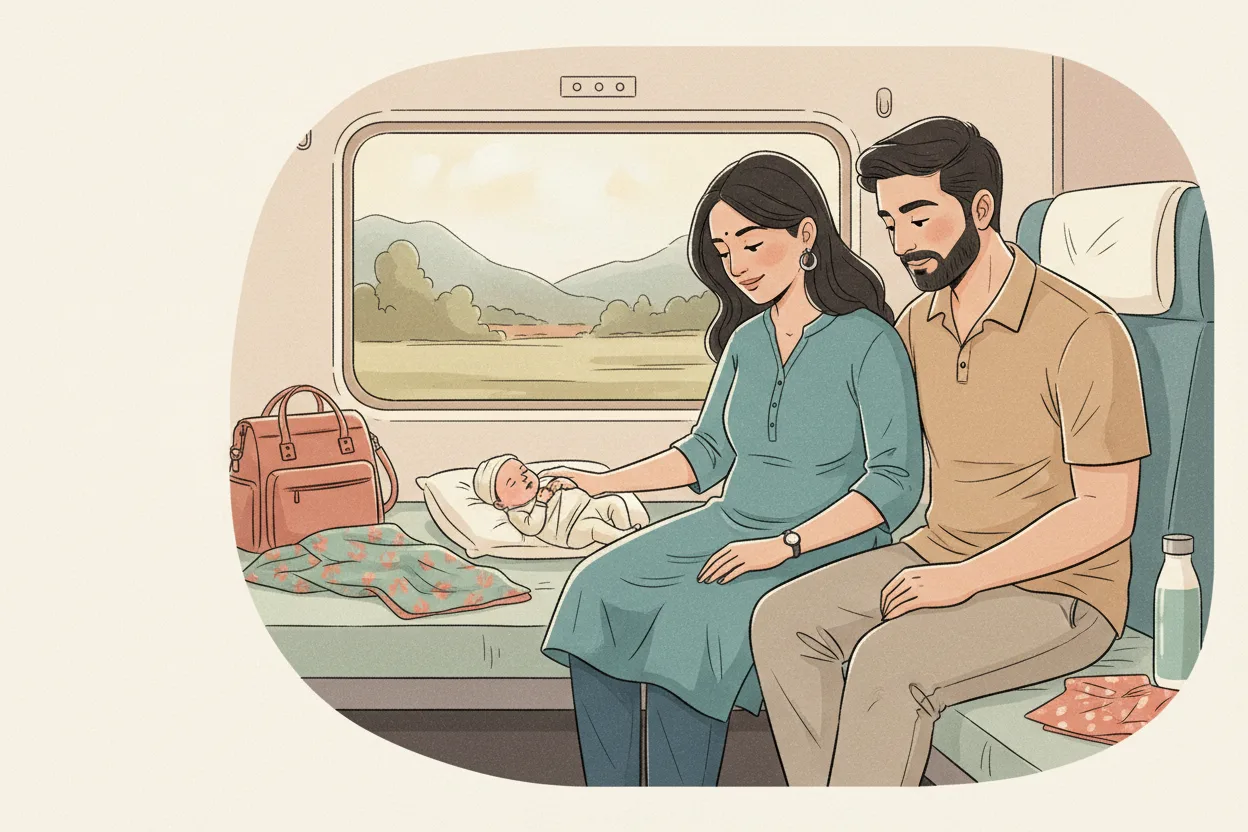
A 2AC (or first-class AC) berth gives you something flights and cars cannot: a flat surface to lie your baby down on, room to feed lying back yourself, and no ear-pressure event to manage. For an overnight or multi-hour route, many parents find this the least stressful option logistically.
The trade-off is exposure — a train coach is also a closed, shared environment for hours at a stretch, so the same proximity-and-duration logic from the National Academies report applies here too, not just to flights. Wipe down the berth, tray, and handles you'll touch before settling in, and keep hand sanitizer within reach for anyone handling the baby.
Road Trips: Full Control, But Only With the Car Seat Done Right
A road trip gives you the most control — you decide when to stop, feed, and change — but it only works safely with the right restraint from the very first kilometre. The AAP recommends that all infants ride rear-facing starting with their very first ride home from the hospital, and that applies just as much to a multi-day road trip as it does to the drive home from the maternity ward. Don't substitute an adult lap or a makeshift arrangement for a properly installed, rear-facing infant car seat, even for a short stretch.
Break a long drive into short legs — a couple of hours at a time — with stops to feed and change rather than one long haul. It's easier on you, and it's easier on a newborn too young to say when something's wrong.
Building Immunity Before You Travel: Why Breastfeeding Helps
However you travel, ongoing breastfeeding is one of the most concrete things in your control. A study of children in an Indian Air Force community (Medical Journal, Armed Forces India) found a statistically significant, progressive decline in acute respiratory infections among children under 2 as the duration of breastfeeding increased. It's not a guarantee against catching anything on a journey, but it's a real, evidence-backed reason to keep nursing through a travel-heavy period rather than pausing it.
Timing Around Festival Rush and Winter Pollution
Two India-specific factors are worth planning around, separate from the mode you choose.
Festival season crowding. Diwali, Chhath, and the big holiday weeks bring the heaviest crowds to both trains and airports — longer queues, fuller coaches, and more people in close contact for longer. If your dates are flexible, traveling a few days before or after the peak rush cuts down on exactly the proximity-and-duration exposure factors described above.
Winter air pollution. A study on the respiratory health of children in Delhi found that respiratory symptoms in children were more common in winter than in summer or monsoon, tracking the seasonal rise in particulate air pollution — the same pattern shows up across many north Indian cities in the winter months. If your trip involves time outdoors in a high-pollution city between roughly November and February, keep outdoor stretches shorter, travel by car or train (both filtered/enclosed relative to standing outside) rather than lingering on open platforms, and mask up yourself since a one-month-old can't wear one.
Heat, if you're traveling in summer. HealthyChildren.org (AAP) advises that a heat index of 90°F or higher — common across most of India outside winter — can be dangerous, especially for babies. On a road trip or at a station platform in that kind of heat, keep your baby in shade, take breaks out of direct sun, and offer extra breastfeeds rather than water, since a baby this young shouldn't have plain water.
What to Pack, Whichever Mode You Choose
| Item | Why | Where to Buy |
|---|---|---|
| Rear-facing infant car seat | Non-negotiable for any car/road-trip leg | Amazon.in / FirstCry |
| Muslin cloths / swaddle wraps | Feeding cover, wipe-down, light layer for AC coaches or cabins | FirstCry |
| Hand sanitizer + wipes | Quick clean-up of shared surfaces (tray tables, berth handles, armrests) | Amazon.in |
| Compact diaper-change mat | Turns any berth, car seat, or airport bench into a clean changing spot | FirstCry |
Frequently Asked Questions
Is it safe to fly with a one-month-old at all? Many parents do, but a Cleveland Clinic pediatrician's general guidance is to wait until at least 3 months, when vaccinations have started and the immune system is a little more developed. If travel at one month is unavoidable, get your pediatrician's sign-off first and choose the most direct route available.
What actually helps with ear pain on a flight? Feeding at the breast or bottle, or offering a pacifier, during takeoff and landing is the AAP's core advice — the swallowing motion equalizes ear pressure. Time the feed to start just before descent begins, not after.
Is the train really lower-risk than a flight for infection? Not automatically — both are enclosed, shared spaces. Risk on any aircraft or similarly enclosed setting depends on proximity to an infectious person and how long you're exposed, not the mode itself. A quiet, less crowded train departure can be lower-risk than a packed flight, and vice versa.
Does a newborn need their own car seat for a short drive too? Yes. The AAP recommends rear-facing from the very first ride, including the drive home from the hospital — there's no "short trip" exception.
Does breastfeeding actually lower infection risk while traveling? There's a real association: longer breastfeeding duration was linked to fewer acute respiratory infections in a study of young children. Keep nursing on your usual schedule through the trip if you can.
Should we avoid travel entirely during Delhi's winter smog season? Not necessarily, but be deliberate about it. Respiratory illness in children tracks the winter rise in particulate pollution in cities like Delhi, so minimize your baby's time standing outdoors on platforms or in open-air queues during that season, and prefer enclosed transport for the bulk of the journey.