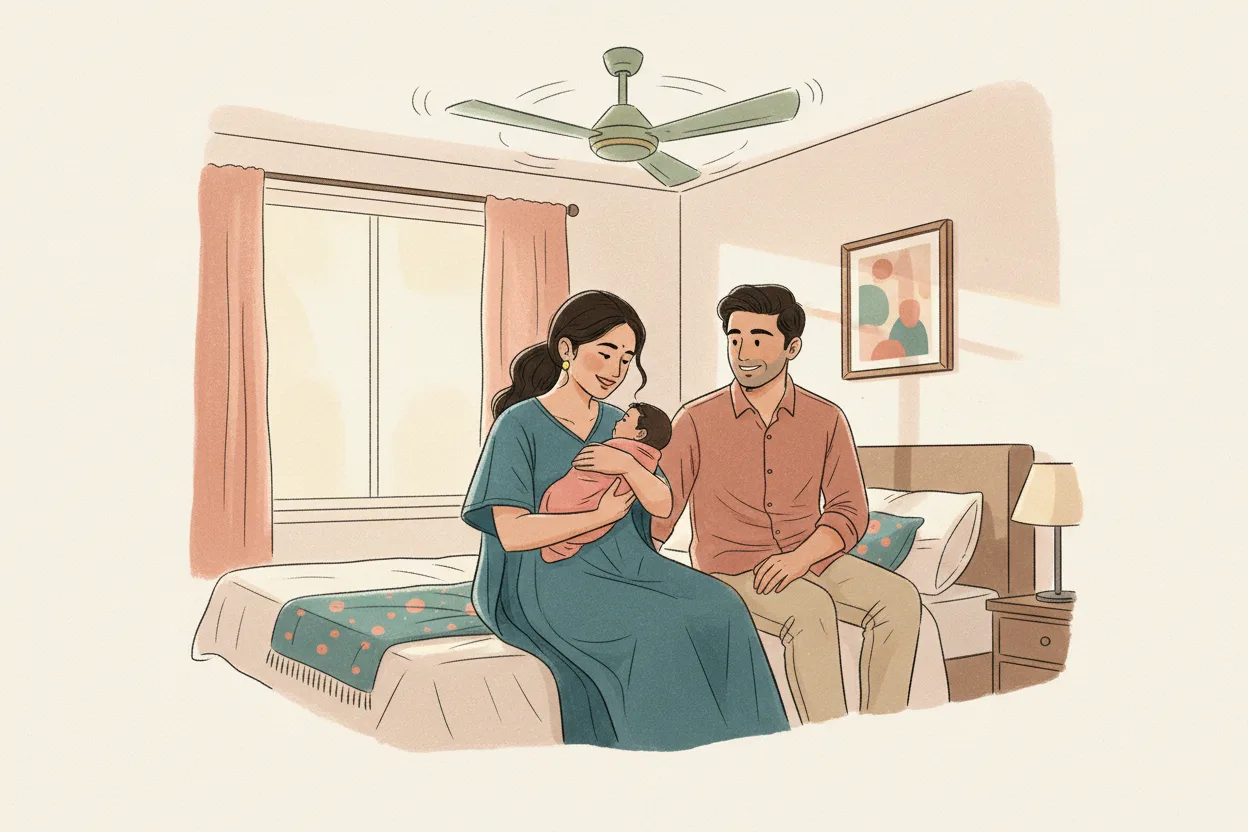
The best nursing wear for home use in India gives you fast, one-handed access to the breast, breathes in heat and humidity, and doesn't need re-adjusting every time baby latches. Four styles cover almost every home situation: zipless lift-and-feed tops, button-down nursing nighties, wrap-style nursing kaftans, and side-zip dresses or tops. Which one suits you depends on how and where you feed, not on fashion.
Not medical advice — consult your pediatrician or a lactation consultant for guidance specific to you.
Why This Matters More at Home in India
WHO recommends supporting mothers to breastfeed responsively — as often as the baby wants, day and night — rather than on a fixed schedule. In practice, HealthyChildren.org (AAP) advises that a newborn should not go longer than about two to three hours during the day or four hours at night without a feed, and should get eight to twelve feeds in every 24-hour period. That frequency is the whole design brief for nursing wear: clothing that takes fifteen seconds to open, at 3 a.m. and again during a mid-morning nappy change, without you having to fully undress or hunt for buttons in the dark.
Cleveland Clinic explains that cluster feeding — several short feeds spaced close together, often in the evening or during growth spurts — is a normal newborn pattern. Loungewear you can stay in comfortably for a two-hour stretch of back-to-back feeds matters as much as clothing for a single quick feed.
Two things make an Indian home slightly different from a Western nursery brand's marketing photos. First, heat and humidity: HealthyChildren.org (AAP) advises dressing in loose-fitting cotton clothes when it's warm, to avoid the trapped sweat that causes heat rash — the same logic applies to what you wear against your own skin for hours a day. This isn't just a baby-care rule extended by analogy: Cleveland Clinic advises that adults, too, should wear clothes that fit loosely and let skin breathe, because cotton fabrics are better than synthetic ones at preventing heat rash. Second, feeding around family: in a joint or multi-generation home, you'll often feed with in-laws or guests nearby. A wrap-style or zip-front top that opens discreetly in your own room, without pulling a garment over your head, makes that easier.
The Four Styles That Actually Work
| Style | How it opens | Best for | Typical price |
|---|---|---|---|
| Zipless lift-and-feed top | Two-layer front you lift from below | Quick daytime feeds, wearing under a dupatta | Rs. 500 – Rs. 1,200 |
| Button-down nursing nighty | Buttons down the front, loose fit | Overnight feeds, postpartum recovery, C-section comfort | Rs. 600 – Rs. 1,500 |
| Nursing kaftan | Wrap or hidden side-zip, flowy cut | Hot weather, cluster feeding sessions, visiting relatives | Rs. 800 – Rs. 2,200 |
| Side-zip nursing dress/top | Zip runs along the side seam | One-handed access while holding baby, discreet feeding with guests around | Rs. 900 – Rs. 2,500 |
A button-down nighty is often the easiest starting point — it needs no learning curve and works for sleep and feeding both. A zipless lift-and-feed top is faster once you're used to it, since there's no fastening to manage with one hand. Kaftans and side-zip dresses suit warmer weather and moments when you're likely to have visitors, because they cover more while still opening cleanly for a feed.
Newborns who have prolonged skin-to-skin contact with their mother are more likely to breastfeed successfully, per WHO. A front-opening top or wrap kaftan that bares the chest easily at home — not just at the breast — supports this in the early weeks, before you've settled into a feeding routine.
Getting the Bra Right Underneath
What you wear under nursing wear matters as much as the outer layer. La Leche League International cautions that bras with underwire or other firm, tight structure can contribute to blocked ducts and even mastitis, and are best avoided in the early months. Soft, unstructured nursing bras or bralettes are the safer default while your supply is still establishing.
That doesn't mean going without support altogether. Cleveland Clinic notes that a supportive bra doesn't cause mastitis — that's a myth — and that the steady pressure of a well-fitting bra can actually help keep fluid moving in your breasts during engorgement. The goal is support without compression: a soft-cup nursing bra or sleep bra with a wide, non-wired band, sized so it doesn't dig in at any point.
Products Worth Buying
| Product | Price Range | Where to Buy |
|---|---|---|
| Zipless lift-and-feed top | Rs. 500 – Rs. 1,200 | Amazon.in / FirstCry |
| Button-down nursing nighty | Rs. 600 – Rs. 1,500 | Amazon.in / FirstCry |
| Nursing kaftan | Rs. 800 – Rs. 2,200 | Amazon.in |
| Soft-cup nursing bra (non-wired) | Rs. 350 – Rs. 1,000 | Amazon.in / FirstCry |
Buy at least two of whichever style you settle on before your due date or soon after birth — with 8–12 feeds a day, you'll want a clean one ready while the other is in the wash. A dark or printed fabric hides milk-leak marks better than plain white for daytime wear.
Frequently Asked Questions
Do I need special nursing wear, or can I just wear a loose kurta? A loose kurta or nightdress works fine if you're comfortable lifting the hem or pulling a neckline aside. Dedicated nursing wear just makes access faster and more discreet, which matters more as feeds add up — 8 to 12 times in 24 hours in the newborn stage, per the AAP.
Is an underwire bra really that risky, or is this overcautious? It's a real precaution, not a myth to dismiss. LLLI cautions that underwire or other firm-structured bras can contribute to blocked ducts and mastitis, so it's simplest to avoid them in the early months and switch back once feeding is well established, if you prefer underwire normally.
What fabric should I look for in hot weather? Cotton or cotton-blend fabrics that breathe, over synthetic ones. The same principle the AAP applies to dressing babies — loose, breathable cotton to prevent heat rash from trapped sweat — holds for what you wear against your skin for long stretches too, and Cleveland Clinic confirms this directly for adults: loose clothing that lets skin breathe, with cotton fabrics preferred over synthetic ones, is the standard heat-rash prevention advice.
Can I wear nursing wear to sleep in? Yes — a button-down nighty is designed for exactly that, so you're not fumbling with fastenings for a night feed. Since feeds continue through the night in the early months, sleepwear that doubles as nursing wear cuts down on how much you have to change.
Will a supportive bra make engorgement worse? No — that's a common misconception. Cleveland Clinic notes a well-fitting supportive bra doesn't cause mastitis and can help keep fluid moving during engorgement. The bra to avoid is one that's tight or wired, not one that's supportive.
How many pieces of nursing wear should I buy for cluster feeding evenings? Enough that you're not stuck in a damp or milk-stained top for a two-hour stretch. Cleveland Clinic explains that cluster feeding — several short feeds spaced close together — is a normal newborn pattern, often in the evening, so one comfortable loungewear set you can stay in through a long session is worth having on hand.