Reaching for a packet of fortified cereal on a night you're too tired to cook does not make you a bad parent. The dividing line that actually matters isn't homemade versus store-bought — it's what's in the packet, and whether you'd know either way.
Not medical advice — consult your pediatrician for guidance specific to your baby.
Why the Guilt Runs So Deep in Indian Homes
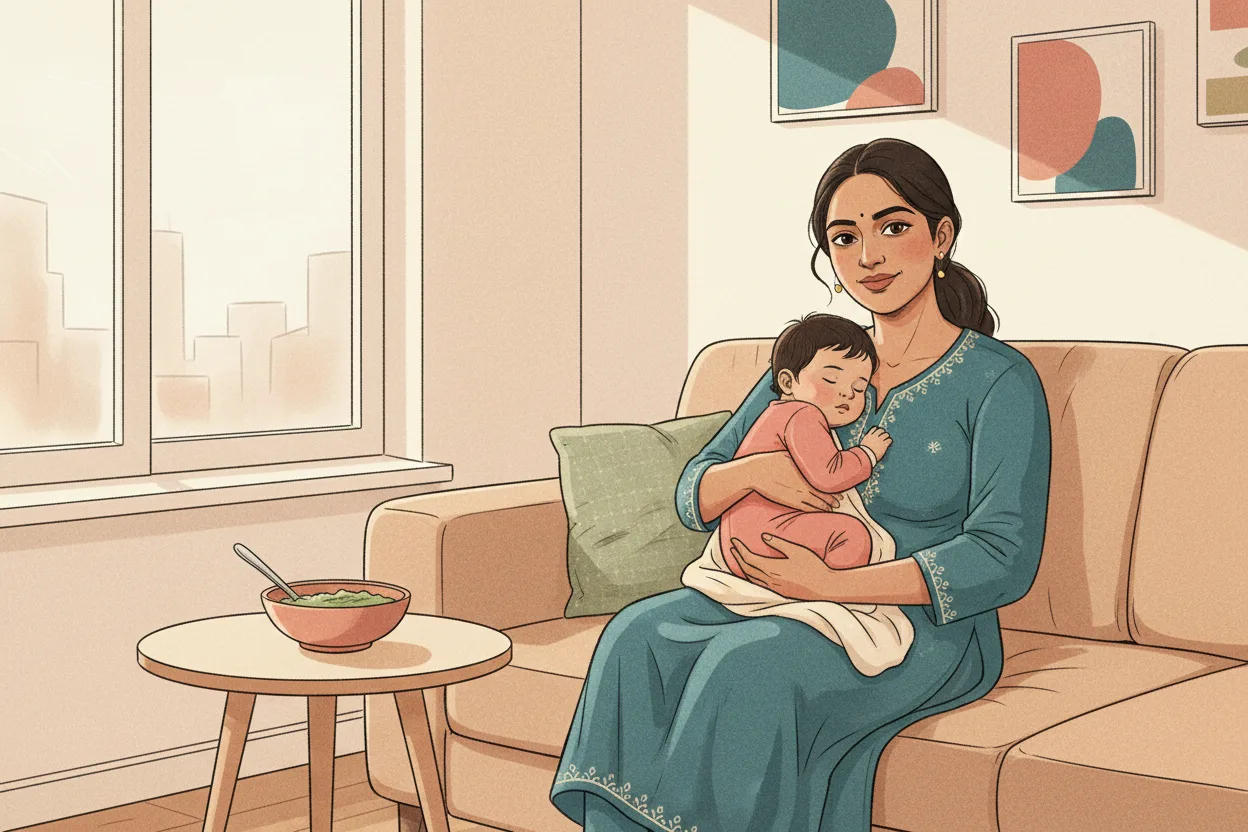
In a lot of Indian families, "good mother" and "grinds fresh khichdi every single day" get treated as the same thing. A grandmother visiting for the week, a mother-in-law commenting on the pantry shelf, a WhatsApp group where someone posts a photo of hand-mashed dal — all of it can make a jar of puree or a box of baby cereal feel like a confession waiting to happen.
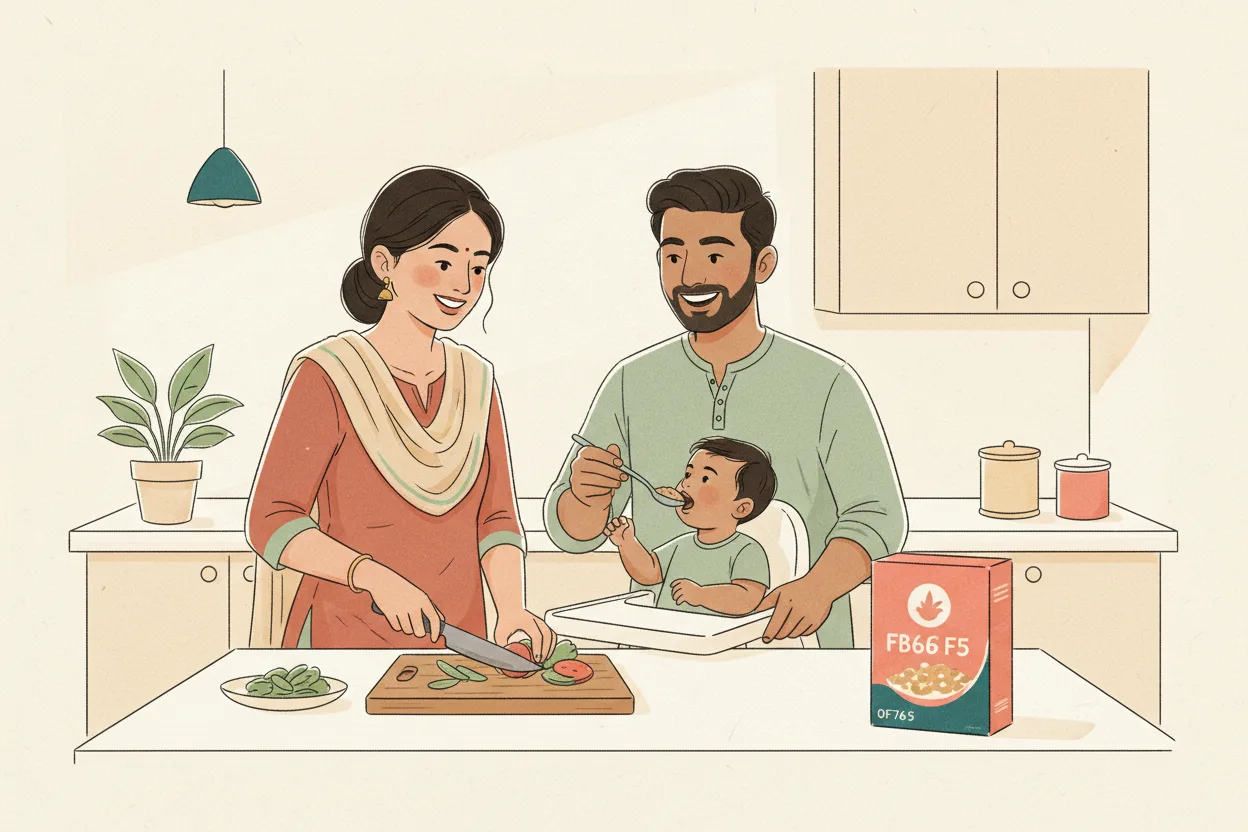
That pressure falls hardest on whichever parent is already stretched thinnest — usually whoever is back at work, up at night, or managing the kitchen solo while the other parent covers something else. Both parents sharing the load of feeding, whether that's one of them blending fruit on a Sunday or the other opening a trusted packet on a Tuesday night, matters more than which parent did which task.
What Actually Matters at 6 Months
The WHO's 2023 complementary feeding guideline recommends that infants be introduced to complementary foods at 6 months while continuing to breastfeed — not much earlier, and not delayed. Timing, not the homemade-versus-packaged question, is the first thing that actually affects your baby's health.
ICMR-NIN's Dietary Guidelines for Indians (2024) state that breast milk alone is not adequate for a baby's growth beyond six months of age, so getting complementary foods started on time — whatever form they take — is the priority over perfecting the source of every spoonful.
The Anaemia Number That Changes the Calculus
Here's the fact that should take some of the moral weight off this decision: a study using Indian National Family Health Survey data reports that anaemia among children aged 6–59 months rose to 67 percent nationally in NFHS-5. That's roughly two in three young children — a number too large to blame entirely on parenting choices, and one that makes iron intake a bigger priority than the homemade-vs-packaged debate for most Indian families.
This is where a well-chosen packaged product can genuinely help rather than hurt. A systematic review and meta-analysis found that children receiving fortified complementary food products were significantly less likely to have anaemia at follow-up than children receiving non-fortified complementary foods. In concrete terms, an effectiveness study of a fortified infant cereal in Indian infants found that a single 50g daily serving supplied about 75% (3.75mg) of the Indian daily recommended iron intake for infants (5mg) — a meaningful chunk of a baby's iron needs from one packet, with homemade iron-rich foods covering the rest. A fortified infant cereal, used alongside homemade meals, is doing real nutritional work — not standing in as a lesser substitute for it.
When Packaged Is Genuinely Fine — and When to Read the Label Twice
| Situation | What actually matters |
|---|---|
| Fortified infant cereal (rice, ragi, multigrain) | Iron fortification is a genuine plus given how common anaemia is in Indian children — fortified products lower anaemia risk compared with non-fortified ones |
| Any packaged food, cereal or pouch | Check the label for added sugar — ICMR-NIN's guidelines advise that sugar or salt need not be added to complementary foods at all |
| A pouch or jar puree on a hard day | Fine occasionally, but don't assume it's automatically low-sugar — a WHO-commissioned study found that roughly a third of the energy in commercial baby foods, on average, came from total sugar |
| Everyday, general approach | ICMR-NIN cautions that the benefits of home-made complementary foods outweigh those of commercially prepared foods, and that processed foods high in fat, salt, or sugar should be avoided — that's a reason to lean homemade most days, not a rule against ever opening a packet |
| Any honey-containing product, homemade or packaged | Never before 12 months — the American Academy of Pediatrics warns that honey is a source of botulism spores and should be avoided in babies under 12 months of age |
The pattern across all of this: the label is the thing worth your attention, not the fact that a machine packed the food instead of a family member.
How to Actually Read the Label
Three checks take under a minute at the store or before you order online:
Look for "no added sugar." ICMR-NIN's guidance is direct that a baby's complementary foods don't need added sugar or salt — a cereal or puree that lists sugar, jaggery, or fruit concentrate high on the ingredient list is worth swapping for one that doesn't.
Look for iron fortification. Given how widespread anaemia is among Indian children, a cereal that states its iron content on the label — and backs it with the kind of fortification research that shows a real reduction in anaemia risk — is doing more than a plain, unfortified one. As a rough benchmark, one well-fortified serving has been shown to cover around three-quarters of a baby's daily recommended iron intake, so a label that lists a similar iron content per serving is a genuinely useful one, not just marketing.
Skip anything with honey if baby is under 12 months. This applies whether it's a jar from a shop or a homemade remedy passed down from a relative — the botulism risk doesn't care which one it came from.
Products Worth Keeping in the Pantry
One or two trusted staples for busy days is plenty — a full cabinet of options isn't necessary. Millet-based and ragi cereals are widely available from Indian brands (Slurrp Farm, Timios, and similar) alongside imported options; use the label checklist above for whichever brand you pick.
| Product type | Typical price | Where to buy |
|---|---|---|
| Fortified millet/ragi baby cereal (200g) | Rs. 250 – Rs. 450 | Amazon.in / FirstCry |
| Single-fruit or vegetable puree pouch | Rs. 60 – Rs. 120 per pouch | Amazon.in |
| Combination dal/rice ready meal pouch | Rs. 80 – Rs. 150 per pouch | FirstCry |
Keep a couple of these on hand for nights when cooking isn't happening — that's exactly what they're for.
Frequently Asked Questions
Is packaged baby cereal as good as homemade khichdi or dal? They're not identical, and ICMR-NIN's guidance leans toward homemade as the general preference. But a fortified packaged cereal has one advantage a home kitchen can't easily replicate — measured iron fortification tied to a real drop in anaemia risk — so using both, rather than treating it as an either/or choice, covers more ground.
My mother-in-law says packaged food is unhealthy. Is she wrong? Not entirely — she's echoing a real, reasonable preference. ICMR-NIN itself advises leaning homemade and avoiding processed foods high in fat, salt, or sugar, and the Indian Academy of Pediatrics' own parental guideline says that as far as possible a child's food should be prepared at home, and that commercial foods shouldn't be promoted for feeding infants and young children. Where the guilt goes too far is treating an occasional, label-checked packaged meal as equivalent to a daily diet of chips and biscuits — the guidance is about leaning homemade and avoiding processed HFSS snacks, not banning every packaged product outright.
How much sugar is too much in a baby food product? There's no need for any added sugar at all — ICMR-NIN states sugar and salt aren't necessary in complementary foods. Since commercial baby foods can average around a third of their energy from sugar, check the ingredient list rather than assuming any store-bought product is automatically fine.
Can I give my baby a cereal or remedy that contains honey? No, not before 12 months, regardless of whether it's homemade or packaged. The AAP is clear that honey carries a botulism risk for babies under a year old.
When should I start any solid food — packaged or homemade? Around 6 months, while continuing to breastfeed. The WHO's complementary feeding guideline and ICMR-NIN both point to this window — not earlier, not much later — as when breast milk alone stops being enough on its own.
Is my baby at real risk of anaemia if I use packaged food sometimes? The bigger risk factor is low iron intake overall, not the source of the food. With anaemia affecting roughly two-thirds of Indian children aged 6–59 months, a fortified packaged cereal used alongside iron-rich homemade meals is a reasonable part of the answer, not something to feel guilty about.