

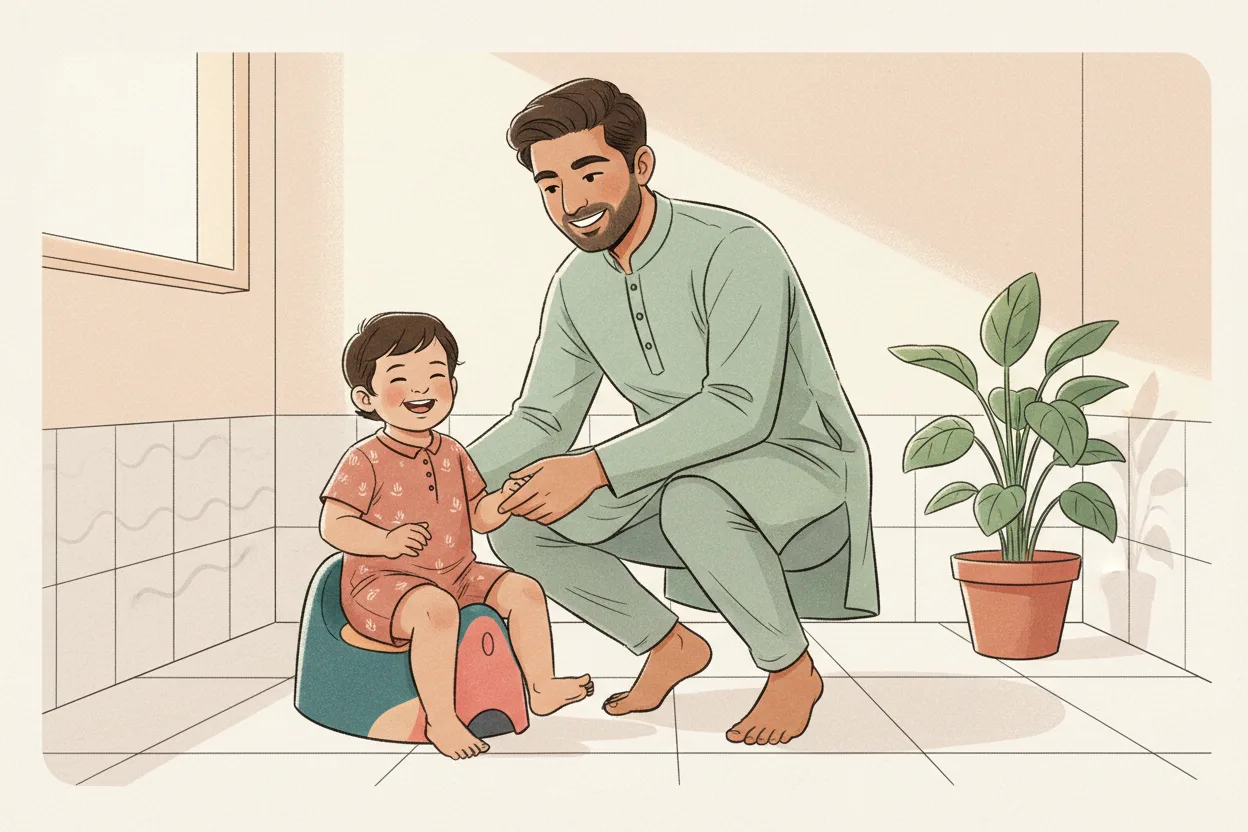
Most toddlers aren't ready to start potty training before around 18 months — that's when the bladder and digestive system have matured enough to hold on briefly between trips. Most children finish daytime training somewhere between 2 and 4 years old, so if you're planning around a return to work, the honest answer is: start later than you think, not earlier.
Why Timing Matters More in India
Potty training rarely rests on one person here. Between parents, a nanny, and grandparents around during the day, a toddler often gets three or four different sets of instructions in a single afternoon. That's manageable — but only if everyone starts from the same readiness signals and the same plan, instead of each caregiver deciding independently that "now" is the time.
The instinct to start early — often timed to land before maternity leave ends or a nanny is hired — is understandable. But readiness is a biological milestone, not a scheduling one, and starting too early tends to backfire.
When Is Your Child Actually Ready?
HealthyChildren.org, the American Academy of Pediatrics' parenting site, states that most children become physiologically ready for toilet training at around 18 months of age, once their bladder and digestive system have matured enough to delay elimination briefly. Before that, the signals you're looking for — staying dry for longer stretches, telling you before or after they've gone, showing interest in the toilet — simply aren't reliably there yet.
There's also a real cost to jumping the gun. A prospective study published in Pediatrics, indexed on PubMed, found that starting intensive toilet training at a younger age was associated with a longer overall duration of training, not a shorter one. In other words, waiting for readiness signs instead of a target date on your calendar tends to get the whole process over with faster, not slower.
If you're choosing between a gradual, child-led approach and a more structured, intensive method over a few concentrated days, know that an AHRQ-funded systematic review of toilet-training methods, on NCBI Bookshelf, found that the two approaches have not been directly compared, so it's difficult to say one is superior to the other for a healthy child. Pick whichever fits your household's schedule and temperament — neither is the "medically correct" one.
Getting Your Partner, Nanny, and Grandparents on the Same Page
This is the part that actually determines whether training goes smoothly in a multi-caregiver Indian household. HealthyChildren.org (AAP) advises making sure your approach to toilet training is consistent with that of your child's other caregivers as well.
Before you start, sit down with everyone involved — your partner, the nanny, grandparents around during the day — and agree on:
- The same words for using the toilet (so your toddler isn't decoding three different vocabularies).
- The same routine — when you offer the potty (after meals, on waking, before naps) and how long you wait.
- The same response to accidents — calm, no scolding, from every adult in the house, every time.
Write it down if that helps, and share it with the nanny before her first day handling training solo. A toddler getting consistent cues from a father doing the after-dinner potty run and a nanny doing the mid-morning one will get there faster than one managing conflicting approaches from every adult around them.
What to Avoid — Especially If You're Racing a Return-to-Work Date
Pressure is the single biggest thing that backfires. HealthyChildren.org (AAP) explains that pushing a child into toilet training before they're ready can lead them to start holding back their stools as a way of taking control, which is why it's best not to push children into toilet training before they're ready. That stool-withholding pattern can then lead to constipation — which makes the whole process harder and slower, the opposite of what a deadline-driven parent wants.
The same goes for how caregivers react to accidents and slow progress. HealthyChildren.org (AAP) recommends avoiding a power struggle, since children at toilet-training age are becoming aware of their own individuality and will push back against being forced. Brief this into your family/nanny agreement explicitly: no punishment, no shaming language, no bribery framed as a threat ("no potty, no TV"). Praise the attempt, not just the result.
If you're eyeing a specific date — nanny start date, end of maternity leave, before a sibling arrives — treat it as a rough window, not a deadline. A child not ready on day one of that window will be ready a few weeks later if you wait for the signs instead of forcing the date.
Nighttime Dryness Comes Later — Plan for It Separately
Daytime and nighttime training are two different milestones, and conflating them is a common source of frustration. HealthyChildren.org (AAP) notes that although most children are toilet trained between 2 and 4 years of age, some children may not be able to stay dry at night until they are older.
Occasional bedwetting well past daytime training is normal and expected, not a sign anything went wrong. The NIH's National Institute of Diabetes and Digestive and Kidney Diseases (NIDDK) states that by ages 5 or 6, children might have a bedwetting problem only if the bed is wet once or twice a week over a few months — well past the age most families expect nighttime dryness. Keep using overnight protection and don't attach any timeline pressure to it; it resolves on its own timeline, separate from daytime training.
What Actually Helps
| Item | Price Range (INR) | Where to Buy |
|---|---|---|
| Potty seat / training seat | Rs. 400 – Rs. 1,200 | Amazon.in / FirstCry |
| Toilet step stool | Rs. 300 – Rs. 900 | FirstCry |
| Washable/waterproof mattress protector | Rs. 500 – Rs. 1,500 | Amazon.in |
| Training pants (cloth or disposable) | Rs. 400 – Rs. 1,000 per pack | FirstCry / Amazon.in |
Keep one potty seat or step stool in the main bathroom your toddler uses, and consider a spare for a grandparent's home or the nanny's routine if your toddler spends significant time there — familiarity with the same setup in every location helps.
Frequently Asked Questions
What's the earliest we should start? Most children aren't physiologically ready before around 18 months, per HealthyChildren.org/AAP, so treat that as the earliest realistic starting point rather than a target to beat.
Our nanny wants to start before we're ready as parents. Should we let her? No — hold off until every caregiver is using the same approach. HealthyChildren.org (AAP) advises keeping your approach consistent with your child's other caregivers, so agree on the plan together before anyone starts solo.
Is the "3-day method" better than doing it gradually? Neither is proven better for a healthy child. An AHRQ-funded review found the two approaches haven't been directly compared, so it's difficult to say one is superior — choose what fits your household.
My toddler is 3 and still wets the bed at night. Is that normal? Very likely yes. HealthyChildren.org (AAP) notes that some children aren't dry at night until well after they're trained during the day, and NIDDK considers it a possible problem only from ages 5–6 onward, and only if it's happening once or twice a week for several months.
My toddler suddenly refuses to sit on the potty. What now? Back off the pressure. HealthyChildren.org (AAP) explains that pushing a child before they're ready can trigger stool-withholding, and HealthyChildren.org (AAP) also recommends avoiding a power struggle altogether — ease off for a couple of weeks and try again without making it a confrontation.
How do we keep grandparents from undoing our approach? Share the same written plan you give the nanny — same words, same routine, same calm response to accidents. HealthyChildren.org (AAP) frames this consistency as part of the training plan itself, not an optional extra.
Not medical advice — consult your pediatrician if you have concerns about your child's toilet training progress or bladder/bowel health.