
Raising an emotionally aware son isn't a conversation you have once he's engaged. It's a set of daily habits — how you name his feelings, how his father shows up at home, how the two of you treat each other — started while he's still small, that compound quietly over eighteen years.
Not medical advice — this is general parenting guidance; consult a paediatrician or child psychologist for concerns specific to your child.
Why "The Talk" Before Marriage Is Too Late
The "mama's boy" pattern usually gets treated as a marriage problem — something to fix with a stern conversation once a young man is getting engaged. By then, most of the groundwork is already set. A developmental-psychology review in PMC (NIH) states that empathy expands in stages through childhood — younger children mostly care about people they know, while older children and teens gradually learn to understand feelings and situations beyond their own experience. Empathy is a skill built across years, not a lecture delivered at 25.
Two other things set the foundation early. A study published in PMC (NIH) found that a father's hands-on involvement in caregiving — not just being the family's breadwinner — is linked to better emotional regulation, social competence, and cognitive growth in children. And a study published in PMC (NIH) found that the quality of the relationship between parents shapes how children adjust, largely by modeling what a respectful relationship looks like. Both are visible to a toddler long before he understands what marriage even means.
In many Indian households, sons are still raised with fewer chores and less emotional check-in than daughters, while daughters absorb both. This isn't just a feeling — India's Ministry of Statistics and Programme Implementation found that female participants spend about 140 minutes a day on caregiving for household members versus 74 minutes for male participants, "corroborat[ing] the Indian social fabric wherein most of the caregiving responsibilities for household members are borne by the females of the household." That gap doesn't show up as a problem until adulthood — in a marriage, a shared home, or a moment of stress he doesn't know how to name. Starting differently, from toddlerhood, is what closes it.
Name His Feelings Instead of Shutting Them Down
The single most concrete habit you can start today is emotion coaching — naming what your son is feeling instead of brushing past it ("you're fine," "boys shouldn't cry," "stop being dramatic"). HealthyChildren.org (AAP) advises that naming and validating a child's emotions helps the child feel understood and supported, which in turn makes it easier for them to manage those emotions themselves. Instead of "stop crying," try "you look really frustrated that your tower fell — that's hard." You're not indulging the meltdown; you're giving him the vocabulary to eventually calm himself down without you.
This isn't just a feel-good idea. A peer-reviewed intervention study in PMC (NIH) found that parental emotion coaching is related to improved emotion-regulation abilities in children — a boy who can regulate his own emotions is less likely to grow into an adult who shuts down or explodes when a partner brings up something hard.
A pattern worth watching for at home: A study indexed on PubMed (NIH) found that from preschool age, fathers attend more to daughters' submissive or sad emotions than to sons'. If a household comforts a crying daughter and tells a crying son to "man up," it teaches him — well before school age — that his softer emotions aren't welcome. This isn't only a Western pattern: a study of school-going adolescents in Telangana, India, published in PMC (NIH), found that most boys and girls themselves already believe boys/men are expected to be tough and less emotional — evidence the "boys don't cry" expectation is alive in Indian homes and classrooms today, not a relic. Naming your son's sadness or disappointment the same way you would a daughter's closes that gap.
Let Him See a Father Who Shares the Load
Boys learn what a partner does at home by watching one, not by being told about it later. A 31-year US panel study (Cunningham, 2001), cited in a PMC-published review, found that fathers' contribution to stereotypically "feminine" housework predicted their sons' involvement in the same type of work once those sons became adults. A son who watches his father cook, fold laundry, or handle a diaper change is more likely to do the same in his own household one day — no lecture required.
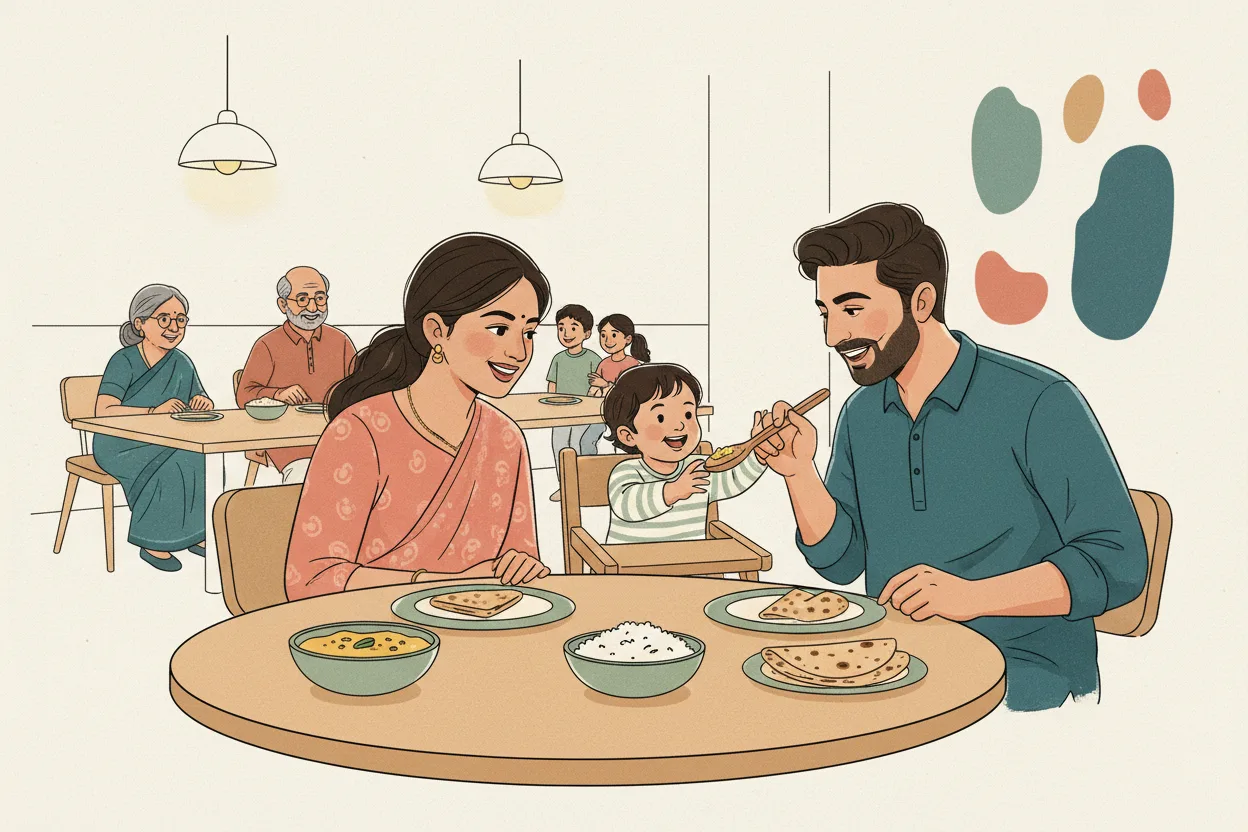
In a joint or nuclear Indian home, this shows up in small, visible moments: dad packing the tiffin some mornings, doing a night feed with expressed milk, or wiping down the kitchen counter after dinner. None of these need to be dramatic gestures — what matters is that your son sees them often enough to register them as ordinary, a father's job rather than a favour he's doing "to help."
| What he sees at home | What it teaches him |
|---|---|
| Dad and mum both do school pickups and diaper changes | Caregiving is a parent's job, not a mother's job |
| Dad cooks, cleans, or does laundry sometimes | Household work isn't gendered |
| Both parents name their own feelings out loud ("I'm stressed today") | It's normal for men to name emotions too |
| Disagreements between parents are resolved calmly, not with silence or shouting | Conflict can be handled with respect |
Model the Relationship You Want Him to Repeat
Long before he has a relationship of his own, your son is studying yours. A study published in PMC (NIH) found that the interparental relationship is associated with children's adjustment through the parent-child relationship — how you and your partner treat each other filters into how your child copes and, eventually, how he relates to others.
That doesn't mean pretending the two of you always agree in front of him. It means letting him see disagreements handled with respect — a raised concern, a calm conversation, an apology — rather than silent treatment or shouting. If grandparents model an unequal or dismissive dynamic in front of him, it's worth being explicit, in age-appropriate language, about what you and your partner do differently and why.
Why This Is Worth the Effort, Not Just Etiquette
It's tempting to treat all of this as a nice-to-have — good manners, better marriage prospects down the line. The stakes are more serious than that. NIMH (NIH) data show that in 2023, the suicide rate among males was nearly four times higher than among females. A boy taught to suppress distress instead of name it carries that pattern into adulthood, at real cost — raising a son able to say "I'm struggling" instead of shutting down is a habit that can matter to his safety, not just his relationships.
Starting Points by Age
No formal curriculum is required — small, repeated moments do more than one big conversation.
| Age | What to practice |
|---|---|
| 2–4 years | Name his emotions out loud; let him see both parents doing chores and caregiving |
| 5–8 years | Give him real, non-gendered chores; ask "how did that make you feel?" after a tough moment |
| 9–12 years | Involve him in caregiving for younger siblings or cousins; let him see parent conflicts resolved calmly |
| Teens | Direct conversations about respect and sharing a household — as normal expectations, not a one-off lecture |
Frequently Asked Questions
Isn't this just about being a strict parent? No — emotion coaching is about naming and validating feelings, not permissiveness. You can hold firm limits on behaviour while still validating the emotion behind it.
My son's grandparents tell him "boys don't cry." How do I handle that? Model the opposite consistently — name his feelings yourself, and let him see his father do the same. Research shows fathers already tend to attend less to boys' sadness than girls'; a grandparent's comment is one more reason to counter it at home.
Does it matter if my son doesn't do "feminine" chores yet — he's only 6? Start now. A long-running US study found the pattern predicts adult behaviour — the earlier a task feels normal rather than novel, the more likely it sticks.
What if my partner and I argue in front of him — have we ruined it? No. What matters, per PMC-published research, is the overall quality of the relationship he observes, not the absence of every disagreement — seeing conflict resolved with respect teaches him more than a home with no visible conflict at all.
Is this only relevant once he's a teenager? No — empathy develops in stages from early childhood through adolescence, so the habits that build it matter from toddlerhood onward, not just the teenage years.
Should I be worried this is "too Western" an approach for my family? These are patterns from developmental and family research on how children build emotional skills and household habits, and they apply inside any family structure, joint or nuclear, once practiced consistently.