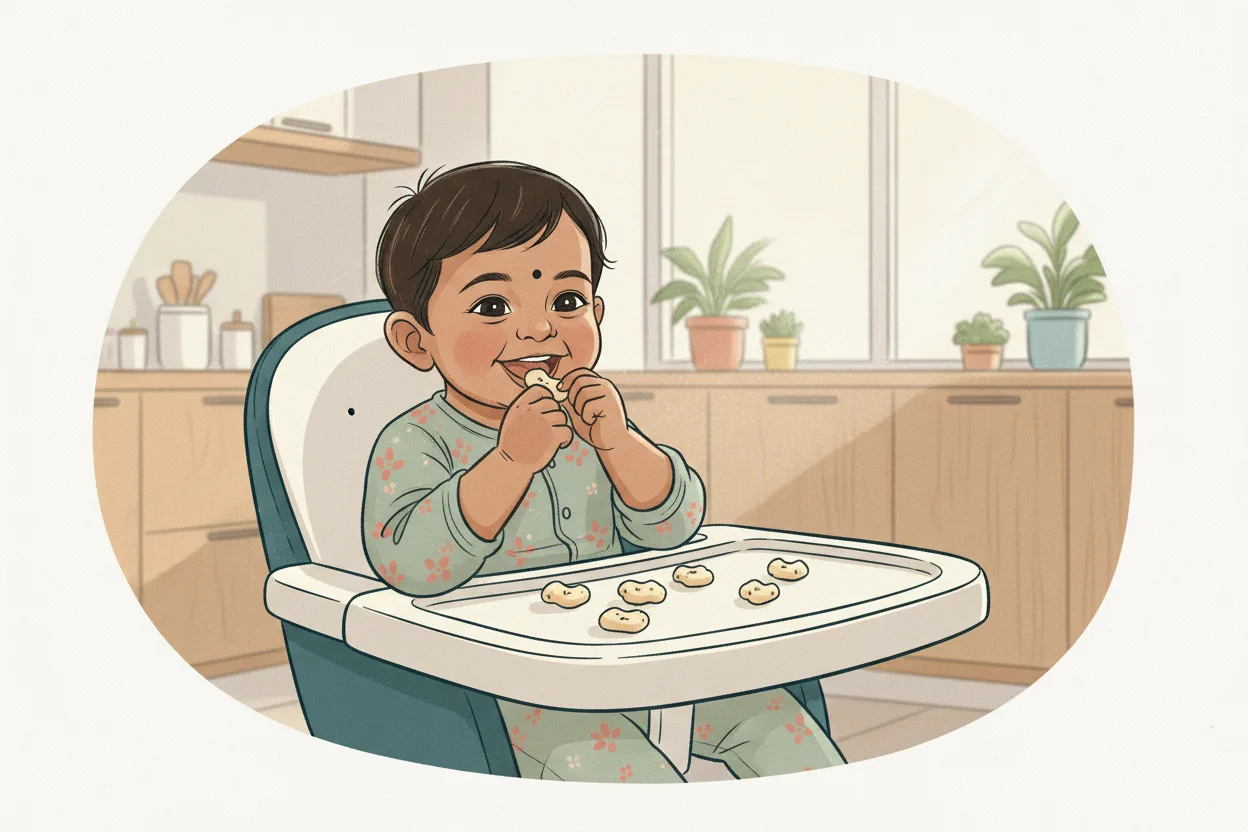
Once your baby can sit up unsupported and bring food to their own mouth, finger foods become the right next step — and most babies reach that milestone right around the time family and friends start handing over packaged puffs, rusks, and teething biscuits. The trouble is that "made for babies" on an Indian shelf doesn't automatically mean safe or low-sugar.
Not medical advice — consult your pediatrician about when and how to introduce specific foods for your baby.
Choking Safety Comes Before Anything Else on the Label
Before you even check ingredients, check shape and texture. The AAP is direct on this: "Do not give children younger than 4 any round, firm foods unless they have been cut into very small pieces." That rules out whole grapes, cherry tomatoes, and raw carrot rounds as snacks — and it's worth applying the same caution to any packaged snack that comes in hard, round, coin-sized pieces.
Whole or roughly chopped nuts belong in the same category. The Indian Academy of Pediatrics' parental guideline on complementary feeding notes that "any nut should be well grinded and mixed with food as solid pieces may cause choking in young children" — so a snack bar or biscuit studded with whole almonds or cashew pieces isn't a good fit yet, even if the packaging says "protein-rich."
However safe the snack itself, how baby eats it matters just as much. NHS guidance states that you should "always supervise babies and young children while they're eating." That means snack time happens seated upright in a high chair, not while crawling around the living room or being distracted with a screen — and it means you're within reach the whole time.
The One Ingredient That's a Hard No Before 12 Months
Some teething biscuits and rusk-style snacks list honey as a sweetener — check for it specifically. The AAP states that "honey is another source of botulism spores and should be avoided in babies under 12 months of age." This applies to honey baked into a biscuit exactly as much as it applies to honey off a spoon, since baking doesn't destroy the spores. If your baby is under a year, put back any pack listing honey or "shahad" in the ingredients.
Reading the Label: What "Healthy-Looking" Packaging Doesn't Tell You
A pastel box with a cartoon and the word "millet" or "natural" on the front tells you nothing about sugar or salt content — you have to turn it over. Here's the bottom line for a baby this age, from three separate authorities.
The AAP recommends that you "avoid serving foods and drinks with added sugar to children under 2 years of age" — full stop, no exceptions for jaggery-sweetened or "no refined sugar" versions, since the concern is added sugar of any kind, not just white sugar. WHO's guideline for complementary feeding of infants and young children goes further for the 6–23 month age band specifically, stating that "foods high in sugar, salt and trans fats should not be consumed" at all. On home ground, ICMR-NIN's Dietary Guidelines for Indians (2024) state that "added sugar must be totally avoided for children below 2 years" — which rules out most sweetened puffs, cream-filled biscuits, and flavoured rusks on Indian shelves, however they're marketed.
The good news is that reading the label just got easier. India's FSSAI has mandated that "nutritional information regarding added sugar, salt, and saturated fat" appear "in bold letters and relatively big font sizes on labels of packaged food items." Flip the pack over and look for that bold callout before you look at anything else on the front. As a working rule: if added sugar (in any form — sugar, jaggery, glucose syrup, honey) or salt appears anywhere near the top of the ingredient list, or if the bold sugar/salt panel shows a non-trivial number for a snack this small, skip it.
Brand Options Beyond Slurrp Farm
Slurrp Farm popularised the "baby-safe" snack aisle in India, but it isn't the only option worth checking. Treat every brand name the same way — as a starting point to go read the actual back-of-pack label, not a guarantee.
| Snack type | Brands to check | Typical price | Where to buy |
|---|---|---|---|
| Ragi/millet puffs | Slurrp Farm, Timios, Early Foods | Rs. 99 – Rs. 180 | Amazon.in / FirstCry |
| Teething rusks/biscuits | Farmley, Early Foods, Timios | Rs. 120 – Rs. 250 | FirstCry |
| Vegetable/lentil sticks | Early Foods, Timios | Rs. 100 – Rs. 200 | Amazon.in |
| Plain dry fruits (no added sugar, ground for age) | Any trusted grocer, sold loose or packaged | Varies by weight | Local grocer / Amazon.in |
For every option, the process is the same: check the shape for choking safety, check for honey if baby hasn't turned one yet, and flip to the bold FSSAI sugar/salt panel before it goes in the cart — regardless of what the front of the box promises.
Frequently Asked Questions
At what age can my baby start having finger-food snacks? Once your baby can sit up unsupported and bring objects to their own mouth, they're ready to try finger foods — for most babies this lines up with somewhere around 8–12 months, but follow your baby's own readiness rather than the calendar.
Are ragi or millet puffs actually healthier than regular biscuits? The grain itself isn't the deciding factor — the sugar and salt content is. A millet puff with added sugar high on the ingredient list is still a food WHO's guideline says shouldn't be given at this age. Always check the bold sugar/salt panel rather than trusting the grain on the front of the pack.
Can I give my 1-year-old jaggery-sweetened snacks since it's "natural" sugar? No. The AAP's guidance on added sugar and ICMR-NIN's 2024 dietary guidelines both treat added sugar as added sugar regardless of source — jaggery, honey, and glucose syrup all count, and are best avoided under 2.
Is it fine to give teething biscuits with honey once my baby has teeth? Go by age, not teeth. The AAP is clear that honey should be avoided until 12 months regardless of how many teeth your baby has, because the risk is botulism spores, not chewing ability.
Should I stay in the room while my baby eats a snack? Yes, every time. NHS guidance is to always supervise babies and young children while they eat — seated upright, not walking or lying down, and with you close enough to act immediately if they choke.
What if the packaging says "no added sugar" but lists jaggery or fruit concentrate? Read that as added sugar. Both add free sugars to the food even though they aren't table sugar, which is exactly what WHO's complementary feeding guideline and the ICMR-NIN guidelines advise against for this age group.