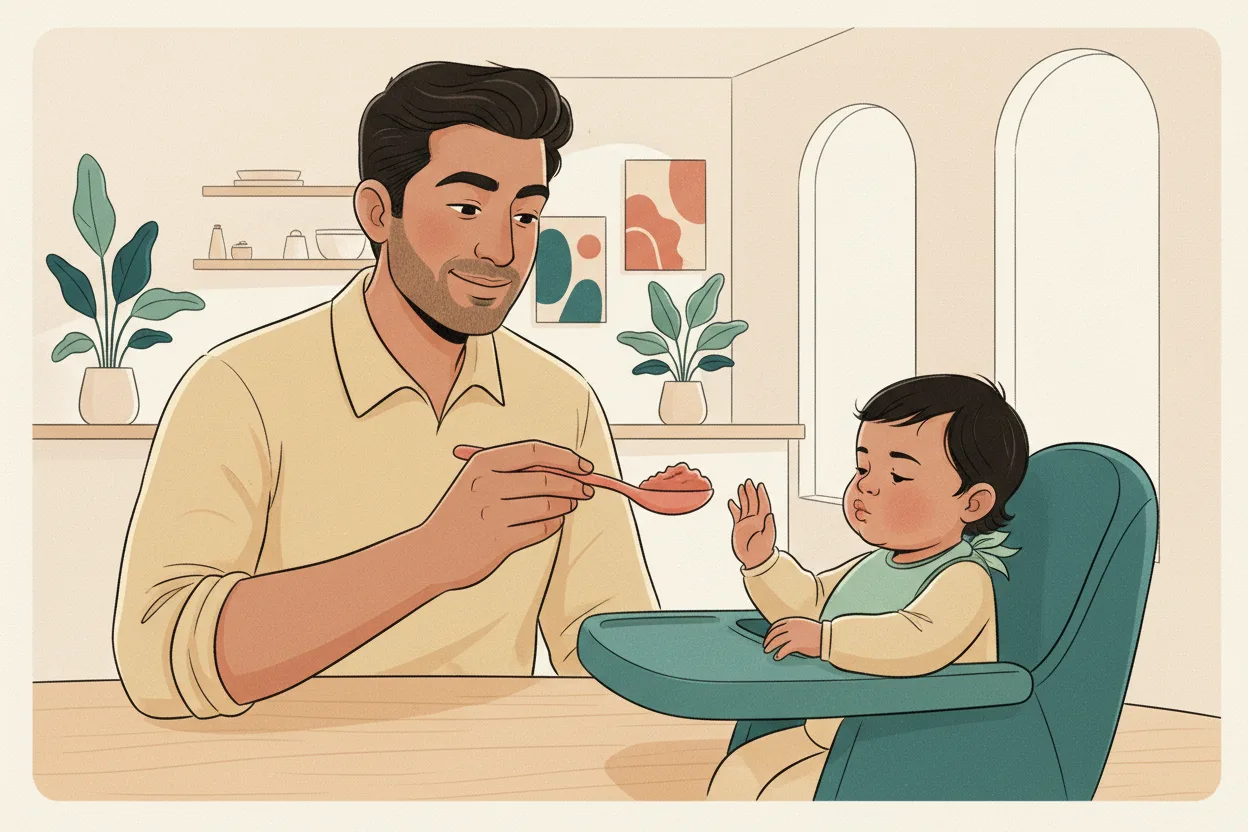


No — if your baby is under six months, gaining weight steadily, and having plenty of wet diapers, your breast milk is doing its job. WHO's Infant and Young Child Feeding fact sheet states that additional, complementary foods only become necessary once a baby's energy and nutrient needs start to exceed what breast milk alone provides — and that point is around 6 months, not three or four.
Not medical advice — consult your pediatrician before making any feeding changes for your baby.
Why Everyone Has an Opinion on When to Start
In many Indian homes, a grandmother's own experience of starting solids early carries more weight than a doctor's pamphlet. That advice usually comes from love and confidence, not carelessness — she raised children successfully, and she's telling you what worked. But infant feeding research has moved on a great deal since that generation raised their babies, and today's guidance is built on evidence about digestion, development, and nutrition that simply wasn't available decades ago.
The result is a familiar scene: a well-meaning push to begin rice kanji, mashed banana, or a bottle of formula-thickened cereal at three or four months, often framed as "your milk isn't enough anymore" or "she's waking at night because she's hungry." Both of those are common, understandable worries — and both deserve a real answer, not just a firm no.
What the Guidelines Actually Say
Every major pediatric authority, global and Indian, lands on the same window.
| Authority | What they recommend |
|---|---|
| WHO | Exclusive breastfeeding to 6 months; complementary foods added from 6 months |
| American Academy of Pediatrics | Only breast milk for approximately the first 6 months |
| Indian Academy of Pediatrics | Exclusive breastfeeding for 6 months; complementary foods only after completing 6 months |
| ICMR-NIN (India) | Exclusive breastfeeding for the first 6 months |
The American Academy of Pediatrics recommends providing a baby only breast milk for approximately 6 months after birth, before solids are introduced. In India, the Indian Academy of Pediatrics' 2016 Infant and Young Child Feeding Guidelines state that exclusive breastfeeding for the first six months, followed by continued breastfeeding with appropriate complementary foods only after completing 6 months, is the most appropriate feeding strategy. ICMR-NIN's own Dietary Guidelines for Indians — the government's national nutrition guidance — call for exclusive breastfeeding for the first 6 months, continuing to 2 years and beyond alongside complementary foods. This isn't a Western import being applied to India; it's India's own health establishment saying the same thing as WHO.
Why 6 Months, Not 4? The Science Behind the Number
Readiness. The motor skills a baby needs to safely handle solids — steady sitting with support, head control, losing the tongue-thrust reflex — don't reliably show up at 3 or 4 months. A 2019 scientific opinion from the European Food Safety Authority found that sitting without support can be observed in some infants at 4 months, but more commonly between 5 and 7 months of age. There's also a physical reason a very young baby fights off the spoon: Cleveland Clinic states that the tongue-thrust reflex, which pushes food back out of a baby's mouth, starts to disappear at around 6 months — exactly when babies become ready for solid foods. A baby who can be propped up to eat is not the same as a baby who is developmentally ready to eat.
Iron. A 2021 consensus review in the journal Nutrients, by a panel of Italian pediatric societies, found that a baby's birth iron stores become gradually depleted at about 6 months, and breast milk alone can no longer meet iron requirements from that point — which is exactly why complementary foods are timed to start there, not earlier.
Weight and long-term risk. Starting solids too early isn't a neutral choice either way — it carries a measurable downside. A 2025 systematic review in the journal Cureus found that introducing solid foods before 4 months of age was associated with an increased risk of childhood obesity or a higher BMI later in childhood. Separately, the American Academy of Pediatrics states that introducing solids before 4 months is associated with increased weight gain and adiposity, both in infancy and in early childhood. Waiting isn't just "playing it safe" — it's the option with evidence behind it.
How to Tell If Your Milk Is Actually Enough
The real test isn't your baby's age, and it isn't how many hours she sleeps — it's diapers and growth. HealthyChildren.org (AAP) advises watching for 6 or more wet diapers a day with pale or nearly colorless urine, alongside steady weight gain tracked by your pediatrician, as the signs that milk supply is meeting your baby's needs. If your baby's diaper count is healthy and her weight is on track at checkups, her milk supply is doing its job — a fussy evening or a rough night at 3 months is a developmental or comfort issue, not proof that "the milk has run out."
Bring your baby's growth chart to the next family gathering if you need to. A number on a page from the pediatrician tends to land better than a debate about theory.
What to Say When Family Pushes Back
Winning an argument about nutrition science at the dinner table isn't the goal — a few calm, repeatable lines that end the conversation peacefully work better.
- "Our pediatrician wants us to wait until she's older — she's tracking weight and development at every visit, and everything's on track."
- "She's gaining weight well and having plenty of wet diapers, so the doctor says the milk is doing its job for now."
- "I know things were different when you were raising us — the advice has been updated a lot since then, so we're going with what our doctor set out for her stage."
- "Let's ask together at the next checkup, so we're all hearing the same answer from the same person."
Framing it as "the doctor's plan" rather than "my decision" often defuses tension fastest — it isn't you rejecting their experience, it's both of you following the same professional guidance.
Frequently Asked Questions
My mother-in-law says my milk "thinned out" at three months and the baby needs food now. Is that true? There's no fixed age at which breast milk simply stops being enough. HealthyChildren.org advises judging supply by wet diapers and weight gain, not by age — if those are on track, supply is adequate, whatever the calendar says.
What's the real harm in starting solids just a few weeks early, like at 4 months? It isn't risk-free. A 2025 review in Cureus found that starting solids before 4 months was linked to a higher risk of childhood obesity or higher BMI later on, and the AAP notes that early solids are associated with increased weight gain and body fat in infancy and early childhood.
My baby can sit propped up and grabs at our food at 4 months — doesn't that mean she's ready? Not necessarily. EFSA's review of infant development found that sitting without support is seen in some babies at 4 months but is far more common between 5 and 7 months — reaching for food is curiosity, not the same as the motor readiness needed to eat it safely.
Won't she become iron-deficient if we wait until 6 months instead of starting at 4? No — 6 months is precisely the age the guidance is built around. A 2021 review in Nutrients found that iron stores deplete and breast milk alone stops covering iron needs at around 6 months, which is why complementary foods, including iron-rich ones, are introduced from that point — not because 6 months is "too late."
How do I bring this up with family without starting a fight? Lead with the pediatrician, not your own opinion. Most relatives soften once they hear it's the doctor's plan and that growth is being actively tracked — it reframes the conversation from "you versus her experience" to "both of you following the same expert."