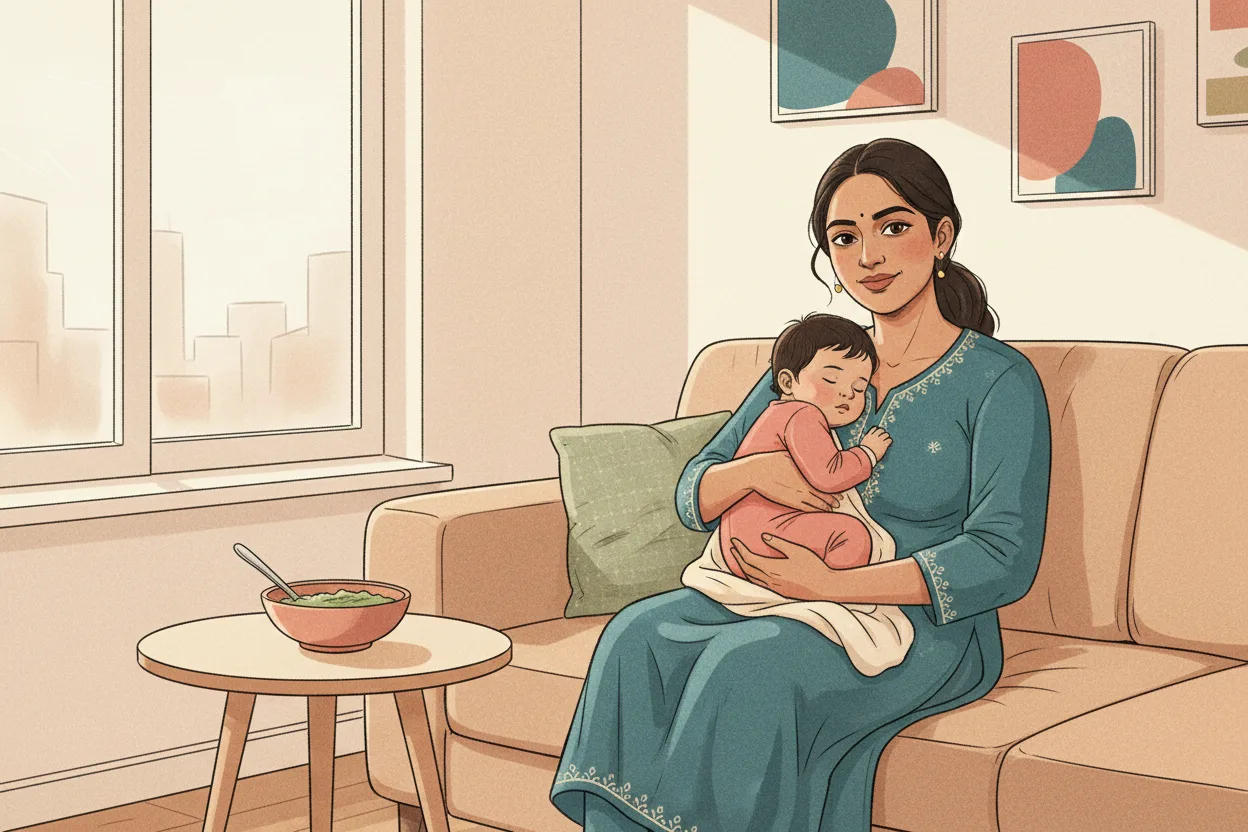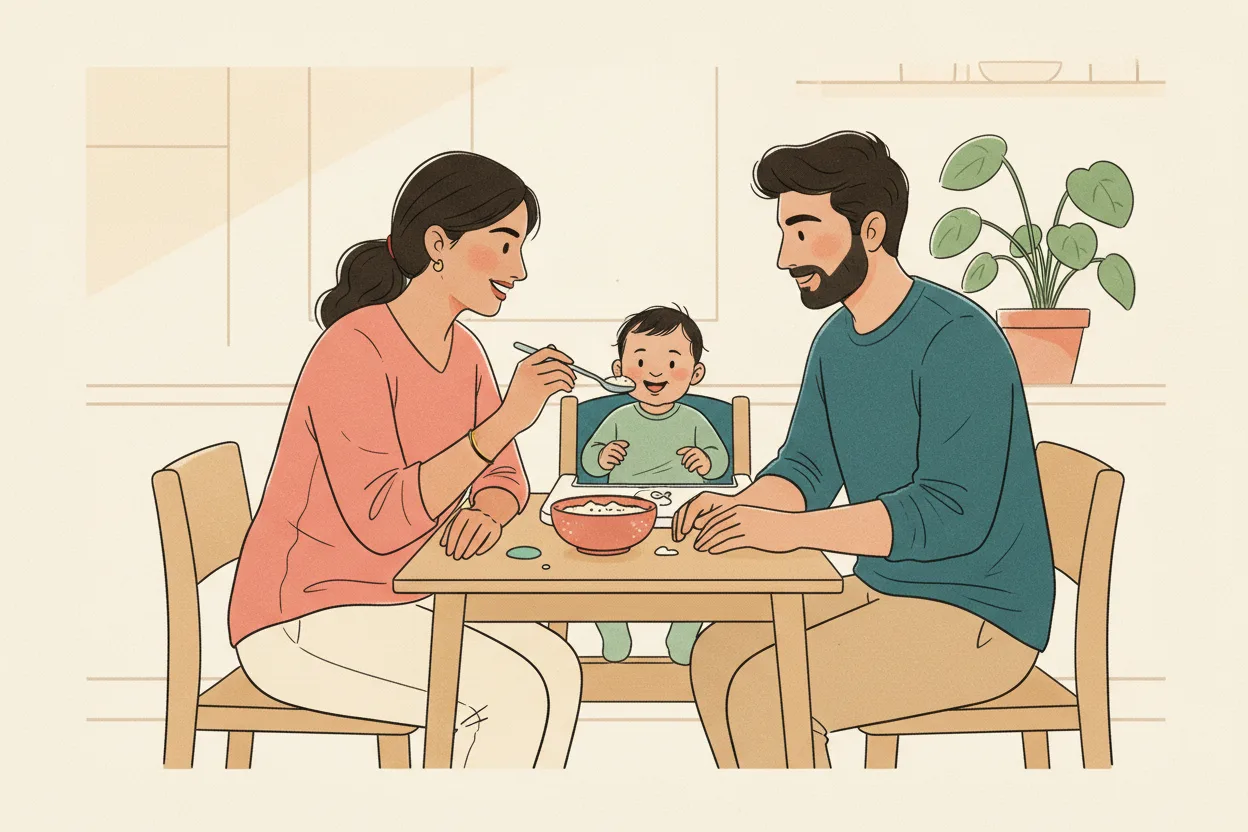
A baby with cow's milk protein allergy (CMPA) starts solids on the same timeline as any other baby — you just build the plate around dairy-free first foods instead of the dahi- and ghee-heavy defaults most Indian weaning charts lead with.
Not medical advice — consult your pediatrician before starting solids or making any change to your or your baby's diet, especially with a diagnosed allergy.
Why Indian Weaning Defaults Need a Rework Here
Most Indian first-food routines lean on curd (dahi) for probiotics, ghee for calories, and paneer for protein by month seven or eight. For a baby with CMPA, all three are off the table until a pediatrician or allergist clears a reintroduction. That doesn't mean starting solids later, doing it more cautiously, or reaching for less nutritious food — it means swapping the dairy-based staples for other iron-rich, calorie-dense, calcium-rich options from day one.
What CMPA Actually Is
Cleveland Clinic explains that a milk allergy is your baby's immune system overreacting to one or more proteins in milk — a different mechanism from lactose intolerance, which is a digestive issue with the milk sugar, not the immune system. That distinction matters because the two are managed very differently, and it's worth getting your baby's specific diagnosis in writing from your pediatrician rather than assuming which one you're dealing with.
You're not dealing with a rare condition. The Indian Academy of Pediatrics' Standard Treatment Guidelines state that CMPA is the most common food allergy in infancy in India, with a reported prevalence of 1.5–3% in infancy that falls below 1% by age 6 — most babies do grow past it well before school age.
The American Academy of Pediatrics states that a milk protein reaction can show up as urticaria (hives), angioedema (swelling), throat tightness, or respiratory symptoms like difficulty breathing, coughing, and wheezing. Some babies instead have slower, non-immediate reactions — pain, gas, or loose stools hours after a feed — which is why families sometimes take weeks to connect the dots.
Don't self-diagnose. A World Allergy Organization guideline update states that the standard way to confirm CMA is a doctor-supervised elimination diet for two to four weeks, followed by a food challenge under medical supervision. Cutting dairy from your baby's diet — or your own, if you're breastfeeding — without that confirmation risks an unnecessary, months-long restriction based on a guess.
Starting Solids: The Timeline Doesn't Change
The WHO's complementary feeding guideline recommends introducing complementary foods at 6 months (180 days) while continuing to breastfeed. A CMPA diagnosis doesn't push that window later — your baby needs the same nutritional head start as any other 6-month-old, just built from dairy-free ingredients.
That timing isn't arbitrary. A peer-reviewed review on complementary feeding and iron status found that iron stores become gradually depleted around 6 months, and breast milk alone can no longer meet a baby's iron requirements from that point. Getting iron-rich first foods onto the plate early — CMPA or not — is one of the most important things a first-food routine has to do.
Dairy-Free First Foods to Start With
| Food group | Dairy-free options | Why it helps |
|---|---|---|
| Iron-rich | Ragi porridge, moong dal khichdi, iron-fortified infant cereal, mashed egg yolk, well-cooked minced chicken or fish | Covers the iron gap that opens up around 6 months |
| Calcium (non-dairy) | Mashed leafy greens (spinach, methi), broccoli, tofu, fish with soft edible bones like sardines, calcium-fortified cereal | Replaces the calcium usually expected from dahi/paneer |
| Fruits & vegetables | Mashed banana, cooked apple, sweet potato, pumpkin, carrot | Easy first textures, no allergen concerns |
| Fats/calories | Coconut milk (unsweetened), vegetable oils, avocado, nut butters (thinned, once tolerated) | Dairy fat substitute for calories and growth |
On calcium specifically: NIH's Office of Dietary Supplements states that non-dairy calcium sources include canned sardines and salmon with edible bones, as well as vegetables like kale, broccoli, and bok choy. A dairy-free plate doesn't have to be a low-calcium one — it just needs a bit more planning around what replaces the dahi and paneer.
If You're Still Breastfeeding
Breastfeeding through the weaning window is common in India, and it changes what "dairy-free" means for you too. AAP's HealthyChildren.org advises that if a breastfed baby is diagnosed with a cow's milk protein allergy, the pediatrician may recommend the mother remove cow's milk from her own diet — and it can take several weeks for the milk protein to clear from breast milk entirely, so don't expect an overnight change in symptoms.
That means checking your own meals, not just baby's bowl — packaged paneer-based snacks, milk-based sweets, and ghee used in cooking dal for yourself all count if you're on an elimination diet for your baby's sake.
Reading Labels: Dairy Hides in More Than Dahi and Paneer
Once you start reaching for packaged biscuits, bread, or namkeen instead of home-made dahi and ghee, label-reading becomes the real work. Nemours KidsHealth advises that milk and milk proteins can turn up in unexpected packaged foods — processed meats, salad dressings, baked goods, and crackers among them — and that products labeled "non-dairy" may still contain milk protein. Scan Indian packaged snacks for casein, whey, milk solids, or milk powder on the ingredient list, not just the obvious "contains milk" line, and don't assume a "non-dairy" biscuit or namkeen is automatically safe.
What About Other Allergens — Soy, Egg, Peanut, Fish?
A CMPA diagnosis often makes families nervous about every allergen, but the evidence doesn't support delaying most of them. AAP's HealthyChildren.org states there is no reason to delay giving your baby foods thought of as common allergens — like peanut products, eggs, or fish — once you've started solids. Introduce one new food at a time, in a small amount, and watch for a reaction over the next couple of days, the same way you would with any first food.
Soy is the one exception worth a closer look before you reach for it as a dairy substitute. An NIH StatPearls review states that a meaningful share of infants with cow's milk protein intolerance also develop soy protein intolerance when given soy-based formula, so soy-based formula isn't a guaranteed substitute for a CMPA baby. Run any soy-based formula or soy-heavy substitute past your pediatrician first, rather than assuming it's automatically safe because it's dairy-free.
Will This Last Forever?
For most babies, no. MedlinePlus (NIH) states that children usually outgrow milk allergies or intolerances by around age 1. Your pediatrician will guide a reintroduction — usually a small, supervised amount of dairy, tracked closely for a reaction — rather than you testing it at home on your own timeline.
When your pediatrician does clear reintroduction, it's rarely "just give a glass of milk and see." A peer-reviewed review on milk-ladder reintroduction states that dairy is typically brought back through a stepwise "milk ladder" — starting with extensively baked or heated milk forms (like milk baked into a biscuit or muffin) and gradually progressing to less-processed and then fresh milk as tolerance is confirmed at each step. This is a medically supervised process, not something to freelance at home on your own schedule.
Practical Gear for Dairy-Free Weaning
| Product | Price Range | Where to Buy |
|---|---|---|
| Baby food masher/processor | Rs. 500 – Rs. 1,500 | Amazon.in / FirstCry |
| Silicone freezer trays (for batch-cooked purees) | Rs. 300 – Rs. 700 | Amazon.in |
| Iron-fortified dairy-free infant cereal | Rs. 250 – Rs. 500 | FirstCry |
| Allergy/food-introduction diary | Rs. 150 – Rs. 400 | Amazon.in |
A food-introduction diary is worth the small cost even if it feels excessive — with a confirmed allergy, you'll be tracking more new foods than most families, and a simple log makes it far easier to spot a pattern if a reaction does show up.
Frequently Asked Questions
Can I still start solids at 6 months if my baby has CMPA? Yes. WHO's guideline puts the start of complementary feeding at 6 months for every baby, allergy or not — you're just choosing dairy-free first foods instead of the usual dahi/ghee/paneer defaults.
Is CMPA the same as lactose intolerance? No. Cleveland Clinic explains that a milk allergy is an immune-system reaction to milk proteins, while lactose intolerance is a digestive issue with milk sugar — they're managed differently, so get a clear diagnosis rather than assuming.
How is CMPA actually diagnosed — can I just try an elimination diet myself? Work with your pediatrician. A World Allergy Organization guideline describes the standard process as a supervised elimination diet followed by a food challenge — not a self-guided trial-and-error at home.
My baby is breastfed — do I need to give up dairy too? Possibly, if your pediatrician recommends it. AAP's HealthyChildren.org notes it can take several weeks for milk protein to clear from breast milk after you cut it from your own diet, so give it time before judging whether it's helping.
Where does my dairy-free baby get calcium? Leafy greens, broccoli, tofu, and fish with soft edible bones are solid non-dairy calcium sources, per NIH's Office of Dietary Supplements. Your pediatrician can tell you if a calcium supplement is also needed for your baby specifically.
Will my baby outgrow this, or is it lifelong? Most babies do outgrow it. MedlinePlus states children usually outgrow milk allergies or intolerances by around age 1, though your pediatrician will confirm readiness for reintroduction rather than you testing it independently.