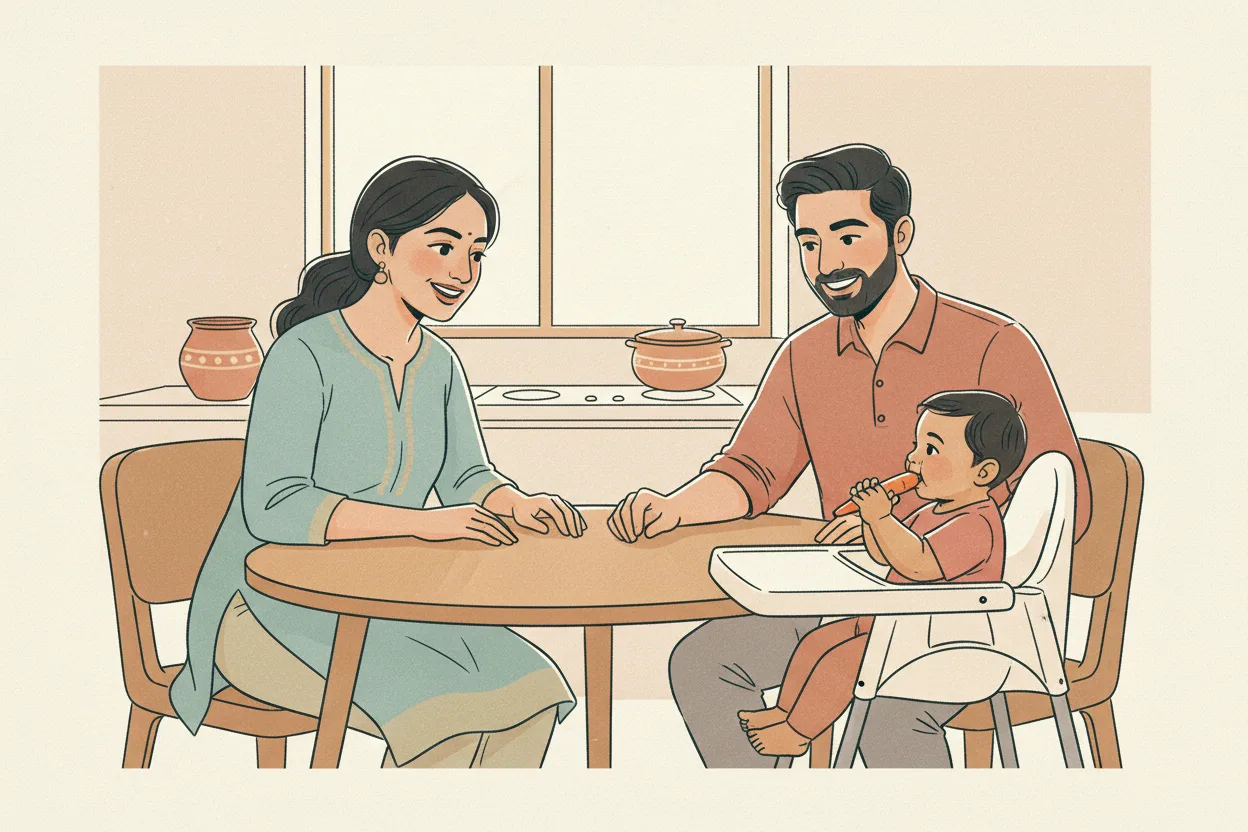

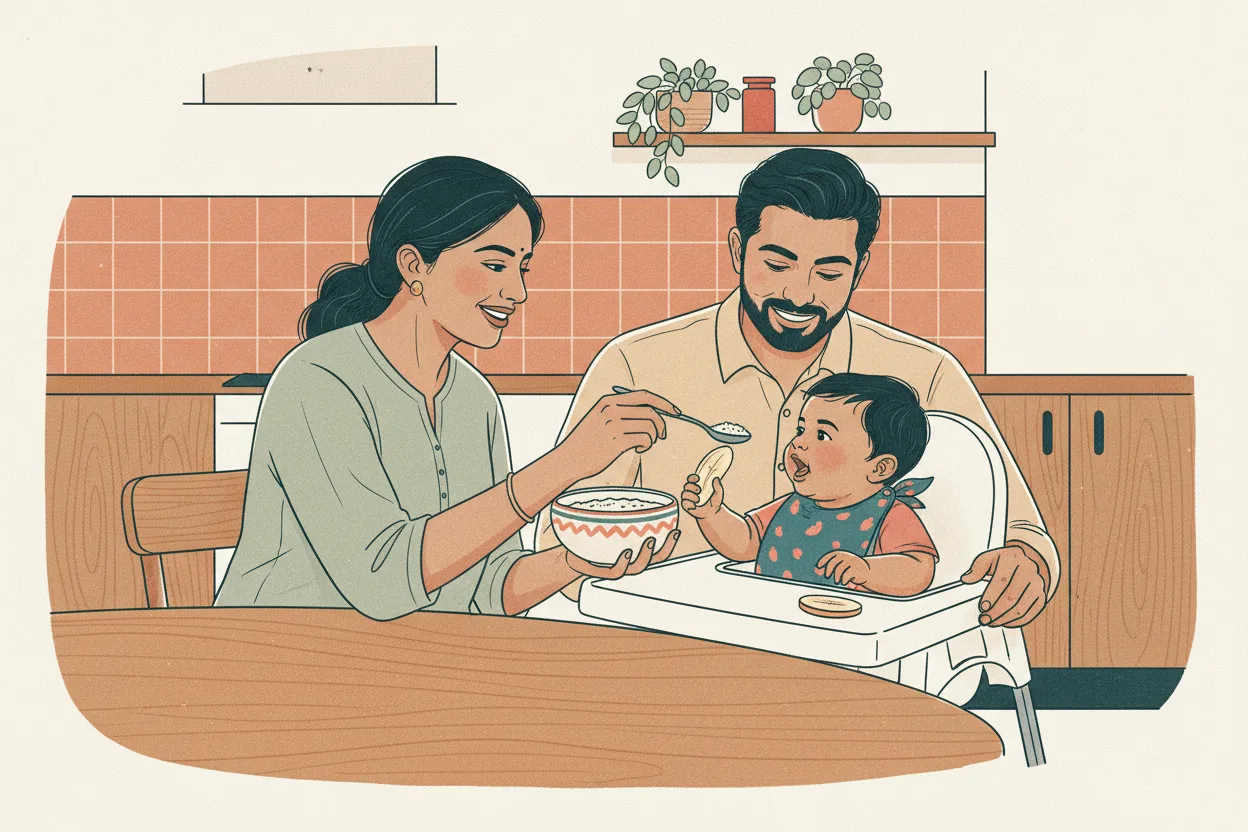
Solids can start once your baby is 6 months old — 180 days, not a day earlier — while breastfeeding continues alongside the new food, the WHO Guideline for complementary feeding recommends. Whether the first spoon holds home-made rice kanji, a soft-cooked vegetable stick for baby-led weaning (BLW), or a bit of both, the same first-week rules apply: right foods, right size, right pace.
Not medical advice — consult your pediatrician before starting solids, especially if your baby was premature or has a health condition.
Rice Kanji, BLW, or a Combo? What Actually Matters
This is often the first disagreement in the house. Grandparents tend to push thin rice kanji fed by spoon, the way it's always been done; you may have read that baby-led weaning — letting baby pick up and self-feed soft pieces — is the newer, "better" approach. Neither side needs to win.
The Indian Academy of Pediatrics' parent guideline states that baby-led weaning — feeding as per the baby's choice — should be practiced, right alongside the traditional family foods it's usually compared against. So a BLW or combo approach isn't a rejection of Indian pediatric guidance, and rice kanji isn't outdated either — both are acceptable starting points.
A practical middle path many families land on: thinned rice kanji or dal water by spoon for one meal, plus a few soft, BLW-style pieces — ripe banana, boiled potato, steamed papaya — at a separate meal where you can sit with baby and let them explore with their hands. It keeps the grandparents' method alive while giving baby some self-feeding practice too. What matters far more than which method you pick is that the food is the right size, unsalted, and introduced one at a time this first week.
Day 1–7: What This Actually Looks Like
Keep it simple for the first week: one new food at a time, waiting a bit before starting the next, so you can tell which food is responsible if there's a reaction — HealthyChildren.org (AAP) advises giving one new food at a time and waiting at least a day before the next. There's no need to rush through a long list in seven days.
| Day | A reasonable first-week plan | Prep notes |
|---|---|---|
| 1–2 | Ragi or rice porridge, thinned with breast milk/water | Cook until fully soft, blend or mash smooth |
| 3–4 | Mashed ripe banana or steamed apple | Steam fruit until fork-soft, mash with a fork |
| 5 | Steamed and mashed carrot or pumpkin | Steam until a fork slides through easily, no lumps |
| 6–7 | Moong dal khichdi, well-cooked and mashed | Cook soft, mash to a texture baby can manage |
Start with a teaspoon or two per meal, once a day to begin with. HealthyChildren.org (AAP) advises that a new eater only needs 1–2 tablespoons of a food per serving, increasing gradually as baby gets older — so there's no need to push a bigger bowl this week. The goal this week is practice, not calories — milk feeds are still doing the nutritional heavy lifting. Let your baby's interest, not the clock or a fixed quantity, decide how much goes in.
The Water Question
Small sips of plain water can start now too. HealthyChildren.org (AAP) advises that around 6 months you can offer about half a cup to a cup a day, from an open cup, sippy cup, or straw cup. It isn't a replacement for milk feeds this early — think of it as your baby getting used to drinking from a cup, not a new source of hydration.
Building the Plate Around Iron and Zinc
A newborn's iron stores start running low around this age, which is part of why 6 months is the recommended start, not a fixed age chosen for convenience. HealthyChildren.org (AAP) advises including foods that provide iron and zinc, such as iron-fortified cereal or pureed meat, from the first days of solids — not something to add on later. In an Indian kitchen that can mean iron-fortified ragi or rice cereal, well-cooked dal, or minced meat and mashed egg yolk if your family eats non-veg, blended soft into the kanji or khichdi.
Curd Is Fine, Cow's Milk as a Drink Is Not — Yet
Curd (dahi) is one of the most common first foods offered in Indian homes, and it's a reasonable one: HealthyChildren.org (AAP) advises that plain, whole-fat yogurt is a good first form of cow's milk protein for a baby to try, and homemade dahi mixed into rice or offered plain from a spoon fits the same idea — introduce it on its own for a day or two, like any other new food.
That's different from giving cow's milk itself as a drink, which grandparents sometimes push once solids start ("a katori of milk will fill her up"). HealthyChildren.org (AAP) advises that a baby shouldn't have cow's milk (or another non-human milk) as a drink until they're about 12 months old, unless there's no alternative — breast milk or formula should stay the main drink through this first week and beyond. Small amounts of curd or a little cow's milk mixed into cooking are not the same as a cup of milk to drink, so there's no conflict in offering dahi this week while holding off on milk as a beverage.
Egg and Peanut — Earlier Than You Might Expect
Delaying egg and peanut doesn't protect against allergies; the evidence points the other way. A 2021 review in the journal Nutrients found that early introduction of egg-containing and peanut-containing foods starting around 6 months of age (but not before 4 months) was linked to a lower risk of developing a food allergy to that food. A thin smear of well-cooked egg yolk, or a small amount of peanut butter thinned into a familiar mash, introduced on its own like any other new food, is a reasonable thing to try in week one or two. Ask your pediatrician first if there's a family history of food allergy or eczema.
What Never Goes in That First Bowl
- No honey, in any form, before your baby turns 1 — HealthyChildren.org (AAP) warns that honey is a source of the spores that cause infant botulism, and cooking doesn't reliably remove that risk.
- No added salt in the food or the cooking water — the NHS advises that babies shouldn't eat much salt, as it's hard on their kidneys. Skip the pinch of salt you'd normally add to dal or khichdi.
- No whole grapes, nuts, popcorn, or other hard raw pieces, and cut everything else into pieces no bigger than half an inch — HealthyChildren.org (AAP) recommends this to prevent choking, whether you're spoon-feeding purees or doing BLW with soft finger-sized pieces.
Kitchen Gear Worth Having This Week
| Item | Price Range (INR) | Where to Buy |
|---|---|---|
| Steamer basket / pressure-cooker insert | Rs. 300 – Rs. 800 | Amazon.in |
| Hand blender or mini food processor | Rs. 800 – Rs. 2,500 | Amazon.in |
| Silicone bibs (pack of 2–3) | Rs. 300 – Rs. 700 | FirstCry |
| Soft-tip baby spoons | Rs. 150 – Rs. 400 | FirstCry |
| High chair | Rs. 2,500 – Rs. 8,000 | Amazon.in |
None of this is mandatory to start — a steel katori, a fork for mashing, and a lap to sit on will get you through week one. The high chair and blender earn their place once solids become a daily habit.
Frequently Asked Questions
Is rice kanji as good as baby-led weaning? Both are acceptable starting points. The Indian Academy of Pediatrics' own parent guideline states that baby-led weaning should be practiced, but it doesn't say traditional rice kanji has to stop. What matters more than the method is that food is unsalted, safely sized, and introduced one at a time this first week.
How much water can I give in the first week? About half a cup to a cup a day is fine, per HealthyChildren.org (AAP), offered from an open or straw cup alongside meals — it's a top-up alongside milk feeds, not a replacement for them.
Can I give a tiny bit of honey mixed into food? No, not even a small amount, and not until after the first birthday. HealthyChildren.org (AAP) warns that honey is a source of botulism spores, and there's no safe quantity for a baby under 12 months.
My mother-in-law wants only rice kanji this week, no BLW. Do I have to pick a side? Not really. The IAP's parent guideline endorses baby-led weaning as an acceptable approach, but it sits alongside — not instead of — traditional family foods. Offering rice kanji by spoon at one meal and a few soft BLW pieces at another lets both approaches coexist in the same week.
When can I add egg or peanut butter? Around 6 months is a reasonable time to try both, one at a time like any other new food. A 2021 review found that starting egg and peanut around 6 months (not before 4 months) is linked to lower allergy risk, rather than delaying them.
How do I steam vegetables so they're soft enough? Cut into small, even pieces and steam over boiling water until a fork slides through with no resistance — usually well past the point where the vegetable still looks firm. Test by pressing a piece between your fingers; if it mashes without effort, it's ready for baby.