A big fall in appetite after the first birthday is expected, not a failure on your part. The American Academy of Pediatrics explains that after your child's first birthday you will probably notice a sharp drop in appetite, because the growth rate has slowed and she really doesn't require as much food now.
And the comment you keep hearing — that she looks pale — deserves a real answer from a paediatrician rather than from relatives. Both things are true at once: this pattern is usually ordinary, and the specific thing you have been told to look at is still worth checking properly.
Not medical advice — consult your pediatrician for anything specific to your child.
What Changed Since Her First Birthday
Nothing broke. The engine downshifted. The AAP's guidance for picky eaters puts it plainly: after the rapid growth of infancy, when babies usually triple in weight, a toddler's growth rate — and appetite — tends to slow down. The child who hoovered up everything at eleven months was building a body at a speed she will never match again.
She is also inside a specific developmental window. A 2022 review in Nutrients describes food neophobia — wariness of new foods, and of foods she accepted last month — as a natural stage that peaks between 18 and 24 months and resolves on its own.
Two bites and a turned head at seventeen and a half months is those curves crossing. It isn't a stretch to ignore entirely, though: WHO's 2023 complementary feeding guideline notes this period coincides with the peak period for risk of growth faltering and nutrient deficiencies. Normal and worth watching sit side by side here.
How Little Is Genuinely Normal
The real problem is adult eyes. The AAP notes that young children appear to eat very small amounts of food, especially when compared with adult portions, and that a child who is growing well is getting enough to eat.
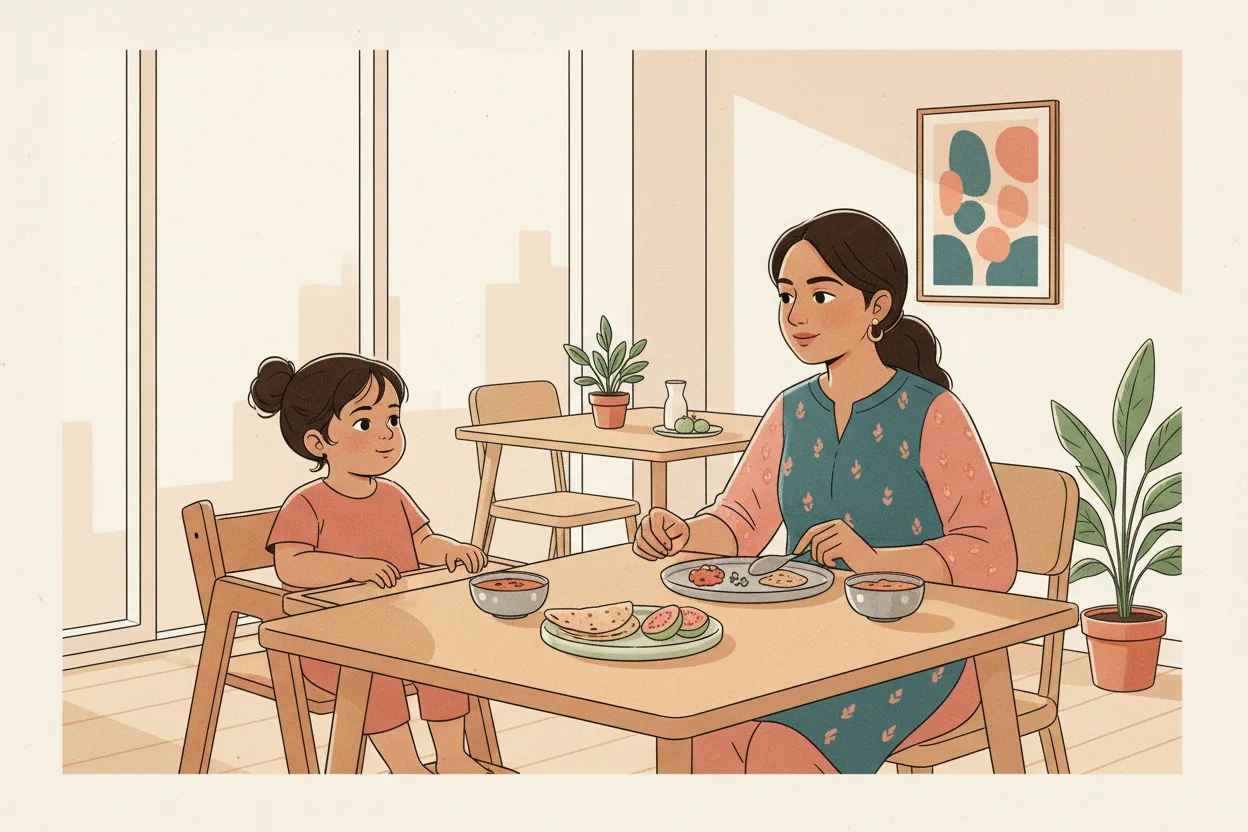
For scale, AAP guidance on toddler serving sizes puts a child's serving at approximately one quarter of an adult's. A quarter of your katori of dal. A quarter of one roti. A couple of spoons of rice. On a steel thali built for a grown-up, her whole meal looks like a rejection.
A whole day looks equally slight. The AAP's sample one-day menu for a one-year-old runs on half-cup and two-to-three-tablespoon amounts — half a cup of cereal, half a cup of cooked vegetables, a few spoons of fruit, a small portion of cooked meat — totalling about 1,000 calories. And the AAP is blunt that the eating habits of toddlers are erratic and unpredictable from one day to the next, so the unit to judge is the week, not the meal.
| What you see | What it usually is |
|---|---|
| "She left most of it" | She ate her portion; the rest was never hers |
| "Two bites all day" | One bad meal, not a trend |
| A flat line across visits | The measurement that actually counts |
The Fruit Demand and the Sweet Tooth
She isn't negotiating. She's wired this way. A 2014 review in the American Journal of Clinical Nutrition reports that the preference for sweet taste is universal and evident among children around the world, and that preferences for sweets remain heightened throughout childhood. Fruit is sweet, soft, predictable and needs no chewing effort. A new sabzi loses that contest every time.
Fruit isn't the villain. Fruit as the entire meal is, and specifically for iron. An ICMR bulletin from the National Institute of Nutrition notes the non-heme iron in cereal-pulse based diets is relatively poorly absorbed, that vitamin C enhances its utilization, and that tannin from tea, fibre and phytates inhibit it — naming amla, guava, citrus fruits and tomatoes as the main Indian sources of vitamin C.
So her fruit habit can work for the iron in her dal rather than replacing it. The NHS lists fortified breakfast cereals, green leafy vegetables, beans and lentils among iron-rich foods, and notes children who don't eat meat or fish are more likely to lack iron. Guava slices next to the khichdi, not instead of it.
Milk earns a mention too. The AAP notes milk is low in iron, high in calories, fills little ones up quickly, can lead to iron-deficiency anaemia, and should stay at no more than 16 to 24 ounces (roughly 475 to 750 ml) a day after the first birthday.
About the Cleared Plates on Instagram
Briefly, because it deserves little: you are holding your worst mealtime against someone else's best thirty seconds. Nobody films the katori going back into the fridge untouched. Mute the accounts that leave you feeling this way — they are not evidence about your daughter.
"She Looks Pale" Is Worth Checking, Not Dismissing
Relatives commenting on a child's complexion is usually noise. Pallor in a toddler whose diet has narrowed to fruit is a different matter, and in India it is a common enough picture to earn a proper look. A 2026 analysis of India's National Family Health Survey-5 (2019–21) found that about two-thirds of the children in the study were anaemic (68.0%).
The AAP lists pale, yellowish or ashy skin, a low or irritable mood, and feeling tired or needing naps more often among the signs of iron deficiency anaemia in children, and notes at least 15% of toddlers in the U.S. show signs of iron deficiency. The NHS lists tiredness, lack of energy and paler than usual skin among the symptoms, and says a doctor will usually do a blood test to find out whether the number of red blood cells is normal.
None of that means your daughter is anaemic. It means the one thing your neighbours keep pointing at is also the one thing a paediatrician can settle quickly. Let them settle it, so you can put it down.
Reasons to Book Rather Than Wait It Out
- Growth is flattening. Slower height or weight gain than expected, or rapid changes on the growth chart, is something the AAP's care guide puts squarely with your paediatrician, who can order labs, review nutrition and track development over time.
- The pallor people keep mentioning. Paler than usual skin alongside tiredness is on the NHS symptom list for iron deficiency anaemia, and a blood test is how it gets answered.
- Tiredness or irritability out of character. A low or irritable mood and needing naps more often sit on the AAP's list of iron deficiency signs.
- The range of food keeps shrinking. The AAP advises contacting the doctor when a milk-reliant toddler still isn't eating many more solids after about two months.
- Anything resembling trouble swallowing. An NHS speech and language therapy service lists coughing or choking around food or drink, wet-sounding or gurgling breathing while eating, recurrent chest infections, and difficulty with age-appropriate consistencies as signs needing referral to the dysphagia team.
The visit itself is undramatic: weight, height and head circumference measured and plotted beside the previous readings, since the AAP notes a paediatrician can order labs, review nutrition and track development over time — the shape of the line across visits matters far more than one low reading. Then a decision about testing, which is your paediatrician's call, not something to settle from a search result or a relative's recommendation.
What to Do at Meals Meanwhile
WHO recommends practising responsive feeding: recognizing and responding to signs of hunger and fullness. In practice that is a clean division of labour. You decide what is offered and when. She decides how much goes in.
So her quarter-portion goes on the plate, you eat your own food, and when she's done the plate goes away without commentary. Keep offering variety even when it comes back untouched, since it may take lots of attempts before a child accepts some foods.
In a joint-family kitchen this only works if everyone at the table runs the same script. Settle it with your partner first — he is at that table as much as you are — then with whoever else feeds her. One calm adult and two anxious ones still adds up to an anxious meal.
Frequently Asked Questions
My toddler has barely eaten since turning one — is that expected?
Largely, yes. The AAP ties the sharp drop directly to the growth rate slowing after the first birthday, so she genuinely doesn't require as much food. The check is growth, not plates: a child who is growing well is getting enough to eat.
She only wants fruit and sweet things. Should I cut out fruit?
No. The pull towards sweet taste is universal in children and stays heightened through childhood, so fighting it head-on loses. Use it instead: vitamin C enhances the utilization of non-heme iron from cereal-pulse diets, and amla, guava, citrus fruits and tomatoes are the main Indian sources of it.
Everyone says she looks pale. Should I get a blood test done at a lab myself?
Take her to the paediatrician and let them decide. The NHS notes a doctor will usually do a blood test to find out whether the red blood cell count is normal, and the AAP notes your paediatrician can order labs, review nutrition and track growth over time. A number without that context just produces more panic.
When does this stop being "just a phase"?
When the growth line changes, not when a meal goes badly. Slower height or weight gain than expected, or rapid changes on the growth chart, belongs with your paediatrician. Separately, coughing, choking or gagging around food, or difficulty managing age-appropriate consistencies, needs its own assessment.