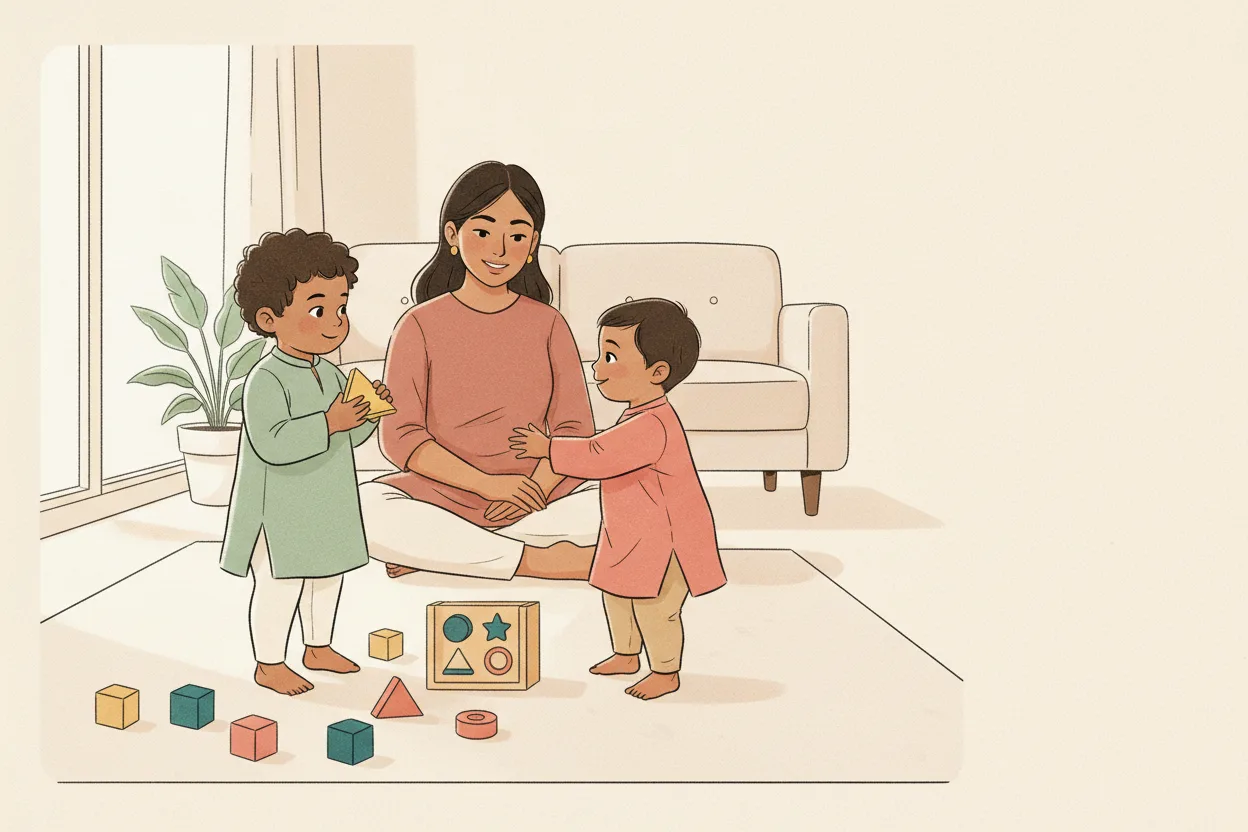
Your two-year-old came back from a playdate two floors down with a yellow triangle from somebody else's shape sorter in her kurta pocket. You spotted it at bath time, decided to return it in the morning, and forgot. The other mother messaged before you did. And when you finally handed the set back, one piece had vanished under a sofa somewhere.
There are two problems in that paragraph, and only one of them is about your child.
The short version: a two-year-old carrying home a toy that isn't hers is ordinary development, not dishonesty. The American Academy of Pediatrics describes children of this age as ones that "may refuse to share things that interests them," and that "do not interact well with other children." NHS health-visiting guidance puts the timeline plainly: children "don't really begin to understand how to share until they are around three years old."
Not medical advice — consult your pediatrician for guidance specific to your child.
Why she took it
Nothing about this is a character flaw. Three separate skills all have to arrive before "that's Aarav's, leave it there" makes sense to a child, and at two, all three are still under construction.
She is still working out what "belongs to" means. A 2023 study of preschool ownership reasoning reported that "2-year-olds were significantly above chance...correct on roughly 40% of such trials, and 3-year-olds correct on about two-thirds" — ownership is a concept she is actively assembling, not one she arrives with.
She cannot yet hold your view and hers at the same time. Research on theory of mind in four-year-olds notes that "false belief understanding emerges around the age of 4 years" — the insight that another person's picture of a situation can differ from your own is a preschool achievement, not a toddler one.
The brakes are not fitted yet. Harvard's Center on the Developing Child explains that "Children aren't born with these skills—they are born with the potential to develop them." Self-control is grown, over years, through exactly the small daily practice a playdate provides.
Sharing itself follows a slow, predictable curve. A 2022 paper in Frontiers in Psychology summarises the research: "At around 18–24 months of age, toddlers may be observed sharing food and toys, initially in response to the explicitly expressed desire of an interlocutor... and from 2 years of age spontaneously." So a flicker of generosity at two is real — it is simply not yet reliable.
| Roughly when | What is realistic |
|---|---|
| Around two | Playing alongside another child; starting to "take turns like rolling a ball back and forth" |
| Around three | Working "out solutions to disputes by taking turns or trading toys" |
| Around four | Holding another child's point of view steadily enough to negotiate |
What actually helps
Before the playdate
Ten minutes of setup beats an hour of correction afterwards.
Put the treasured things out of sight first. NHS children's health guidance is direct about this: "Remember your child doesn't have to share their most treasured things. Put those special items away when other children are around." The same applies in reverse — if you are hosting, the one toy your child guards fiercely goes on top of the almirah before the doorbell rings.
Then rehearse. NHS guidance suggests: "Before meeting up with others, plan with your child about the games they can play. You can agree on what they will try to share." Two lines in the lift on the way down is enough at this age.
During
Give her the words she is missing. The NHS explains that "Toddlers want to express themselves, but find it difficult. They feel frustrated, and the frustration comes out as a tantrum." Narrating for her — "You want the truck. Aarav is using it. Your turn is next" — hands her language she does not yet have, and it is a script she will borrow later.
Let generosity be her idea where you can. A 2017 study of preschoolers found "no significant differences between children's happiness in the 'self' and 'recipient' phase were found in the obligated sharing condition" — forced handovers buy compliance in the moment, without the warm feeling that makes a child want to do it again. Offering a swap usually lands better than prising fingers open.
On the way out
Make a pocket-check part of leaving, the same way shoes and water bottles are. Do it cheerfully and out loud — "Shape sorter pieces go back in Aarav's box. Ready? One, two, three." Turning it into a ritual rather than a search removes the accusation entirely, and a toddler is far more likely to co-operate with a game than an interrogation.
If something does come home, walk it back together the next day and let her hand it over. AAP guidance on conflict is blunt about why: "Children do what they see others do. You are your child's most important role model." She learns returning things by watching returning things happen.
What to skip
Shaming, threats, and the word chor — even said lightly, even to make relatives laugh. The American Academy of Pediatrics warns that "Harsh verbal discipline, even by parents who are otherwise warm and loving, can lead to more misbehavior and mental health problems in children." A two-year-old has no idea what she is being called, only that she is suddenly bad.
Punishment is also aimed at a target she cannot see. The American Academy of Pediatrics points out that "Until age 3 and sometimes later, children simply don't understand the concept of punishment. Setting limits is a much better approach than punishment." A clear, repeated limit — toys stay in Aarav's house — teaches; a consequence she cannot connect to anything does not.
Steadiness matters more than intensity here. The NHS points out that "Children need consistency. If you react to your child's behaviour in one way one day and a different way the next, it's confusing for them." The same calm sentence, every time, does more than one big reaction.
The harder half: the neighbour
This is usually the part that actually keeps you awake — and none of it is about child development.
In a society, you see this person every day. The lift, the park at six o'clock, the WhatsApp group, the school pickup line. That is precisely why it is worth spending thirty seconds of awkwardness now instead of six months of mild avoidance.
Say it plainly, and say it first. "Aarav's shape sorter came home in Meera's pocket — completely my fault for not checking. I'm returning it now, and one piece is missing. Can I replace the set, or would you rather I hunt for the piece another day?" Naming the missing piece yourself is what closes the whole thing. The version that curdles is the one where the other mother has to raise it.
Offer the replacement, and mean it. A shape sorter is a few hundred rupees. Order the same one, hand it over, and let the matter end. If she waves it off — and she probably will — accept that gracefully rather than insisting.
Keep your child out of the apology. She can hand the toy back; she is not the one making amends for the delay. That was an adult logistics failure, and hearing herself discussed as the problem is what turns a non-event into a story she carries.
Let it be small. One plastic triangle is not a referendum on your parenting or your child's character. If a neighbour chooses to make it one, that is information about her, not about you — and the graceful, replaced-it-and-moved-on version of you is the one the rest of the society will remember.
The reframe worth keeping
Playdates at this age are not tests your child passes or fails. They are the practice. WHO's nurturing care framework puts it simply: "children need to receive nurturing care. This means that they enjoy adequate nutrition and good health, feel safe and secure, and have opportunities for learning starting from birth."
A pocketed triangle is one of those opportunities. Handle it warmly, hand it back together, and let her watch you do the grown-up part well.