
If you've missed weeks — or even months — of your baby's vitamin D drops, you don't need a special catch-up course and you don't need to panic. You simply resume the normal daily dose, and if the gap did cause real deficiency, it is very treatable.
Not medical advice — consult your pediatrician before restarting or changing any supplement dose.
Why Vitamin D Drops Are Recommended in the First Place
Breastfed babies are advised to take a daily vitamin D supplement from birth, because breast milk on its own doesn't supply enough. This isn't specific to any one country's babies — it's the standard advice for any exclusively or mostly breastfed infant.
In India, the Indian Academy of Pediatrics' 2021 guidelines recommend 400 IU of vitamin D a day for the whole first year, the same maintenance dose used internationally. The guidelines are also clear that more isn't better: doses above 400 IU/day don't add any extra bone benefit, and doses of 1600 IU/day or higher can actually cause toxicity. So the goal was never a big dose — it's a small, steady, daily one.
Why This Gap Happens to So Many Indian Families
It's easy to assume that with India's sunshine, a missed dose or two barely matters. In practice, a study of breastfed infants and their mothers in Delhi, published in the Indian Journal of Medical Research, found vitamin D deficiency in 66.7% of the infants and 81.1% of the mothers — despite living in a sunny climate. Sun exposure in daily urban life (covered clothing, time indoors, sunscreen, pollution) doesn't reliably replace the supplement, which is exactly why the daily drops are recommended regardless of season or city.
So if a bottle ran out while you were travelling, a course got interrupted during an illness, or the drops simply got forgotten in the newborn haze — you are not the only parent this has happened to, and it is not a rare mistake.
It's tempting to try to make up for missed drops with extra sun time, but sunlight is a poor substitute in practice. A study of breastfed infants in Delhi found that getting enough vitamin D from sunlight alone required at least 30 minutes of midday sun exposure (10 am–3 pm) every week, on 40% of the baby's body, sustained for 16 weeks or more — far more consistent sun than most city routines allow, and not something to attempt with a young infant's bare skin without your pediatrician's guidance. Sunlight can complement the drops; it doesn't replace them.
What to Do the Day You Remember
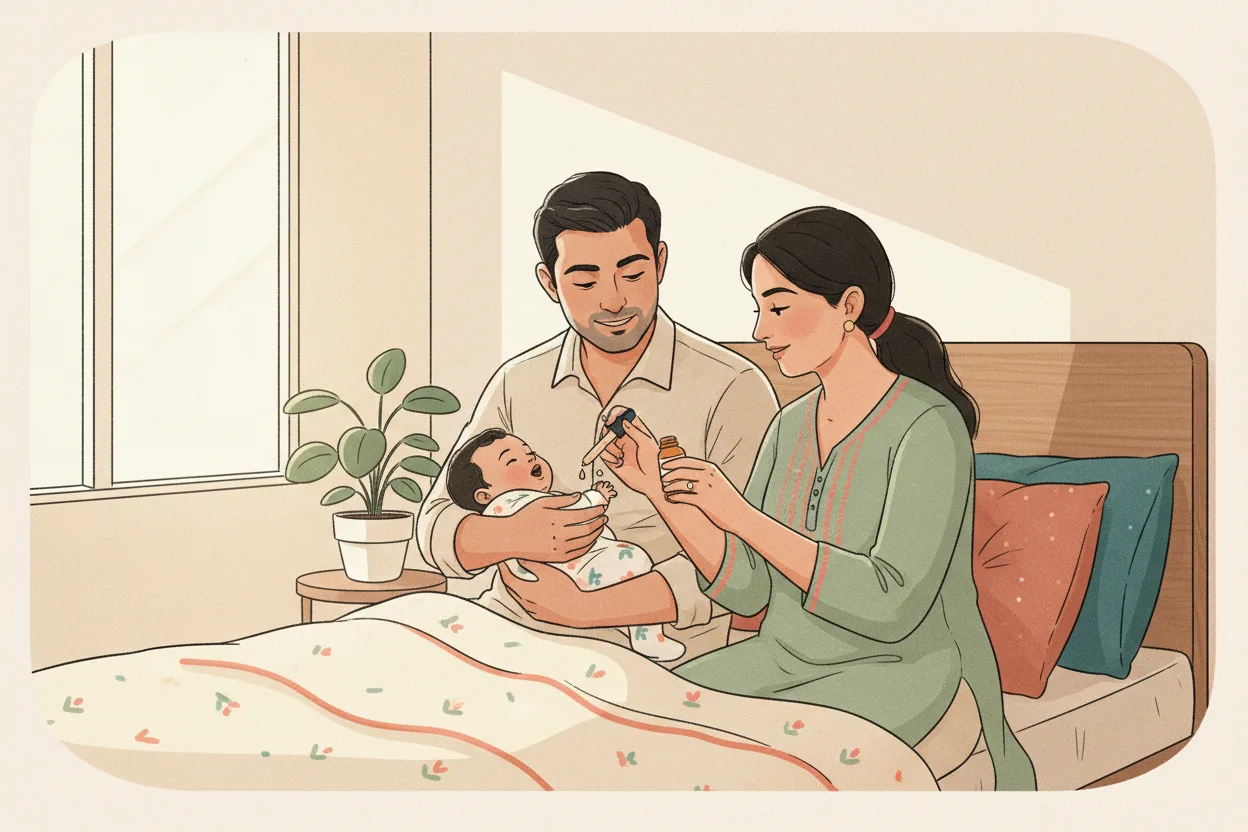
The moment you notice the gap, the guidance is simple: give the dose when you remember, and go back to the normal daily schedule — do not give two doses together or add an extra dose to make up for the ones you missed.
There is no formula for "catching up" a missed month by doubling doses for a while. Vitamin D dosing for babies is designed to run at 400 IU a day for the entire first year, so after any gap — a week or several months — you simply pick the same daily dose back up. Set a phone reminder or keep the bottle next to something you touch every day (the kettle, the diaper bag) so it's easier to keep going this time.
Could the Gap Have Caused Real Deficiency? What Your Pediatrician Checks
A short gap of a week or two is unlikely to cause a problem on its own. For a longer gap — several months of missed or irregular dosing — your pediatrician may want to check for early signs. A rickets diagnostic-workup guide in Pediatric Nephrology lists irritability, poor feeding, and, in some infants, a soft skull (craniotabes) or an unusually large fontanelle as early clinical signs that prompt further evaluation — usually a simple blood draw measuring the 25-hydroxyvitamin D (25(OH)D) level, sometimes alongside an X-ray if deficiency looks likely.
Mention the exact length of the gap at your visit, rather than an approximate guess. That specific detail helps your pediatrician decide whether to simply resume the dose or check further.
Is It Reversible? Yes — Here's the Timeline
This is the part most parents want to hear first: even confirmed vitamin D deficiency or early rickets from months of missed dosing is treatable and reversible. HealthyChildren.org (AAP) states that with adequate treatment, X-ray changes typically start resolving and blood alkaline phosphatase levels normalize in about 6 to 8 weeks. Restarting the daily dose isn't just "better than nothing" — it's the actual, effective treatment, and it works on a predictable timeline your pediatrician can track.
Will Restarting Cause an Overdose?
No — this is a common worry, but the numbers don't support it. Vitamin D toxicity comes from taking far more than the recommended amount over time, and NIH's Office of Dietary Supplements notes that toxicity causes marked hypercalcemia from sustained excess intake — not from resuming a standard 400 IU/day dose after a gap. The IAP's own toxicity threshold of 1600 IU/day or above is four times the maintenance dose, so simply restarting the normal drops carries no meaningful overdose risk. Toxicity only becomes a real concern if drops are given at multiples of the prescribed dose or from more than one supplement source at once — never mix in a second vitamin D product without checking with your pediatrician first.
Getting Back on Track
| What you need | Typical price (India) | Where to buy |
|---|---|---|
| Vitamin D3 infant drops (400 IU/dose, as prescribed) | Rs. 90 – Rs. 250 per bottle | Amazon.in / FirstCry |
| Phone reminder app / daily alarm | Free | Built into any smartphone |
A few practical habits make it easier to stay consistent this time:
- Keep the bottle visible next to something you use daily — the kettle, the diaper caddy, your toothbrush.
- Set a recurring daily phone alarm rather than relying on memory alone.
- If you're travelling, pack the drops with your baby's essentials bag, not in checked luggage.
- With more than one caregiver in the house (a parent, a grandparent, a nanny), pick one person to confirm the dose each day, so responsibility for it doesn't quietly fall through the cracks.
Frequently Asked Questions
My baby missed almost two months of vitamin D drops. Do we need a double dose to catch up? No. NHS medicines guidance is explicit: never take two doses together and never add an extra dose to make up for a missed one. Just restart the normal daily dose and mention the gap to your pediatrician at your next visit.
Is my baby permanently affected by months of missed dosing? Not necessarily. Vitamin D deficiency and even early rickets are treatable, and X-ray changes typically start resolving with alkaline phosphatase normalizing within 6 to 8 weeks of adequate treatment. Restarting the standard dose is the actual treatment, not just a formality.
How do I know if the missed doses actually caused deficiency? Watch for irritability, poor feeding, or a noticeably soft or large-feeling spot on the skull, and mention the length of the gap to your pediatrician, who can examine your baby and order a blood test if needed. Many babies with a missed-dose gap show no symptoms at all.
Do exclusively breastfed babies really need drops even with India's sunshine? Yes. Breastfed babies are advised to take a daily vitamin D supplement from birth regardless of climate, because breast milk alone doesn't provide enough — and deficiency has been found in two-thirds of breastfed infants in a Delhi-based study despite the city's sunny climate.
What's the actual daily dose we should be giving? The Indian Academy of Pediatrics recommends 400 IU per day for the entire first year — the same dose whether you're just starting, or restarting after a gap.
Could giving the drops again cause vitamin D toxicity? No, not at the standard dose. Toxicity results from sustained intake far above the recommended amount, and the IAP's toxicity threshold of 1600 IU/day or more is four times the normal 400 IU/day maintenance dose, so resuming the regular drops is safe.