
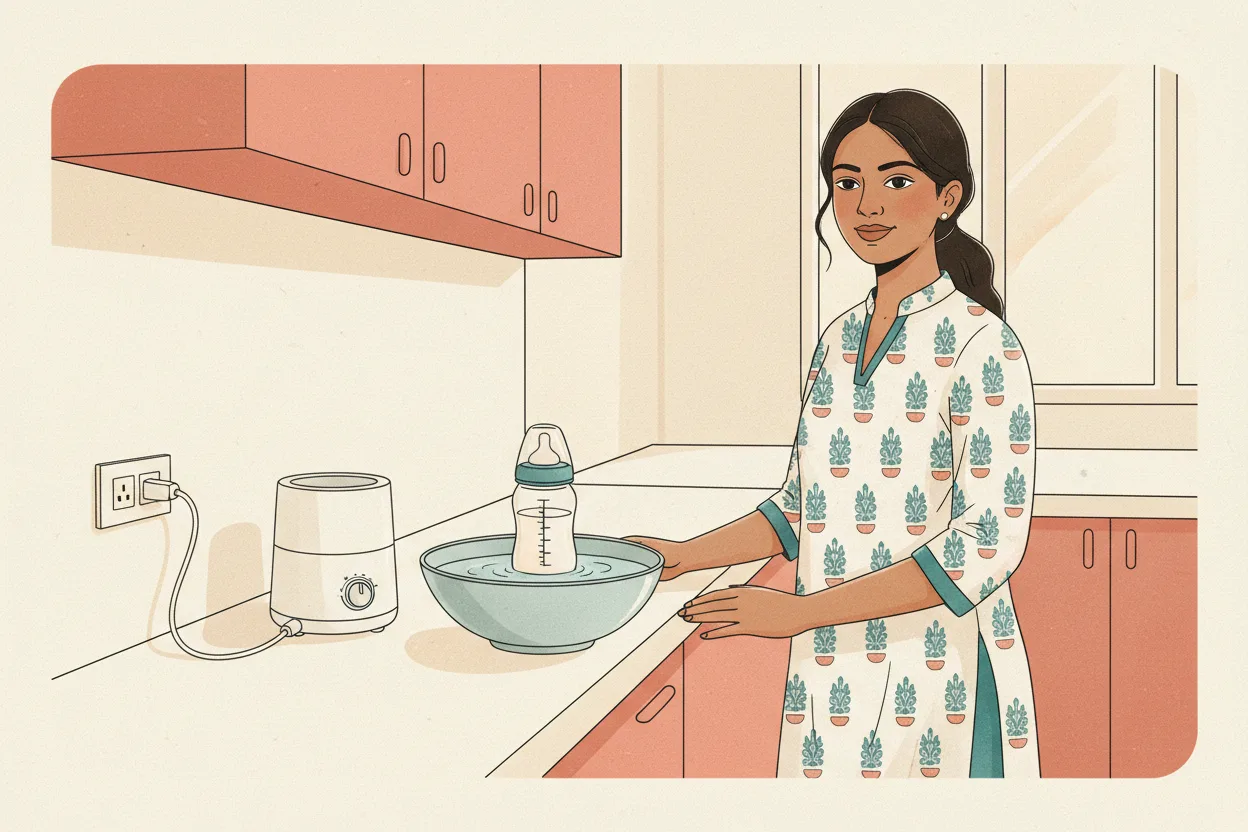
If you stand a bottle of fridge-cold pumped milk in a bowl of warm water and swirl it, you are already doing the thing the guidelines actually describe. The CDC's breast milk preparation guidance says to keep the container sealed, place it into a bowl of warm water or hold it under warm — but not hot — running water for a few minutes, test a few drops on your wrist before feeding, and swirl the milk to mix the fat, which may have separated. Your method is not the thing to fix.
What is worth getting right is the temperature you aim for, the one appliance to keep away, and the clock that starts when the milk goes warm.
Not medical advice — consult your paediatrician or lactation consultant for personal guidance.
You Are Aiming for Body Temperature, Not Hot
The target is lukewarm. The NHS says you can feed expressed milk straight from the fridge if your baby is happy to drink it cold, or warm it to body temperature by putting the bottle in a jug of warm water or holding it under running warm water. The CDC goes further and says breast milk does not need to be warmed at all — it can be served at room temperature or cold. Plenty of three-month-olds will take a cool bottle without protest, which is the fastest option of all if yours is one of them.
If you are boiling water for the bowl, let it stop steaming first. India's Ministry of Health and Family Welfare, in its national guidelines on lactation management centres, puts the water used for rapid thawing at not more than 37°C — hand-warm, not bath-hot. A 2015 PLoS One simulation study of bottle-warming methods notes a 40°C ceiling in human-milk banking guidance, and found that when milk is re-warmed above roughly 40°C its nutritional and immunological value begins to deteriorate. Those two numbers are close enough to give you one simple rule: water you could comfortably keep your hand in.
Then check it the low-tech way: put a few drops on your wrist before you offer the bottle. It should read as neutral against your skin, not warm.
The Microwave Is the One Hard No
This is the one instruction worth memorising, and three authorities say the same thing.
- The NHS says not to heat up or defrost breast milk using a microwave or stove, because this can cause hot spots, which can burn your baby's mouth.
- The American Academy of Pediatrics puts it as a burn risk: microwaving breast milk is not safe due to the risk of scalding your baby with hot milk.
- India's MoHFW guidelines rule out the microwave on two counts — it can create hot spots that cause burn injury to the baby, and it destroys immunoglobulin A and other antibacterial properties more than any other form of thawing.
A microwave heats liquid unevenly, so a bottle that feels fine outside can hold a scalding pocket inside — and swirling afterwards is not a reliable fix. The same CDC page also rules out heating milk directly on the stove, for the same reason: you cannot control what the milk at the bottom of the pan is doing.
The Clock Is What Catches You at 1 a.m.
Most parents get the method right and the timing wrong. Three windows matter, and the published guidance does not fully agree on them.
A bottle you warmed but your baby did not drink. The NHS Best Start in Life guidance says to use warmed-up breast milk within an hour, and to discard any leftover milk that has been warmed. The CDC allows longer — once breast milk is brought to room temperature or warmed, use it within 2 hours. They disagree, so work to the tighter figure: one hour from warm.
A bottle your baby started. The NHS says that once your baby has drunk from a bottle of breast milk it should be used within 1 hour and anything left over thrown away. The CDC's FAQ is more generous again — leftover milk can still be used within 2 hours after the baby is finished feeding, and after 2 hours it should be thrown away. Again: assume one hour, and that the leftover goes down the sink rather than back into the fridge. India's MoHFW guidelines are blunter still, saying excess milk left after a feed should be discarded immediately.
Milk you have already thawed. Thawed milk must not be re-frozen, and the AAP's guidance gives it up to 2 hours at room temperature — so warming the same bottle twice is not a move you have.
The practical consequence is about volume. The CDC's advice to store, thaw and warm milk in smaller amounts specifically to avoid wasting unfed milk is the whole trick at a 1 a.m. feed: warm the 100ml you expect her to take, not the 150ml bottle, because the surplus is not going back.
Fridge and freezer windows, cool-bag transport and how long milk keeps before you warm it are a separate question — we cover those in the night-feeds guide, and formula handling has its own guide.
What a Bottle Warmer Actually Changes
A warmer is a convenience purchase, and a reasonable one. What you are buying is a repeatable result: the same temperature every time, without a bowl, a kettle, or you swirling and guessing at 2 a.m.
What it does not buy you is time. Every window above is unchanged by the appliance — a warmer does not extend how long a warmed bottle can stand, and it does not turn a started feed back into stored milk.
And a warmer left on "keep warm" is actively working against you. The PLoS One study measured that electrical bottle warmers can reach 87°C, well above the 40°C figure human-milk banking guidance recommends, and noted there are no strict guidelines on milk warming — so the appliance is not protecting you here. There is also a named limit worth borrowing: the WHO and FAO guidelines say a feed should be re-warmed for no more than 15 minutes, because holding it warm for longer keeps it at a temperature ideal for the growth of harmful bacteria — and holding feed in bottle warmers for lengthy periods was reported as one probable cause of an E. sakazakii outbreak. That guidance was written for formula, but the appliance behaves the same way with milk in it. Warm it when you need it; take it out when it is ready.
Buying One in India
Three things matter, none of them on the box's feature list:
- Even heating. A warmer that moves warm water or steam around the whole bottle brings it up together, rather than leaving a hot layer at the top you have to swirl out anyway.
- Auto shut-off. Pick one that stops by itself rather than holding the bottle at temperature indefinitely — that is the failure mode that matters.
- Fits the bottles you already own. Check well depth and neck width against your existing bottles: a wide-neck bottle often will not seat properly in a narrow warmer.
Water-bath warmers from Philips Avent and Mee Mee are the commonly stocked options here, broadly in the ₹1,500–₹4,000 band (Amazon.in, FirstCry). Which pump to buy is a separate decision — see our pump comparison for working mothers.
One Last Question
Can I just use water from the electric kettle?
Yes, once it has cooled to hand-warm. Your bowl is doing nothing a mug or a jug cannot — the method is simply a sealed container in warm, not hot, water, or under warm running water. The fat that rises in the fridge is normal; swirl it back in rather than shaking hard.