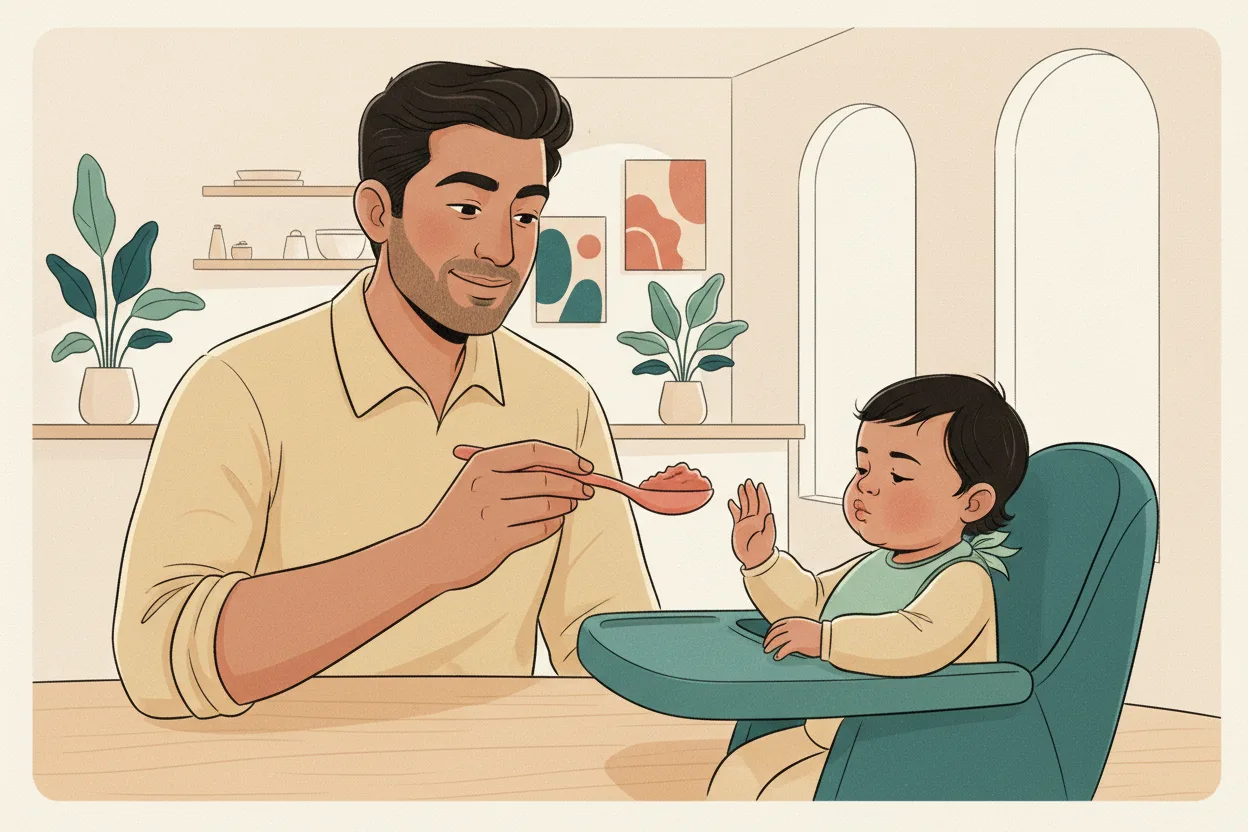

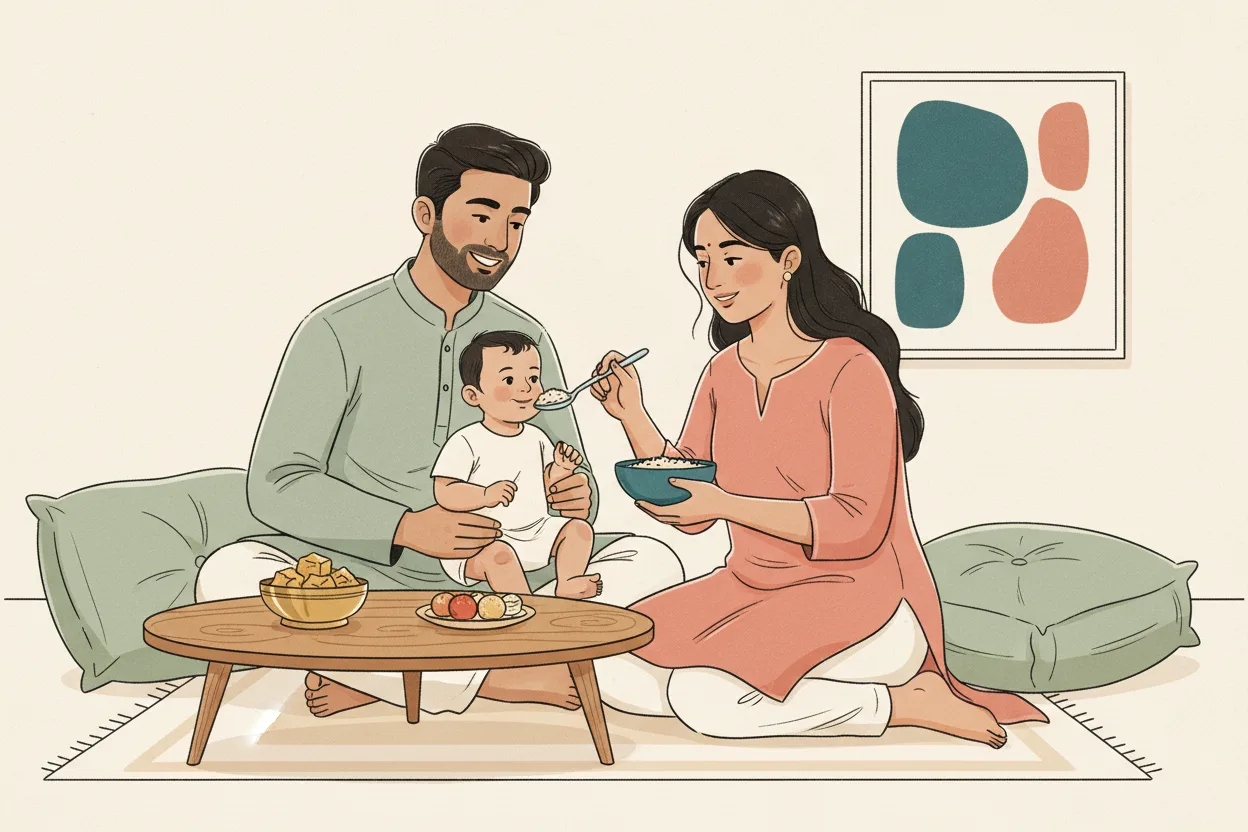
Hold off on added sugar of any kind — including jaggery, gur, and palm candy — until your baby turns 1, then go slow. WHO's complementary feeding guideline for infants and young children aged 6–23 months states that foods high in sugar and sugar-sweetened beverages should not be given at all. That "no sugar" rule doesn't carve out an exception for unrefined sweeteners: WHO's official definition of the "free sugars" it recommends limiting explicitly includes sugars naturally present in honey and syrups, so gur and palm candy count the same way refined white sugar does.
Not medical advice — consult your pediatrician for guidance specific to your baby.
Why "Natural" Doesn't Mean Exempt
In most Indian homes, someone will eventually argue that jaggery is different from sugar — that because it's "natural" and comes with iron and minerals, it's fine to start early. The guidelines don't draw that line. WHO's Guideline: Sugars Intake for Adults and Children states that free sugars are defined as sugars added by a manufacturer, cook, or consumer, plus sugars naturally present in honey, syrups, and fruit juices — jaggery is chemically a form of sucrose with trace minerals, not a different category of food. Any nutritional edge it has over table sugar is small next to the fact that a baby's system treats both the same way. The iron argument doesn't hold up at real-world quantities either: the one Indian randomized controlled trial that found a measurable anemia benefit from jaggery used it in a 60-gram daily dose, combined with sesame seeds and standard oral iron therapy, in children aged 6–11 — nowhere close to the trace spoonful a baby would get as a treat, and it worked alongside iron treatment, not instead of it.
That said, honey deserves its own separate warning, distinct from the general "less added sugar" guidance. The AAP (via HealthyChildren.org) warns that honey is a source of botulism spores and should be avoided in babies under 12 months of age — this includes honey-based sweets, and any ghutti, panjiri, or laddoo that mixes honey in for a newborn or young infant. This is a distinct, more serious risk than the general sugar guidance below, and it applies even to a single taste.
What the Guidelines Actually Say
| Guidance | What it recommends |
|---|---|
| WHO complementary feeding guideline | No high-sugar foods or sugar-sweetened drinks at all, for babies 6–23 months |
| AAP (HealthyChildren.org) | No added sugar under age 2; under 25g (about 6 teaspoons) a day after that |
| WHO free sugars definition | Honey, syrups, and natural sugars count as free sugars, same as table sugar |
| ICMR-NIN Dietary Guidelines for Indians, 2024 | Keep added sugar under 5% of total daily calories |
The India-specific number is worth noting on its own. A 2024 PMC review of ICMR-NIN's Dietary Guidelines for Indians found that the 2024 edition set a specific, quantified target of keeping added sugar under 5% of total calories, replacing the vaguer general-restriction advice of the 2011 edition. That's a national body giving you a concrete number to point to, not just a global recommendation.
Doesn't IAP List Jaggery as a Weaning Food Itself?
It's worth being upfront about one nuance families sometimes raise. The Indian Academy of Pediatrics' own parental guideline on complementary feeding states that jaggery — alongside sugar, ghee, and oils — is one of the traditional ways to raise the energy density of a weaning baby's food from 6 months onward, which is a more permissive, India-specific framing than WHO's blanket "no high-sugar foods" rule. That's not wrong to notice, and it's a fair thing for a grandparent to point to. In practice, it reflects guidance written for calorie-scarce diets, where a spoon of jaggery stirred into a bland cereal solves an energy problem — it isn't an endorsement of jaggery as a sweet, snack, or daily treat. The "wait till 1, then go light" advice above is still the safer default for a baby who isn't calorie-short; if a doctor has flagged slow weight gain and specifically recommends energy-dense additions, that's a conversation for your own pediatrician, not a general green light for gur ka halwa.
Holding the Line With Grandparents
The fight is rarely about the science — it's about a grandparent whose own kids had jaggery by six months, with no harm they can see looking back. A few things make the conversation easier:
Give them a role, not a rejection. Instead of "please skip sugar for the baby," try "he can have a tiny taste of your kheer once he's past 1 — right now his stomach's too small for anything except milk and his regular food." Naming when it becomes okay, rather than shutting it down flatly, tends to land better than an outright no.
Separate the honey rule from everything else. If a grandparent wants to give a newborn a taste of honey or a honey-laced ghutti as a ritual, that's the one you hold firm on regardless of age — explain it's a specific infection risk, not a preference. For general jaggery and sweets, the "wait till 1, then go light" framing is easier for most families to accept than a blanket ban.
Keep a stocked alternative on hand. A small bowl of mashed banana, a spoon of unsweetened dahi, or a piece of soft roti gives a grandparent something to offer at the moment they want to give something, without it being sugar.
Pick your battles by exposure, not by intent. A once-a-month spoon of prasad at a family function is a different thing from a bowl of jaggery mixed into every dal. If sweets are becoming a daily habit rather than an occasional taste, that's the moment worth a direct conversation — not the first exposure itself.
The Long Game: Why It's Worth the Fight
Two findings make the "just wait" advice more than caution for its own sake.
On teeth: A peer-reviewed cohort study in PMC found that early introduction of sugar-sweetened beverages, by the end of a baby's first year of life, is linked to steeper dental-cavity trajectories from age 1 to 4, compared with children who started later. Baby teeth matter for chewing, speech, and holding space for adult teeth — cavities this early are not just cosmetic.
On taste: A peer-reviewed review of taste-preference research in PMC found that children who were routinely fed sweet foods or drinks during infancy preferred sweeter tastes later in childhood than children who were rarely exposed. The palate your baby builds in year one shapes what tastes "normal" to them for years afterward — which is a real reason to hold the line now, beyond just getting through today's meal.
Frequently Asked Questions
Can my baby have a small taste of jaggery or kheer at a festival before turning 1? The guidance is not to — WHO's complementary feeding guideline states that sugar-sweetened foods and drinks should not be given at all to babies 6–23 months. If it happens once at a family event, don't panic; just don't make it a habit, and hold the line for daily meals.
Is jaggery actually healthier than white sugar for a baby? Not in a way that changes the timing advice. WHO's own definition of "free sugars" puts honey, syrups, and other natural sweeteners in the same bracket as refined sugar. Jaggery's trace minerals don't offset the added-sugar load for a baby's small system.
Is honey different from jaggery when it comes to risk? Yes — honey carries an extra, distinct risk. The AAP warns that honey should be avoided entirely under 12 months because of infant botulism, separate from the general added-sugar guidance that applies to jaggery and other sweets.
How much sugar is okay once my toddler turns 2? The AAP recommends capping added sugar at under 25 grams — about 6 teaspoons — a day for children 2 and older. That's a ceiling, not a target to aim for daily.
What does India's own guidance recommend? ICMR-NIN's 2024 Dietary Guidelines for Indians set a specific target of keeping added sugar under 5% of total daily calories — a clearer, more concrete number than the 2011 edition gave.
If I keep sugar away now, will my child just refuse all sweets forever? No — this isn't about permanent avoidance. It's about not building an early preference for very sweet tastes. Research on taste development in PMC found infants fed sweet foods routinely preferred sweeter tastes later, so delaying and going light shapes preferences in a milder direction — it doesn't mean sweets are banned for life once the guidelines' age and amount limits are met.