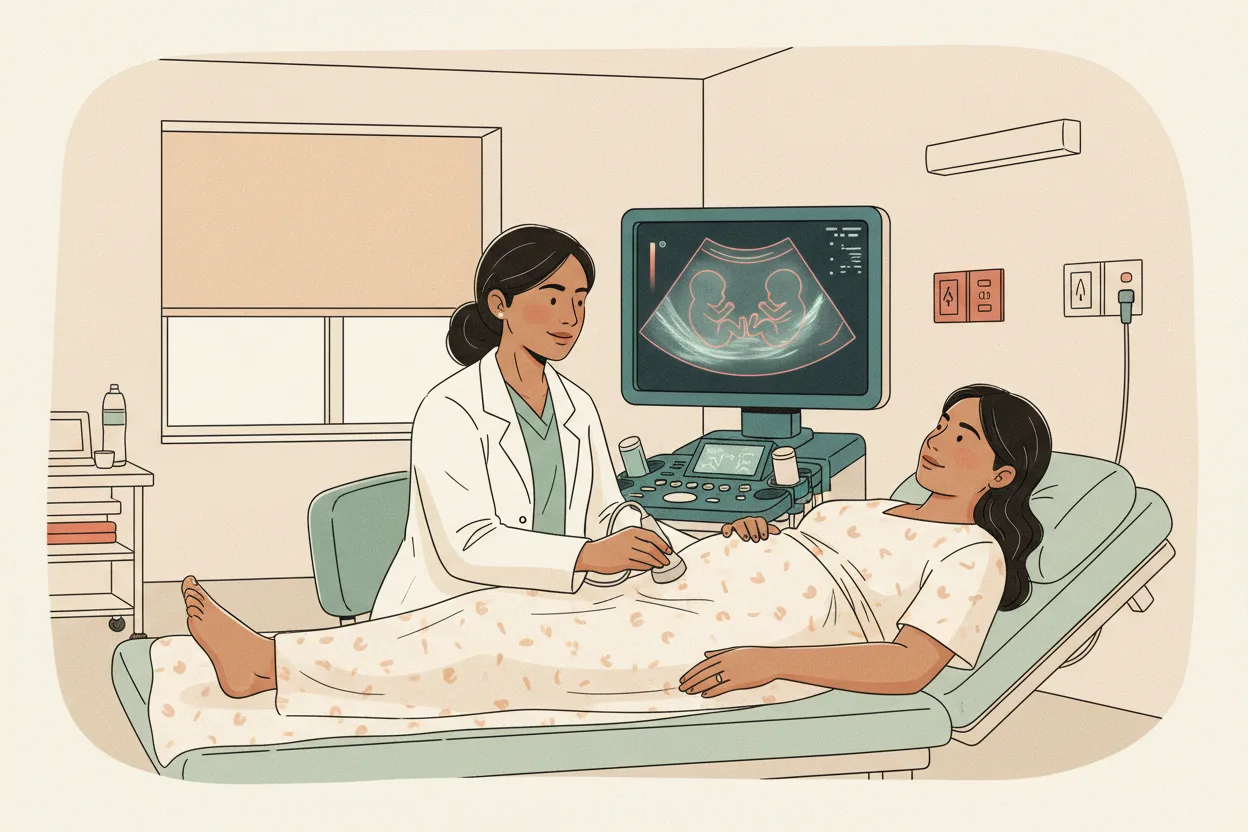
For a twin pregnancy, the answer isn't a flat yes or no — it depends on chorionicity (whether your twins share one placenta or two). If your twins are dichorionic (two placentas), a good hospital sonographer experienced with twins can usually do the anomaly scan. If they're monochorionic (one shared placenta), the Royal College of Obstetricians and Gynaecologists' patient guidance notes that referral to a fetal medicine unit "may be recommended" for at least part of your scanning.
Not medical advice — consult your obstetrician or fetal medicine specialist for guidance specific to your pregnancy.
Why Twin Scans Are a Different Conversation in India
In a singleton pregnancy, most urban Indian maternity hospitals handle the anomaly scan routinely, in-house, without a second thought. Twins change that calculus for two reasons.
First, a 2025 study in Archives of Gynecology and Obstetrics found that "the prevalence of malformations at 4.1% was considerably higher than in singletons" — meaning structural anomalies show up in roughly 4 out of every 100 twin fetuses on detailed ultrasound, which is why twins warrant a more careful anatomical review across trimesters than a single baby would.
Second, chorionicity has to be nailed down early, because it determines your entire monitoring plan for the rest of the pregnancy. ISUOG's updated practice guidelines on twin pregnancy state that "chorionicity should be determined prior to 13+6 weeks of gestation based on as many ultrasound characteristics as possible, including the entire intertwin septum... membrane thickness and number of placental masses." If this wasn't clearly documented at your dating scan, ask your obstetrician to confirm it before the anomaly scan — it decides who should be doing your later scans, and a fetal medicine referral pathway exists at major Indian centres but isn't automatic everywhere.
Dichorionic vs Monochorionic: Why It Changes Who Should Scan You
| Dichorionic (two placentas) | Monochorionic (one shared placenta) | |
|---|---|---|
| Anomaly scan | Regular hospital sonographer experienced with twins is usually adequate | Fetal medicine specialist recommended for at least the detailed anatomy portion |
| Extra monitoring | Standard antenatal schedule, adjusted for twins | Additional dedicated scans for twin-to-twin transfusion syndrome |
| Congenital heart risk | Baseline twin risk | Notably higher — expert cardiac views recommended |
| Referral pattern | Can often stay with your maternity hospital throughout | May be referred to a specialised unit, sometimes a different hospital |
The Royal College of Obstetricians and Gynaecologists' patient guidance states that "sometimes referral to a specialised fetal medicine unit, which may be in a different hospital, may be recommended" — this is specifically flagged for monochorionic twins, not twins generally. If your obstetrician mentions a referral like this, it isn't a sign something is wrong; it's the same pathway RCOG describes for monochorionic pregnancies as a matter of routine best practice.
What a Fetal Medicine Specialist Adds for Monochorionic Twins
The clearest reason to seek a fetal medicine specialist for monochorionic twins is the heart. A systematic review and meta-analysis in the Journal of Clinical Medicine found that "MC twins were 6.3 times more likely to be born with a CHD (59.3 per 1000 liveborn twins; relative risk (RR) 6.3; 95% confidence interval (CI): 4.4-9.1)" compared with the general population — meaning monochorionic twins carry a several-fold higher risk of congenital heart defects, which is exactly the kind of anomaly a detailed fetal echocardiogram by a trained specialist is built to catch.
Monitoring doesn't stop at one scan either. NICE's twin and triplet pregnancy guideline states to "offer diagnostic monitoring for feto-fetal transfusion syndrome to women with a monochorionic twin or triplet pregnancy. Monitor with ultrasound every 14 days from 16 weeks until birth." In practice, this means monochorionic twin pregnancies need dedicated ultrasound checks every two weeks from 16 weeks until delivery — a cadence a general obstetric ultrasound slot isn't usually set up to sustain, which is part of why a fetal medicine unit's specific twin-monitoring pathway matters here.
There's also a nuance around the very first scan of your pregnancy. A study on nuchal translucency in twin pregnancies found that "in MC twins with INT, significantly more twin-specific complications and structural anomalies were noted, and no significant difference was noted for chromosomal abnormalities." In plain terms: if your first-trimester scan flagged increased nuchal translucency in a monochorionic pregnancy, it's more likely pointing toward a structural or twin-specific issue than a chromosomal one — unlike in dichorionic twins or singleton pregnancies, where increased nuchal translucency tracks chromosomal risk the way it usually does. That distinction is exactly the kind of read a fetal medicine specialist is trained to make, and it's worth raising directly if this applies to you.
What's Actually Being Checked at the Anomaly Scan
The NHS states the routine anomaly scan "is usually done when you're between 18 and 21 weeks pregnant." For twins, expect the appointment to run longer than a singleton scan — the sonographer is doing a full anatomical survey of two babies, not one, checking the brain, spine, heart, abdomen, kidneys, and limbs of each twin individually, along with growth and fluid levels around each baby.
Questions worth asking at booking, regardless of which hospital you choose:
- Has our chorionicity been clearly documented, and does that match what's written in my file?
- Is the sonographer doing this scan experienced specifically with twin anatomy scans, not just singleton ones?
- If we're monochorionic, will a dedicated fetal echocardiogram be arranged, and by whom?
- What is our follow-up monitoring schedule from here, and does it match what's expected for our chorionicity?
Finding a Fetal Medicine Specialist in an Indian City
Most metro cities — Delhi NCR, Mumbai, Bengaluru, Chennai, Hyderabad, Pune — have dedicated fetal medicine units, usually attached to a large multi-specialty or maternity hospital, or run as a standalone practice that takes referrals from other hospitals. Your obstetrician is the right first point of contact: ask directly whether they refer monochorionic twin pregnancies out for detailed anatomy scanning and cardiac assessment, and if so, where. In a smaller city without a unit nearby, ask whether a scan can be arranged during a single trip to a nearby metro — the detailed views are typically a one-time or occasional appointment, not something needed every visit.
Frequently Asked Questions
Is a fetal medicine specialist mandatory for all twin pregnancies? Not necessarily. The clearer need is for monochorionic twins — RCOG notes that referral to a specialised fetal medicine unit "may be recommended" for these pregnancies. If your twins are dichorionic and your hospital's sonographer is experienced with twins, staying with your regular maternity team is often reasonable — ask your obstetrician directly which situation applies to you.
When is chorionicity usually determined? ISUOG's guidelines state it should be determined before 13 weeks 6 days of pregnancy. If you're past this point and it isn't documented clearly in your records, raise it with your obstetrician at your next visit — it shapes every scan and monitoring decision after this one.
How often will I be scanned if my twins are monochorionic? NICE recommends ultrasound monitoring every 14 days from 16 weeks until birth for monochorionic twins, specifically to watch for twin-to-twin transfusion syndrome. Ask your care team to confirm this schedule is in place for you.
Does a higher anomaly rate in twins mean something is more likely wrong with my babies? It means twins as a group carry a modestly higher rate of structural anomalies than single pregnancies do — 4.1% versus a lower singleton rate, per the 2025 study — which is why the anomaly scan is done carefully and, for monochorionic twins, sometimes by a specialist. It is not a prediction about your specific pregnancy.
My hospital says their regular sonographer can do our twin anomaly scan — should I get a second opinion? If dichorionic, this is often fine, especially with a twin-experienced sonographer. If monochorionic, it's reasonable to ask whether a fetal echocardiogram by a specialist is also arranged, given the significantly higher congenital heart defect risk in monochorionic twins — a fair question, not second-guessing your doctor.
What if increased nuchal translucency showed up on our first scan? In monochorionic twins, research shows this more often points toward a structural or twin-specific complication rather than a chromosomal one. Raise it directly with your obstetrician or a fetal medicine specialist so it's followed up at the anomaly scan.