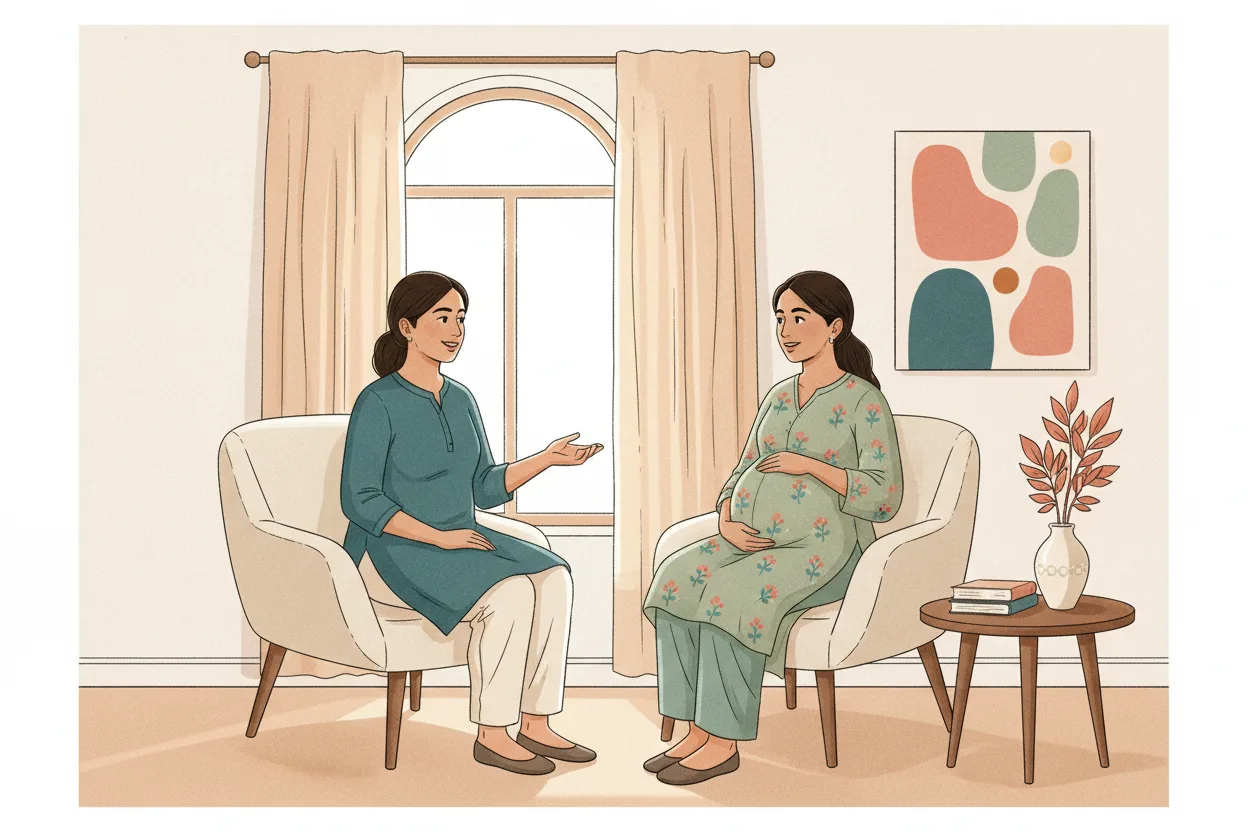
The induction is not about your baby's size. India's Ministry of Health and Family Welfare national guidelines on gestational diabetes state that pregnant women with GDM are at an increased risk for fetal death in utero, and that this risk is increased in pregnant women requiring medical management — which is to say, in women on insulin or metformin rather than diet alone. That background risk is what the plan is aimed at, and the only real lever anyone has over it is the date the baby is born.
Which is why the conversation feels so out of step with how normal everything looks. A well-grown baby and a reassuring trace are both genuinely good news. Neither is a forecast.
Not medical advice — your obstetrician knows your numbers, your blood pressure trend and your cervix. This is here to help you follow the reasoning and ask better questions, not to second-guess the plan.
Why the scan weight and the NST don't settle it
A 2024 study in the International Journal of Gynaecology and Obstetrics found that weight predictions for fetuses below the 10th and above the 90th centiles were less accurate. An estimated 2.6 kg at a 35-week scan is a comfortably grown baby — but it is an estimate with a margin around it, not a measurement, and it was never the deciding number. More on that in scan dating and the "big baby" label.
A non-stress test answers a different question again: how your baby coped during the minutes the belt was on. A reassuring trace is real reassurance about today. What it cannot do is tell anyone what the next fortnight holds.
What the guidance says — and where it disagrees
There is no single number every body agrees on, and the spread is worth seeing.
| Source | What it says about timing in gestational diabetes |
|---|---|
| SIGN 171, via the NHS Right Decision Service | Give birth no later than 40+6 weeks; consider elective birth earlier where there are maternal or fetal complications |
| NHS | Usually around weeks 38 to 40; earlier if there are concerns about you or the baby |
| MoHFW India | Routine delivery before 39 weeks not recommended with good control; earlier and individualised where control is poor or complications exist |
| Cochrane | Insufficient evidence to say whether planned birth or waiting is better |
Two things stand out. The same SIGN guideline sets a far earlier window, between 37+0 and 38+6 weeks, for pre-existing type 1 or type 2 diabetes without other complications — a clue to how clinicians think: the more a pregnancy behaves like established diabetes, the earlier the planned date tends to sit. And every source leaves room to go earlier than its own default. India's national guidelines put it directly: routine delivery prior to 39 weeks is not recommended where sugars are well controlled, while poor control, a hypertensive disorder of pregnancy or other complications are reasons to deliver earlier, with the timing individualised by the obstetrician.
So 37 to 38 weeks sits at the early edge of the published range, and what usually moves a plan to that edge is not the scan weight — it is a complication factor. A daily insulin requirement, a blood pressure that keeps moving and recent threatened preterm labour are all the sort of thing that counts, which is what the wording about maternal or fetal complications is for. Which factor applies in your case is the single most useful thing to ask.
What the evidence behind an early date looks like
The honest answer is an unsatisfying one. A Cochrane review of planned birth at or near term for pregnant women with gestational diabetes concluded that there is insufficient evidence to clearly identify if there are differences in health outcomes for women with gestational diabetes, and that most of the evidence was of very low quality — one small trial is close to all there is. Which is exactly why guidance differs between countries.
The larger observational work points one way. A 2020 population-based study in Acta Obstetricia et Gynecologica Scandinavica concluded that delivery at 38, 39 or 40 weeks' gestation may optimize neonatal outcomes among women with diabetes — while in the same data, planned delivery at 36 and 37 weeks went with more newborn problems rather than fewer. If your team is weighing 37 against 38, that is a fair distinction to raise.
Will the baby end up in the NICU?
Less likely than you are imagining, and the week matters more than the diagnosis. A 2014 study in the American Journal of Obstetrics and Gynecology reported that NICU admission rates were higher for deliveries at 37 compared to 39 weeks — 9.4% against 5.0% overall — and found no significant differences in neonatal respiratory morbidity for deliveries at 38 compared to 39 weeks. A baby born at 38 weeks looks much like a baby born at 39; 37 weeks is the step that carries a measurable difference.
The commoner newborn issue for your baby is low blood sugar, not intensive care. A 2014 paper in the Journal of Medicine and Life notes that infants of diabetic mothers represent the group with the highest risk of developing symptomatic hypoglycemia in the immediate hours after birth. The mechanism is simple: your baby's own insulin output has been running high to match your glucose, and once the cord is cut, your glucose stops arriving while that insulin takes a while to settle.
Which is why the heel-prick checks happen, and why they are not a bad sign. The Indian Academy of Pediatrics' 2022 Standard Treatment Guidelines on neonatal hypoglycemia state that testing is warranted only for at-risk neonates and is not needed for healthy term newborns — your baby is in that group by definition, so testing is protocol, not a verdict. The same guidance puts skin-to-skin care, warmth and breastfeeding within the first hour at the top of the list for every baby at this gestation. The NHS sets out the ward routine: your own blood sugar monitored and kept under control through labour, your baby's tested starting 2 to 4 hours after birth, and feeding as soon as possible and then regularly to keep levels stable. Where a level does run low, the usual fix is a short spell of feeding through a tube or a drip.
Blood pressure, and why it can move the date
Blood pressure genuinely is one of the things that can change timing, which is why a reading that keeps moving late in pregnancy gets watched rather than shrugged off. A 2022 review in Frontiers in Cardiovascular Medicine reports that most studies concluded that GDM is independently associated with PE in singleton pregnancy — the reason your pressure and a urine dipstick are checked at every visit now. Your own numbers are for your obstetrician to read, with the trend across visits in front of her.
Contact your maternity unit straight away, rather than waiting for the next appointment, if any of these appear. The NHS lists, among symptoms of pre-eclampsia that need urgent medical help, a severe headache that does not go away with simple painkillers, vision problems such as blurred vision or seeing flashing lights, pain below the ribs, sudden swelling of the face, hands or feet, and feeling very unwell.
On your baby's movements the NHS advises that if your baby is moving less than usual, if you cannot feel movement any more, or if the usual pattern has changed, you call immediately and do not wait until the next day — even in the middle of the night.
With threatened preterm labour already behind you this fortnight, the tightening-and-pressure side of that list matters more than usual. We set it out in full in late-pregnancy pelvic pain, engagement and when to call.
Questions for your next visit
Take these in writing. A specific question gets a specific answer.
- What exactly, in my case, is putting the date at 37 to 38 weeks rather than 39 or 40?
- What share of my fasting and post-meal readings have been inside the target range you set for me, and does that change the plan?
- Has there been any protein in my urine, and what has my blood pressure trend looked like across the last three visits?
- Is the date movable — if my sugars and pressure hold steady, could we review it at 38 weeks instead?
- If I go into labour on my own first, does anything about the plan change?
- How ripe is my cervix, which method of induction are you planning, and how long will my baby's sugars be checked afterwards?
Also worth reading beforehand: what happens if an induction does not progress, and what induced contractions actually feel like.
The positive stories you asked for
We can't hand you anecdotes, and inventing them would be worse than useless. What we can give you is the shape of the thing: a planned induction at 37 to 38 weeks for insulin-treated gestational diabetes is a common, scheduled, well-trodden route rather than an emergency, and in the single trial the Cochrane reviewers found no clear differences between induction and expectant management in caesarean or instrumental birth, and no maternal or perinatal deaths in either group. The one thing more common after induction there was newborn jaundice — phototherapy, perhaps a slightly longer stay. And this is not rare ground: a 2024 systematic review and meta-analysis in BMC Public Health estimated that the pooled prevalence of GDM in pregnant women in India was 13%.
The family conversation. Expect opinions — that the baby is being taken out too early, or that another date would be more auspicious. Both come from affection. The efficient move is to bring one parent or in-law to the next appointment, so they hear the reasoning from your obstetrician directly; it settles the argument faster than anything said at home. And if a date matters to your family, say so out loud at that visit — an elective induction has a window, and where the clinical picture allows, a day either side is sometimes a conversation your doctor can have.
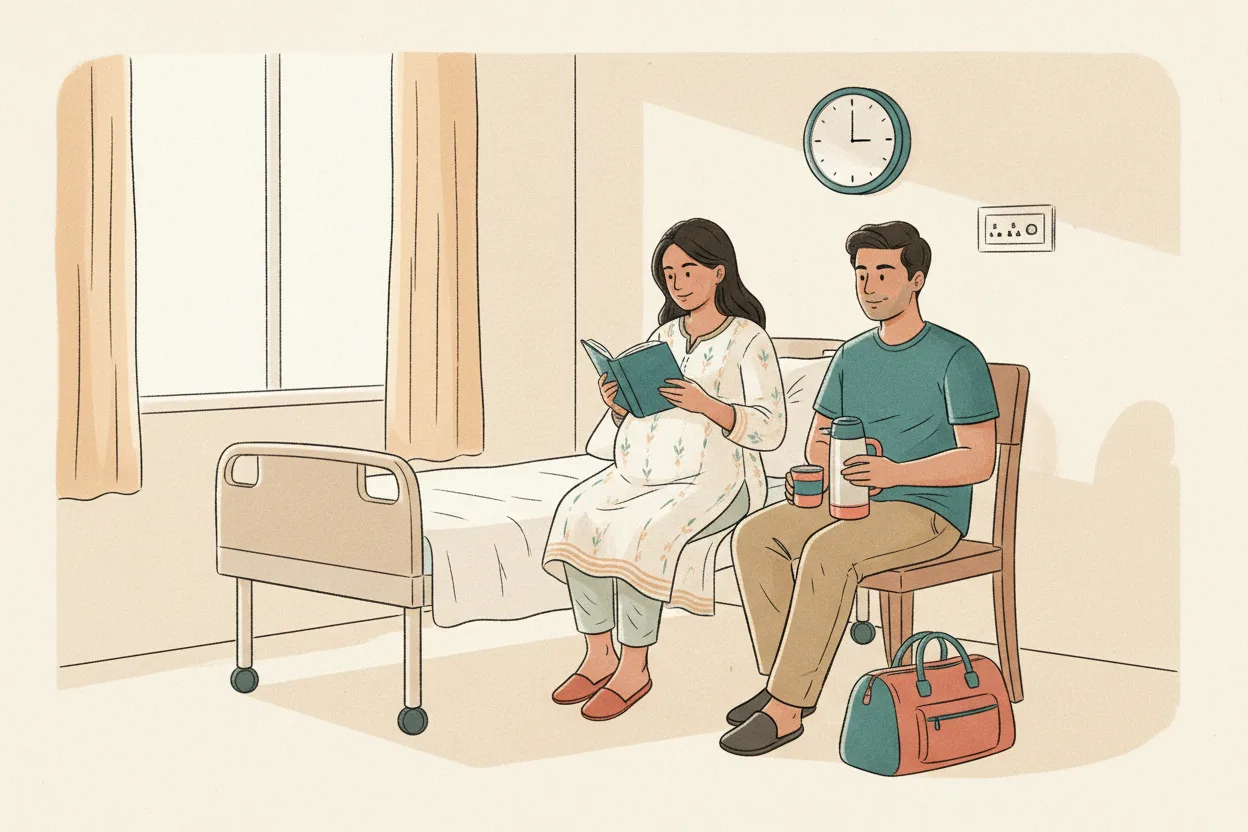
For your partner. The fortnight has a list with your name on it: the hospital bag packed tonight rather than on the day, insurance pre-authorisation cleared with the hospital's TPA desk, a plan for the drive if labour starts first, and being the one in the room writing down what the obstetrician actually said.
One last signpost: if sugars are out of range and the baby's growth percentile is falling scan after scan, the reasoning for an early date is a different one, covered in declining growth percentile with gestational diabetes. This piece is about the happier picture — a well-grown baby and reassuring testing.
After the birth
Gestational diabetes usually goes after delivery, but it leaves a flag worth acting on. The NHS recommends that you have a blood test to check for diabetes 6 to 13 weeks after giving birth, repeated once a year if the result is normal. Put the date in your phone now, because the newborn weeks will swallow it whole.
Not medical advice — consult your obstetrician and your pediatrician about your own pregnancy and your baby.