

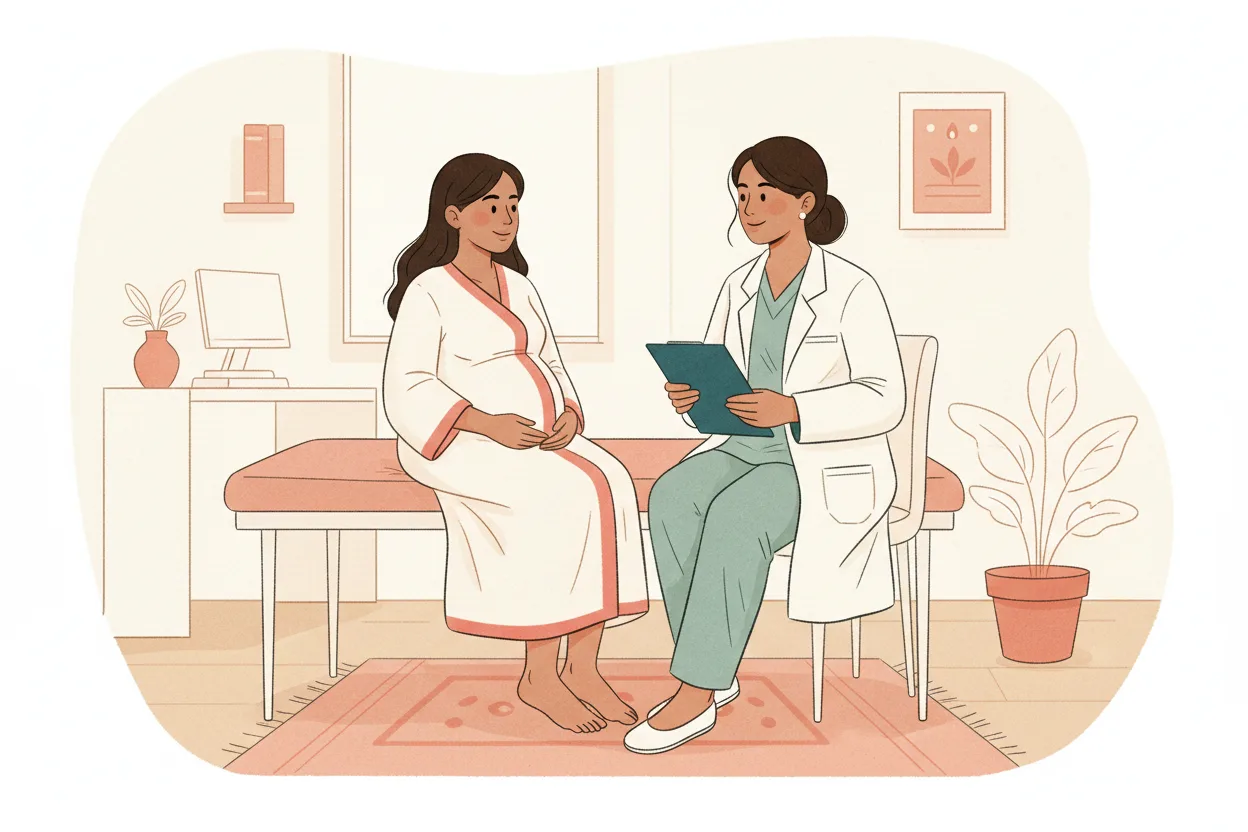
You can ask your doctor to stop an exam at any point, for any reason — ACOG's patient FAQ on pelvic exams is direct about this: "Remember that you can ask to stop the exam at any time." You're also entitled to privacy, a cover sheet or gown, and — if the doctor examining you is male — a female attendant in the room with you.
Not medical advice — for specific concerns about a visit, raise them directly with your obstetrician or the clinic's patient relations desk.
Why This Comes Up at Indian Clinics
A parent recently described a routine prenatal exam where the clinic skipped the cover sheet entirely, and she felt too caught off guard to ask for one in the moment. That feeling — not wanting to seem difficult, or not knowing what's actually reasonable to ask for — is common, and it's worth separating from what you're actually entitled to.
Busy government and private OPDs alike can move fast, with residents, nurses, and attendants moving in and out of the room. That pace is a scheduling reality, not a reason to skip privacy or your say in the exam. The two things — an efficient clinic and a dignified exam — aren't in conflict, and knowing what to ask for makes it easy to get both.
What You Can Expect in the Exam Room
Privacy and a drape, not exposure. New York State's Department of Health patient guidance on pelvic exams describes what a proper exam looks like: "You will be given privacy in the exam room and asked to undress and change into a clean gown — or you will be given paper covers or drapes." If a gown, paper cover, or drape isn't offered, you can simply ask for one before the exam starts.
A chaperone if your doctor is male. India's Charter of Patients' Rights, adopted by the National Human Rights Commission and circulated by the Ministry of Health and Family Welfare, states that "Female patients have the right to presence of another female person during physical examination by a male practitioner. It is the duty of the hospital management to ensure presence of such female attendants in case of female patients." This isn't a favor the clinic is doing you — it's a stated responsibility of the hospital, and you can ask for it by name ("I'd like a female attendant present, please") without needing to justify the request further.
The right to say stop, even mid-exam. ACOG's committee opinion on informed consent and shared decision-making states that "an adult patient with decision-making capacity has the right to refuse treatment, including during pregnancy, labor, and delivery." That right doesn't disappear once you've said yes to an exam. If something feels wrong partway through — pain, discomfort, or simply wanting a moment — you can ask to pause or stop, and start again when you're ready, or not at all.
Speaking Up Without It Turning Into a Confrontation
None of this requires a difficult conversation. A few short, specific lines get you what you need without turning the visit into a standoff:
| Situation | What to say |
|---|---|
| No cover sheet was offered | "Could I get a gown or a cover before we start, please?" |
| Doctor examining you is male, no attendant present | "I'd like a female attendant in the room, please." |
| Exam feels uncomfortable or rushed | "Can we pause for a moment?" or "I'd like to stop here." |
| You want to understand a step before it happens | "What are you about to do, and why?" |
If a clinic pushes back on a straightforward request like these, that's useful information — most good obstetric practices in Indian cities are used to patients asking, and a doctor or nurse brushing off a request for privacy or a chaperone is worth naming to the hospital's patient relations desk or bringing up directly with your ob-gyn at the next visit. Bringing your partner or a family member into the room for the consultation portion (before any physical exam) is also a normal, reasonable ask at most clinics.
If raising it at the desk doesn't go anywhere, you don't have to just let it drop. India's Charter of Patients' Rights and Responsibilities states that "every Hospital shall have/establish a time bound Grievance redressal mechanism to address the grievances of the patients," with a named Grievance Redressal Officer whose contact details are supposed to be displayed on-site, and that unresolved complaints can go to "the district registering authority." Asking the front desk "Who is your Grievance Redressal Officer?" is a legitimate, specific next step if a privacy or consent concern is brushed aside more than once.
What Good Antenatal Care Looks Like Overall
Dignity in the exam room is one part of a bigger standard. WHO's Antenatal Care for a Positive Pregnancy Experience guideline states that the goal is to "provide pregnant women with respectful, individualized, person-centred care at every contact, with implementation of effective clinical practices." That's the bar for every visit, not just the physical exam — how your questions are answered, how much time you get, and how test results are explained.
WHO's 2016 antenatal care guideline recommends "antenatal care models with a minimum of eight contacts... to reduce perinatal mortality and improve women's experience of care" across a pregnancy, starting in the first trimester. Each of those visits should include a genuine check-in, not just a quick weigh-and-go.
Blood pressure checks are one concrete example worth watching for at every single visit. ACOG's patient FAQ on preeclampsia states that "your obstetrician–gynecologist (ob-gyn) should check your blood pressure at each prenatal care visit" — it's one of the simplest ways clinicians catch pre-eclampsia early. If a visit is moving so fast that even this gets skipped, it's fair to ask for it before you leave.
Frequently Asked Questions
Is it rude to ask for a cover sheet or gown? No. Patient guidance from New York State's Department of Health treats privacy and a gown or drape as the standard for a pelvic exam, not an extra courtesy. Asking is a completely normal request, not a complaint.
Can I say no partway through an exam if I've already agreed to it? Yes. ACOG is explicit that an adult patient's right to refuse a part of her care holds "even after initially agreeing to it," including during pregnancy. Consent can be withdrawn at any point.
What if my regular ob-gyn is male — do I still get to ask for someone else in the room? Yes. The Charter of Patients' Rights puts the responsibility on the hospital to make sure a female attendant is present for a female patient examined by a male practitioner. You don't need a special reason to ask.
How many antenatal visits should I actually be getting? WHO recommends at least eight contacts across a pregnancy, beginning in the first trimester. If your clinic's schedule looks much thinner than that, it's worth asking your ob-gyn to walk you through the plan for the rest of your pregnancy.
My doctor seemed irritated when I asked to pause. Was I wrong to ask? No. Every patient keeps the right to pause or stop an exam, regardless of how the request is received in the moment. A single tense reaction from one visit doesn't change what you're entitled to ask for at the next one — and if it happens repeatedly with the same provider, that's worth factoring into whether they're the right fit for your care.