

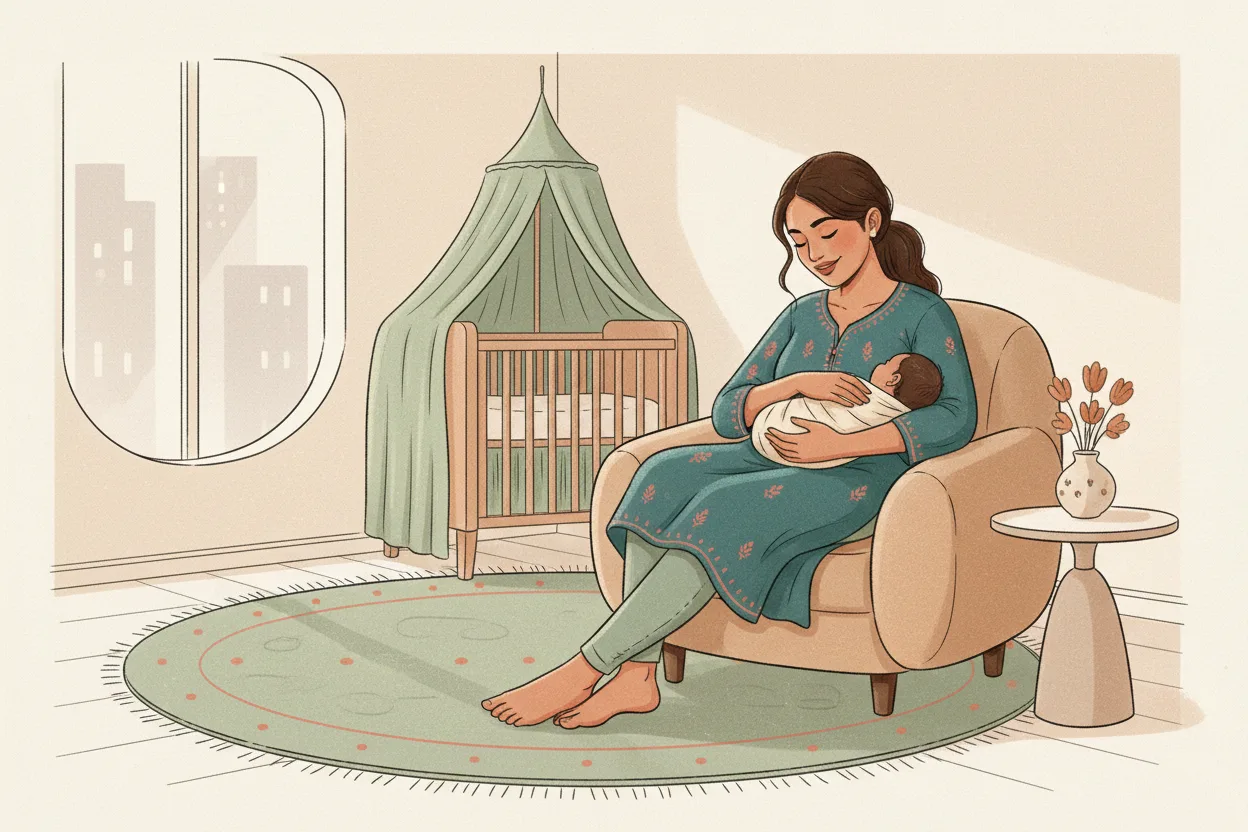
If your baby nurse can settle your newborn faster than you can right now, that is not proof you are being replaced. The American Academy of Pediatrics (AAP) explains that babies naturally bond with their parents, but they can also develop close attachments with other people who regularly, lovingly care for them and make them feel safe — that is a sign your nurse is doing her job well, not a sign your bond is weaker. A peer-reviewed review on prenatal auditory learning also found that soon after birth, infants show a strong preference for their mother's voice over the voice of another woman — that preference was built over months in the womb, and no amount of expert night-settling by someone else erases it.
Not medical advice — consult your pediatrician or a mental health professional if this is weighing on you.
Why This Cuts So Deep in an Indian Household
Live-in baby nurses ("baby ayahs" or maternity nurses) are common in urban Indian homes in the first weeks after delivery, especially after a C-section or a difficult birth, when a mother is still recovering physically. That arrangement is genuinely useful — but it also puts an experienced, confident caregiver in the room with you around the clock, at the exact moment you are least confident yourself: sleep-deprived, sore, and still learning your own baby's cues. When she gets a cry to stop in thirty seconds and it takes you five minutes, it is easy to read that gap as a verdict on you as a mother, instead of what it actually is — one person with more practice at this particular skill, this particular week.
What's Actually Happening, Biologically
Your baby is not choosing sides. The AAP is clear that a baby can be closely bonded to a regular, loving caregiver without that competing with their bond to you — attachment isn't a fixed pie where one relationship shrinks so another can grow. And biologically, your baby already knows your voice specifically: the same review found that newborns prefer their mother's voice within hours or days of birth, a preference that starts forming from sounds heard in the womb, long before your nurse ever entered the picture. What looks like "the baby prefers her" in the moment is usually just that a settled routine, done the same way each time, soothes a newborn faster than a routine that is still being built.
Reconnect Through Feeds, Not Competition
The fastest way to rebuild your own rhythm with your baby is to reclaim feeding time as yours, not a task to hand off. NHS guidance states that in the first few weeks, your baby should feed at least 8 times every 24 hours to protect your milk supply — ask your nurse to bring the baby to you for every feed, day and night, rather than settling them by other means first. Add skin-to-skin time before or after feeds where you can: a peer-reviewed study found that skin-to-skin contact raises oxytocin levels in both mother and infant, which helps reduce stress and is linked to lower cortisol for both of you. If feeding still feels hard or painful right now, that is ordinary, not a failure — KellyMom, a widely cited IBCLC-run resource, notes that the truth is everyone struggles in the early days, just in different ways, and it gets easier with practice.
Reset the Dynamic With Your Nurse
You can keep the help and still change the shape of it. A few boundaries that work well in Indian homes:
- Ask her to bring, not settle, in the first instance. Any cry in the first minute goes to you first; she steps in only if you ask.
- Give her a defined lane — night watch while you sleep in blocks, laundry, sterilizing bottles and pump parts, cooking — so her role is support, not parenting-by-default.
- Say it plainly once: "I want to learn to settle her myself, so please pass her to me before you try." Most experienced nurses have heard this before and respect it; it isn't rude, it's normal.
- Carve out baby-only time daily — a bath, a walk, a few songs — where she isn't in the room at all.
None of this is about distrust. It's about making sure the person building fluency with your baby, this week, is you.
Get Your Partner Back Into the Rotation
A baby nurse often ends up filling a gap that your partner could be filling instead, especially at night. The AAP notes that children with involved fathers develop better language skills and enjoy better overall mental health than children whose fathers are less involved — so splitting night feeds, baths, and settling with your partner isn't just fairer to you, it's genuinely good for the baby too. It also protects your own sleep, which matters more than it might feel right now: a critical review of sleep and perinatal mood found that symptoms of insomnia carry a significant risk for new-onset depression and anxiety in this period. Trading one broken night off with your partner, with the nurse on standby rather than as the default, protects both of you.
When It's More Than Feeling Replaced
Feeling low, weepy, or on edge in the first two weeks is extremely common and usually passes on its own. A clinical review in NCBI's StatPearls states that approximately 50% to 75% of new mothers experience the "baby blues," which are temporary and need no treatment. But if what you're feeling is not easing, or you feel sad, hopeless, or anxious for more than two weeks — or the sense of being disconnected from your baby doesn't lift even as you spend more time with them — the U.S. Office on Women's Health advises that this may be postpartum depression, and it's worth talking to your doctor. Feeling replaced by a nurse is common and usually resolves as your own confidence grows; feeling numb, hopeless, or unable to bond no matter what you try is a different, medical thing, and deserves the same prompt attention you'd give any other postpartum symptom.
Frequently Asked Questions
Is it common to feel jealous of my baby nurse? Many new mothers using live-in help describe exactly this feeling. It doesn't mean you love your baby less or that something is wrong with your bond.
Will my baby forget me if the nurse does most of the settling for a few weeks? No. Babies form a lasting bond with their parents that isn't displaced by a caregiver, and newborns already recognize and prefer their mother's voice from the earliest days.
Should I just let the nurse go if this is how I feel? Not necessarily — many mothers find the practical help essential for recovery, especially after a C-section. Try resetting boundaries first (see above); if the feeling doesn't ease once you're doing more of the hands-on care yourself, that's a fair time to reconsider the arrangement.
How long until I feel as confident as my nurse at settling my baby? There's no fixed timeline, but confidence builds fast once you're doing the feeds and settling yourself consistently — most parents feel noticeably more capable within a couple of weeks of hands-on practice.
What if my mother-in-law says the nurse is "better" with the baby? That comment reflects the nurse's experience, not your capability. Politely redirect: you're building that same experience now, on purpose, and that takes doing it yourself.
When should I actually worry about how I'm feeling? If sadness, anxiety, or a sense of disconnection from your baby lasts more than two weeks, or feels severe at any point, contact your doctor rather than waiting it out.