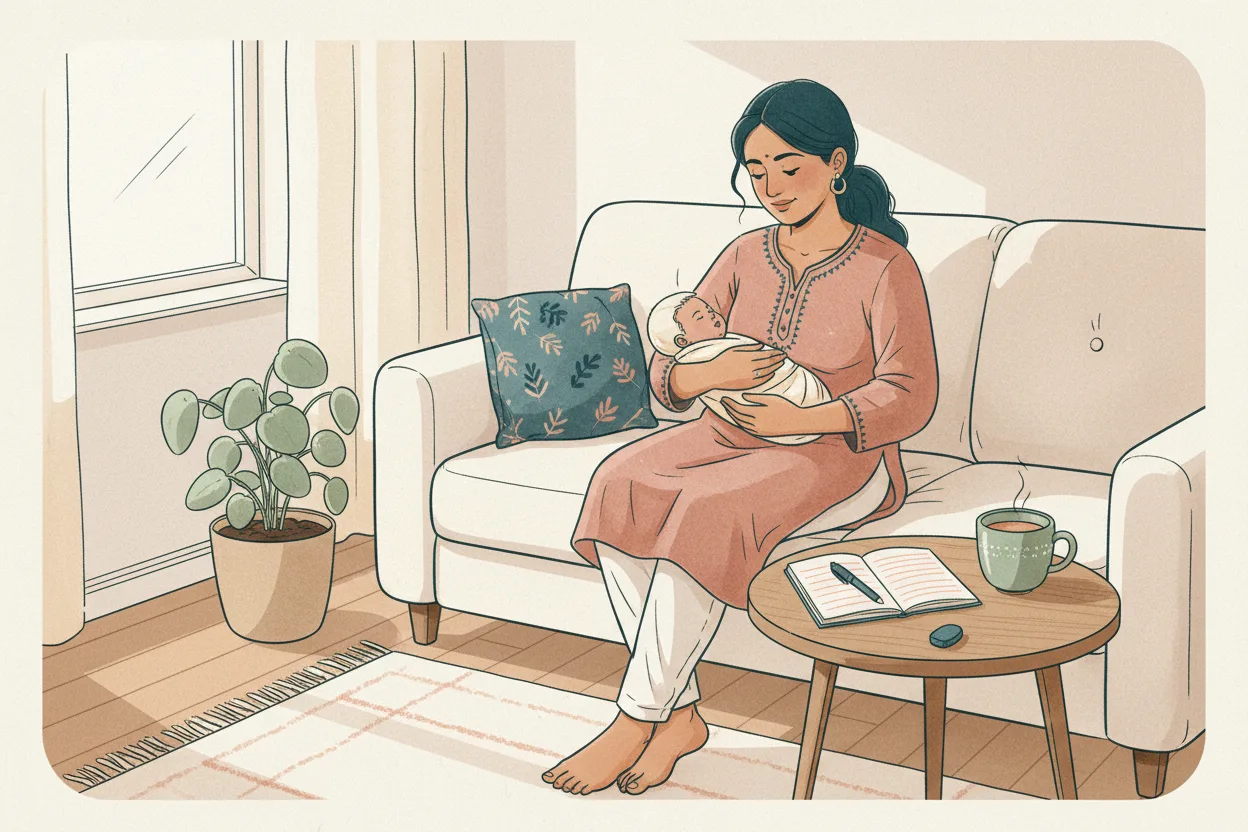

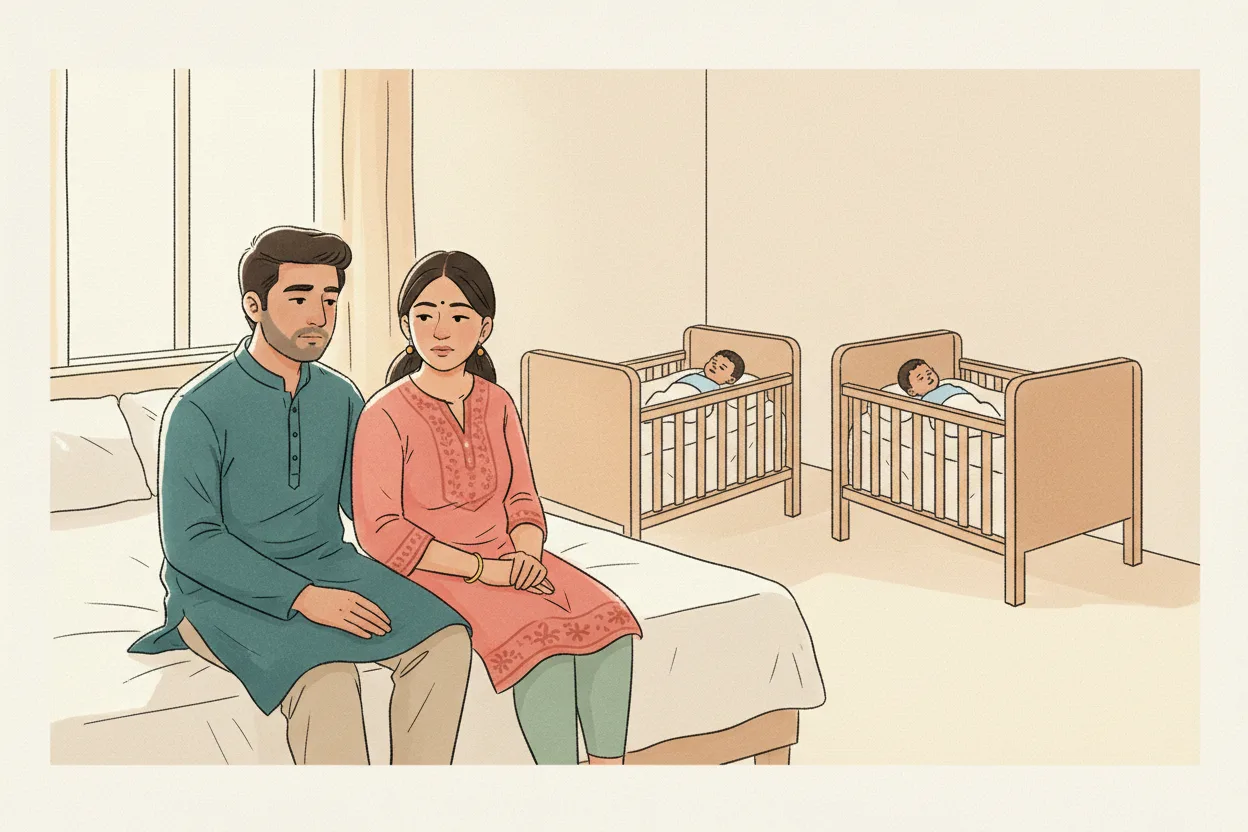
Three months in with twins, no sexual feeling left, and the only five minutes the two of you get alone spent deciding which of you takes which baby tonight. What has gone quiet is physiology and circumstance. It is not your attraction to each other, and saying it that way round is the first useful thing anyone can hand you.
The second useful thing is that you have already identified the right problem. You said you miss the emotional connection more than the physical one — being loved, being pampered, being talked to about something other than feeds. That is the part to work on first, and it is the part that moves fastest.
Not medical advice — talk to your gynaecologist about anything here that sounds like you.
What Is Switching Desire Off Right Now
It helps to see how ordinary this is. The MAMMI cohort study of 832 first-time mothers, published in BMC Pregnancy and Childbirth, found that "nearly half of the women (46.3%) reported a lack of interest in sexual activity, 43% experienced a lack of vaginal lubrication and 37.5% of included women had dyspareunia 6 months after birth" — and breastfeeding was one of the factors associated with all three. Note which one is commonest: not pain, but interest simply being gone.
If you are feeding two babies, your body is running a hormonal programme that pulls in the opposite direction from desire. A 2026 mechanistic review in Sexual Medicine Reviews explains that prolactin "remains elevated throughout breastfeeding through inhibition of hypothalamic GnRH pulsatility, sustaining functional hypoestrogenism." In plain language: feeding keeps prolactin high, high prolactin keeps oestrogen low, and low oestrogen is not a mood — it is a tissue state.
You feel it in two places. The NHS says that "hormonal changes after birth can make your vagina feel drier than usual," and suggests a personal lubricant from any pharmacy to begin with. Dryness is also why sex can hurt — and the timing is not random. A 2025 systematic review of 65 studies in Obstetrics & Gynecology, the journal of the American College of Obstetricians and Gynecologists, pooled pain on sex at "60.0%" at three months postpartum, falling to "39.7%" at six and "28.5%" at twelve. Three months is the top of that curve. You are standing at its worst point.
Add the rest of the load. ACOG's Committee Opinion on optimizing postpartum care puts "sleep and fatigue" and "physical recovery from birth" in the same postpartum assessment as "sexuality" — these are listed as clinical domains, not as excuses you are making. The NHS notes that caring for a baby "can be really tiring, especially in the first few months," when a child wakes several times a night; with two of them on different schedules, nobody in your house has had a whole night's sleep since the babies came home.
So: hormones, healing, broken sleep, and a brain running a two-baby operations desk. That is a physiological and logistical account of a quiet libido. It is not a verdict on how you feel about your husband.
The Disconnection Is the Part to Treat First
The NHS is direct about this: "Having a baby often puts a strain on relationships, regardless of what they were like before." Regardless is the word doing the work. A good marriage does not exempt you.
It is measured, too. A 2022 meta-analysis of 49 studies in Frontiers in Psychology found that "marital satisfaction has a medium decrease between pregnancy and 12 months postpartum," while over a comparable stretch of marriage, couples without a baby showed only a small decline. The dip you are inside is the normal shape of this year for most couples — not a crack that opened up in yours.
Which means the separate rooms deserve less weight than you are giving them. Two babies waking at different times, two adults, two rooms, one baby each: that is a staffing decision for a season, a shift roster rather than an estrangement. It is also the arrangement letting each of you get a few unbroken hours — and plenty of couples quietly reverse it later, without ceremony.
The thing actually worth changing is the five minutes. At the moment they are the only slot in the day when two adults are alone and able to make decisions, so logistics flood them — that is not a failure of will, it is a scheduling accident. A full house does not fix it, either: more adults around means more hands, and also more to coordinate.
Two moves, both small. First, protect one exchange a day that contains no child in it — a question with no operational content, a message in the afternoon, two minutes on the balcony. Second, uncouple closeness from sex entirely for now. The NHS suggests exactly this: until you want sex, "both of you can carry on being loving and close in other ways." Being held while you cry counts. So does being brought tea without asking.
And say the quiet part to him. The NHS advice is to "make time for each other when you can" and to "tell each other what you want and what's bothering you if you're resentful, angry or upset." He is not avoiding you. He is, almost certainly, not reading your mind either. "I miss being loved by you" is a sentence, and it is allowed out loud. If the frustration is mostly about the division of the invisible work, that is a separate conversation with its own shape.
Does It Get Better?
The honest answer comes in two halves.
The physical half has numbers behind it and they move in your favour: pain on sex drops from about three in five women at three months to under three in ten by a year, in that systematic review's pooled data. And the hormonal driver is temporary by design — the Sexual Medicine Reviews team describes the postpartum tissue changes as "acute and potentially fully reversible with hormonal recovery after weaning."
The emotional half is the half you have to steer. In that meta-analysis, couple satisfaction did not snap back on its own inside the first year. The reliable promise is a narrower one, and the NHS makes it: "the stage when babies and children take up all your physical and emotional energy does not last forever." Twelve-month-olds do not need a parent each at 3am. That part ends.
Two Things Worth a Doctor's Time
Pain on sex is not something to push through. The NHS is unambiguous: "If penetration hurts, say so. If you pretend that everything's all right when it isn't, you may start to see sex as a nuisance or unpleasant, rather than a pleasure." Lubricant first; pain that persists deserves a proper review, and if it turns out to be muscular, pelvic floor physiotherapy is an established route in India.
The anger and frustration are worth a screening conversation. MedlinePlus, from the US National Library of Medicine, lists "feeling unusually angry" and "pulling away from family and friends" among the symptoms of postpartum depression, and says plainly: "if you think you have postpartum depression, talk with your provider." With twins the base rate is higher — a Danish register study of 27,095 twin births found that "twin mothers had increased risk of PPD compared to singleton mothers, which was driven by an immediate increase after childbirth." If that rings true, start with what postpartum mood looks like past the first few weeks, then how to find a perinatal mental health therapist in India.
You are not asking for too much. Missing being pampered by your husband is not a line item you gave up in the delivery room — it is a real loss, it is grievable, and it is the one on this list you can start repairing this week.