
A hard ridge under your incision, an itch that won't quit, or a dull ache weeks after your gynaecologist called your C-section scar "healed" is often just your body still at work. Your skin closed weeks ago, but the tissue underneath keeps rebuilding itself for months — and this guide walks through what to expect, and the handful of specific signs that mean it's time to get it checked.
Not medical advice — consult your gynaecologist or doctor for guidance specific to your recovery.
Why the Two-Week Checkup Isn't the Finish Line
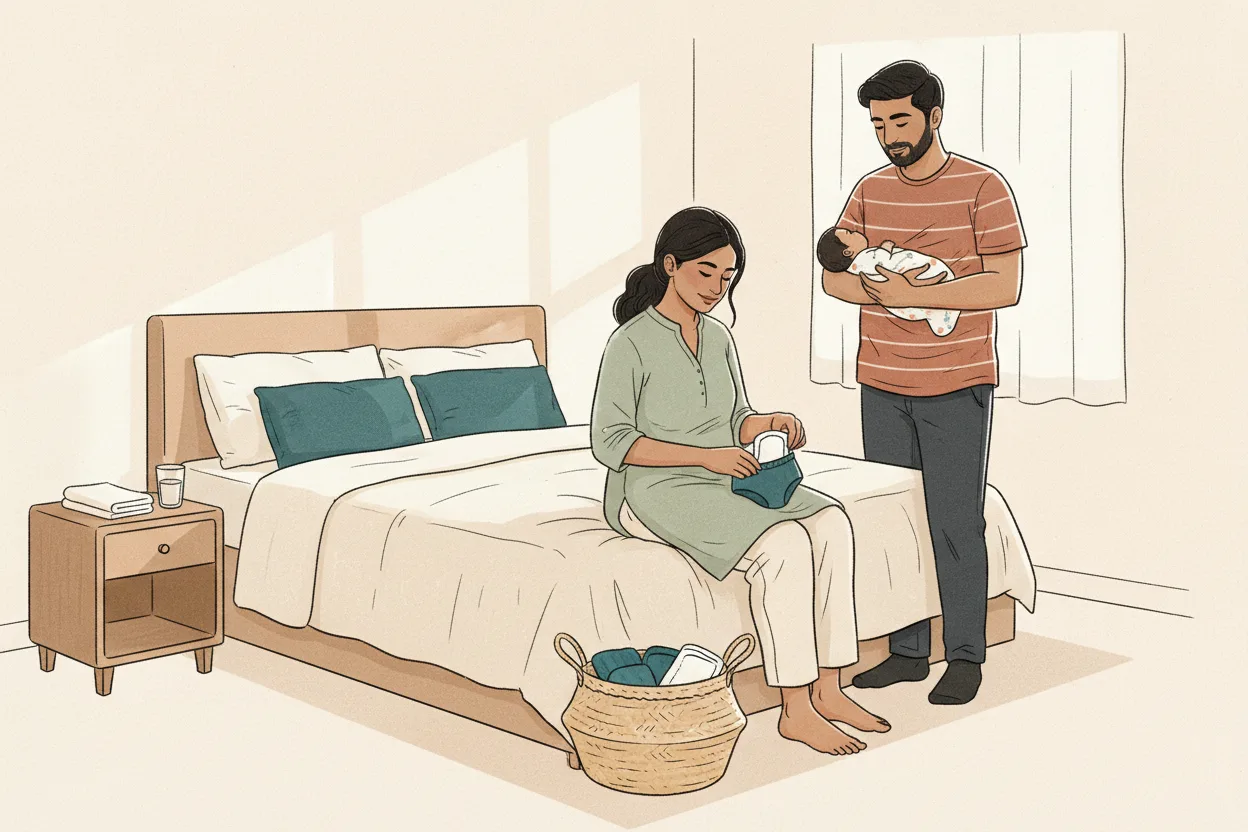
In India, many mothers see their gynaecologist once at around two weeks post-surgery, sometimes not again until six weeks. At that visit, your doctor confirms the skin has closed cleanly and there's no obvious infection — not that every layer underneath is done healing. The deeper layers (fascia, fat, scar tissue) keep remodeling for months after that appointment, which is why a scar declared "fine" at two weeks can still itch, feel firm, or ache at week six or ten. A review on activity restrictions after gynecologic surgery in PMC states that the fascia — the deep supportive layer stitched beneath your skin — regains only about 51 to 80% of its original strength by 6 weeks, climbing to 70-80% by 17 weeks and 73-93% by 20 weeks, and never fully returns to its pre-surgery strength. That gap between "the incision looks closed" and "the tissue is finished healing" is where most of the worry comes from — it's an expected part of the timeline, not a sign your doctor missed something.
The Itch and the Ridge: Often Just Normal Healing
Itching around a healing C-section scar is often a normal part of recovery — an NCBI Bookshelf chapter on scar symptoms states that it's driven by histamine release and inflammation in the skin, and it can continue for months as the scar remodels. If your scar itches at week 8 or week 12 with no redness, swelling, or discharge alongside it, that's consistent with ordinary tissue repair, not a complication.
A firm, raised, or ropey ridge along the scar line is a separate but equally common concern. A review on keloid and hypertrophic scar management in PMC states that a wound taking longer than 10 to 14 days to fully close has a much higher chance of developing into a thickened, raised scar — what's medically called hypertrophic or keloid scarring. C-section incisions, especially after a longer labour or an infection early on, often take a little longer to close than a clean elective cut, which is one reason the ridge you feel may simply be this kind of thickened scar tissue forming rather than anything dangerous. It's a cosmetic and comfort issue to raise at your next visit, not an emergency.
When a Lump Is a Seroma, Not an Infection
Sometimes what you feel isn't ridged scar tissue at all but a soft, fluid-filled pocket near the wound. A systematic review and meta-analysis in PMC found that a seroma — a pocket of fluid that collects at the wound site — is one of the recognised wound complications after a C-section, and it's distinct from an infection. It isn't automatically dangerous, but any new lump is worth having a doctor examine in person rather than diagnosing yourself, since a seroma and an infected collection can look similar from the outside. For context on how common wound problems are in general, a systematic review and meta-analysis in PMC found that surgical site infection after a cesarean section is a recognised risk but not the typical outcome — globally, the incidence is about 5.63% — so most scars heal without this kind of complication.
Red Flags: Call Your Doctor the Same Day
A few signs are not "wait and watch." ACOG advises calling your ob-gyn right away if you develop fever or chills, leg pain, drainage or leakage from the incision, heavy bleeding, or worsening pain — these can point to an infection or a blood clot, both of which need prompt treatment. The NHS notes that increasing redness, pain, and swelling around the wound are also signs it may be infected. None of these overlap with ordinary itching or a firm ridge — they're a distinctly different picture, and they warrant a same-day call, not a wait-for-your-next-appointment approach.
| What you're feeling | Usually normal | Call your doctor same day |
|---|---|---|
| Itching, tightness | Common for months as the scar remodels | If paired with redness or discharge |
| Firm, raised ridge | Common if the wound took longer to close | If it's rapidly spreading or hot to touch |
| Soft, fluid-filled lump | Possibly a seroma — get it examined | If it's hot, red, or you also have fever |
| Fever, chills, leg pain, drainage, heavy bleeding, worsening pain | Never normal | Always — call immediately |
The Lump That Shows Up Months or Years Later
If your scar was genuinely fine for months and a new bulge or ache appears well after your six-week check, it may not be a wound-healing issue at all. A population-based cohort study in PMC found that an incisional hernia after a C-section is often not diagnosed until years afterward rather than weeks, with a median time to diagnosis of about four years, and that risk is higher for mothers who smoke, have obesity, or have had more than one prior caesarean. This is exactly why "my gynae said it was fine at two weeks" and "something feels off now" aren't contradictory — a hernia can develop long after the original wound is fully healed, and it's a different condition from the wound-healing issues above. If you notice a new bulge near the scar, especially one that's more noticeable when you cough, strain, or stand for a while, it's worth seeing a doctor for a hernia check regardless of how long ago your surgery was.
Caring for Your Scar While It Heals
Cleveland Clinic recommends avoiding lifting anything heavier than your baby for about six weeks after a C-section, protecting the deeper layers while they're still gaining strength — this includes toddlers, grocery bags, and full water cans, not just obviously heavy objects. Beyond that, keep the scar clean and dry and wear loose cotton around the waist. If you're worried about a thickened or raised scar, a 2020 review on hypertrophic scar and keloid treatment algorithms in PMC found that silicone gel sheets have evidence for helping prevent and improve this kind of scarring once a wound is newly healed, while scar massage is less well-supported and can actually worsen the scar in someone prone to hypertrophic or keloid scarring by stretching it — so ask your doctor before starting either, and let them confirm your incision is fully closed first.
Who to See in the Indian System
If your gynaecologist has cleared you but something still feels off, there's no need to wait for your next scheduled visit — call and describe the specific symptom (a new lump, spreading redness, fever) and ask to be seen sooner. For a hernia-type bulge that shows up long after delivery, a general surgeon is often the right specialist, since hernia repair falls outside routine obstetric follow-up. Most private hospitals and maternity centres in Indian cities let you book an unscheduled review with your original surgical team by phone or app.
Frequently Asked Questions
Is it normal for my C-section scar to still itch after two months? Yes. An NCBI Bookshelf chapter on scar symptoms states that itching from histamine release and inflammation can continue for months as the scar tissue remodels. It's only a concern if it comes with redness, swelling, or discharge.
Why does my scar feel like a hard ridge instead of a flat line? A review on keloid and hypertrophic scar management in PMC states that a wound taking longer than 10 to 14 days to close has a much higher chance of forming a thickened, raised scar. A longer or more complicated closure is often the reason, not a sign of poor healing.
My gynae said everything is fine at my two-week check — why does it still hurt? The skin closing is only part of healing; deeper tissue keeps remodeling for months after that appointment. If the pain is mild and gradually easing, that's expected. If it's worsening, call your doctor right away — ACOG lists worsening pain as one of the signs that need prompt attention.
How do I tell a seroma from an infection? You often can't from the outside. A systematic review and meta-analysis in PMC found that a seroma is a fluid pocket at the wound site, distinct from infection, but the NHS notes that increasing redness, pain, and swelling point to infection specifically. Any new lump needs a doctor's exam rather than a guess.
Can a hernia really show up years after my C-section? Yes. A population-based cohort study in PMC found a median time to diagnosis of about 4.1 years for incisional hernia after a caesarean, with higher risk for smoking, obesity, or more than one prior C-section. A new bulge near an old scar is worth checking even long after delivery.
When can I go back to lifting my toddler or heavier bags? Cleveland Clinic recommends avoiding anything heavier than your baby for about six weeks. Ask your doctor to confirm you're ready before resuming heavier lifting, especially if you had any wound complications.