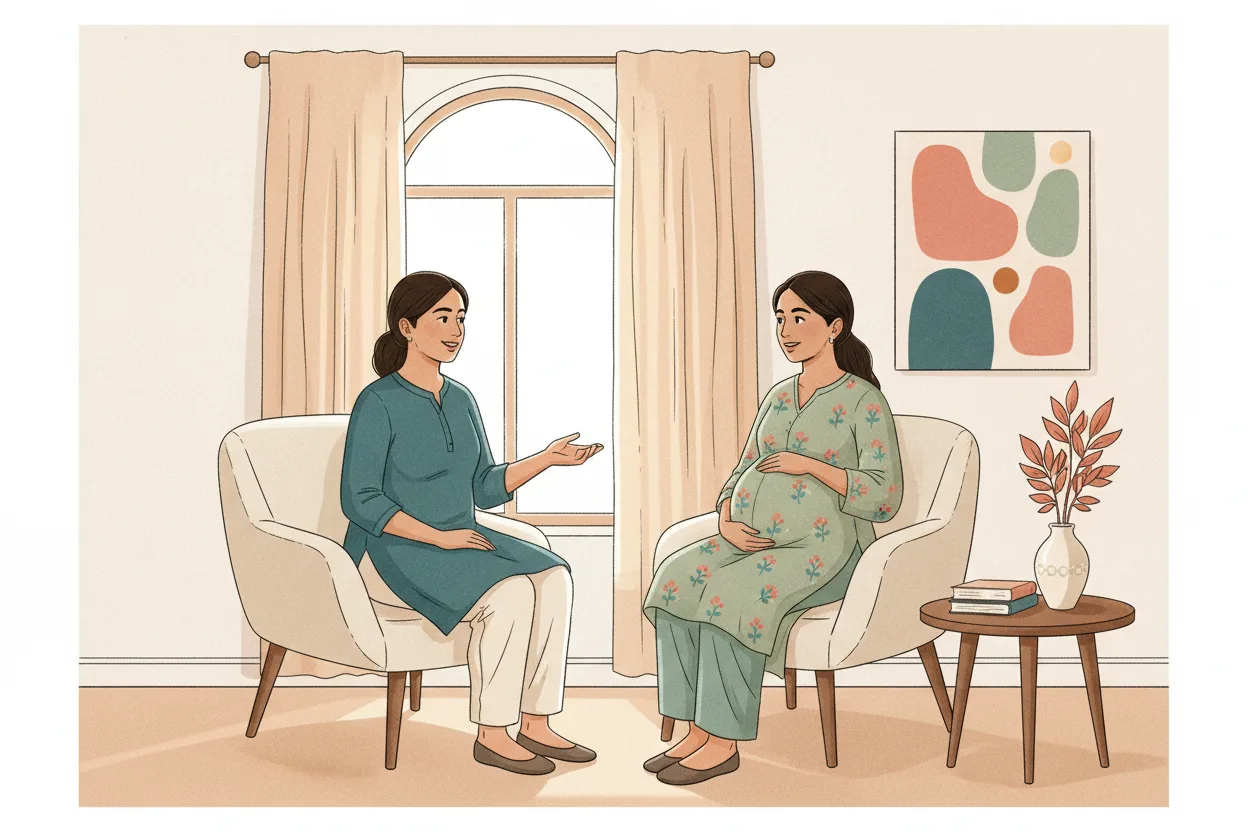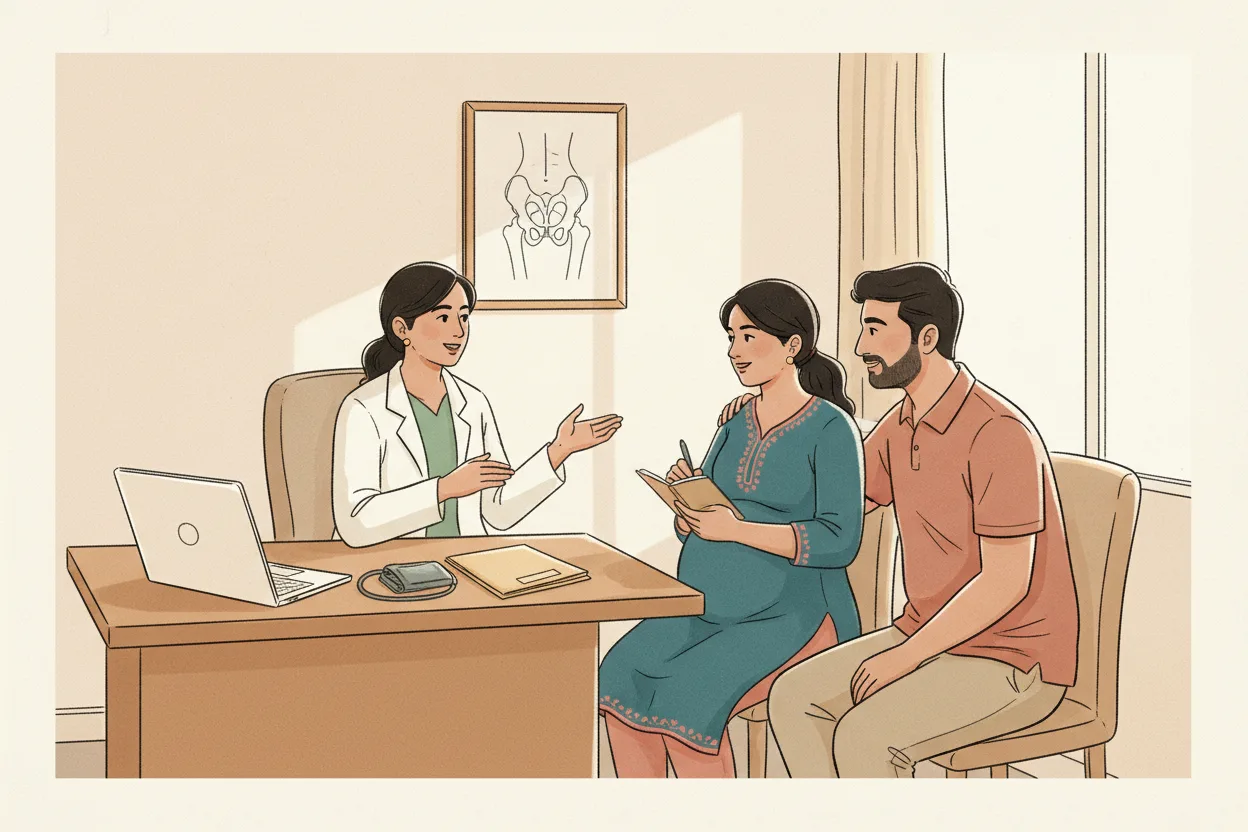
Pick your obstetrician on three things: how easily you can actually reach them, how they make decisions with you, and what the hospital behind them is set up to handle. A name your cousin swears by is not a shortlist. Criteria are — and they travel, from Bengaluru to Kolkata to a tier-2 city.
Not medical advice — consult your obstetrician for guidance specific to your pregnancy.
Start in the First Trimester, Not the Fifth Month
India's Ministry of Health & Family Welfare guidelines for antenatal care state that the first visit should ideally take place in the first trimester — before or at the 12th week of pregnancy — and that a woman coming later is still registered and cared for according to her gestational age. So a late start is fixable, but an early one gives you something valuable: time to change your mind cheaply.
WHO's antenatal care guideline recommends eight contacts across a pregnancy rather than four, with the first in the first 12 weeks and later ones at 20, 26, 30, 34, 36, 38 and 40 weeks. Read that schedule as a practical filter. You are choosing someone you will sit in front of eight or more times over the next seven months, mostly for unglamorous, routine visits. Reachability and manner matter more than reputation.
What Your First Consultation Should Actually Cover
The NHS describes the first antenatal appointment as a long one — roughly an hour — in which the clinician takes a full history, will "ask to check your blood pressure and test your pee (urine)", offers a blood test to check your blood group, and talks through screening tests, birth options and how to reach maternity services.
That last part is the tell. A first consult that is only a scan and a prescription slip has skipped the conversation.
You should also leave knowing when your first scan falls. The NHS states that a dating scan is offered at around 10 to 14 weeks of pregnancy, to work out how far along you are and check the baby's development. A doctor able to sketch that plan out at the first visit is showing you their process, which is most of what you are judging at this stage.
Two things you are entitled to ask for on day one. India's Charter of Patients' Rights, circulated by the Ministry of Health & Family Welfare, states that patients have a right to know the identity and professional status of everyone providing their care, and which doctor or consultant is primarily responsible for it — so "will you personally be there at my delivery, or the team on call?" is a fair, answerable question. And the same Charter states that every patient has a right to information on the rates charged for each type of service, on a display board and in a brochure — which is exactly how you get the delivery package broken down in writing instead of "we'll see at the time".
The Questions Worth Asking at the First Consult
Take these in. Note the answers, not just the vibe.
| Ask this | Why it matters | A good answer sounds like |
|---|---|---|
| Will you personally attend my delivery, or a team? | Sets your expectation before labour, not during it | A clear description of the on-call arrangement and names |
| Which hospital do you admit at, and what is on-site there? | NICU, blood bank and anaesthesia cover are facility features, not doctor features | Specifics: what is in the building versus reached by referral |
| What does your delivery package include and exclude? | Indian package pricing varies hugely between a corporate chain and a standalone maternity centre | An itemised sheet, plus what triggers extra charges |
| How do I reach you between visits, and how fast? | Most first-trimester worries are phone calls, not appointments | A named channel and a realistic response window |
| How do you approach labour if things are progressing slowly? | Reveals the practice philosophy before you are in a gown | A description of options and thresholds, not one script |
| What happens if I need a doctor at 2am? | The honest answer is usually "the duty team" | Who covers, and how your file reaches them |
Red Flags Worth Walking Away From
- An offer to tell you the baby's sex — at any price, in any hint. Under India's PC&PNDT Act, as summarised by the National Health Mission, no person may communicate the sex of the foetus to the pregnant woman or her relatives "by words, signs or any other method". This is a hard stop, not a preference.
- A caesarean framed as a foregone conclusion in the first trimester. WHO's statement on caesarean section rates says that when rates rise towards 10% across a population maternal and newborn deaths fall, but above 10% there is no evidence that mortality improves — the procedure is judged on need, not on a target.
- A private hospital that treats surgery as the default. A 2025 PLoS One analysis of India's NFHS-5 data found that mothers delivering at a private facility had 2.88 odds — about 2.9 times the chance — of a preventable caesarean compared with mothers delivering at a public facility. That is a reason to ask a private hospital how it decides, not a reason to write off private care.
- Consent treated as a signature at the door. The Charter of Patients' Rights states that informed consent must be sought before any potentially hazardous test or treatment that carries risk, including surgery.
- Visible irritation when you mention a second opinion. The Charter also states that every patient has the right to seek a second opinion from a clinician of their choice, and that the hospital must supply the records needed for it without extra cost or delay.
- One option, presented as the only option. The Charter states that patients have a right to choose between alternative treatment or management options where these are available, after considering all aspects of the situation.
Scare-tactic framing usually shows up as urgency without arithmetic: a warning with no numbers behind it, and no willingness to explain the alternative.
When Your Trusted Specialist Doesn't Take Delivery Cases
This is the situation nobody plans for. You have been with the same gynaecologist for years — through endometriosis, PCOS or fertility treatment — and now that you are pregnant, they tell you deliveries aren't part of their practice. It feels like being dropped. It isn't.
Treat it as a planned handover, in the first trimester, on your terms:
- Ask your specialist to name the obstetricians they hand over to, and why those particular ones. This is the one recommendation genuinely worth taking, because it comes from someone with your full history.
- Book the new obstetrician while still under the specialist's care, so the two overlap rather than leaving you between them.
- Get your file moved, not summarised. Surgical notes, imaging and treatment history all travel with you — and the second-opinion right above is the same right that obliges a hospital to release records without cost or delay.
- Settle in writing which doctor is primarily responsible from now on, using the Charter right described earlier, so nobody assumes the other one is watching.
- Ask what the specialist's continuing role is. Many will stay available for their own condition-specific questions alongside your obstetrician.
Your history is a reason to hand over carefully, not a reason to panic. A 2021 systematic review and meta-analysis in the Journal of Clinical Medicine found that endometriosis is associated with an increased risk of gestational hypertension, pre-eclampsia, preterm birth, placenta previa, placental abruption, caesarean section and stillbirth — which is precisely why the new obstetrician needs the old file, and why "she'll be fine" is not a handover.
What Continuity Is Actually Worth
A 2024 Cochrane review of continuity-of-care models found that these models provide care from the same clinician or small team through pregnancy, birth and the early parenting period, in collaboration with obstetric and specialist teams when required — and reported fewer caesarean and instrumental births and more positive experiences of care. In Indian private practice, the nearest equivalent is a named consultant with a small, stable team behind them. Ask how stable that team is.
One more question for the shortlist. WHO notes that labour companionship is a key component of respectful maternity care, so ask each hospital directly whether your husband, mother or a doula can stay with you through labour. Policies differ sharply between hospitals in the same city, and it is much easier to ask in month three than to argue in month nine.
Handling the Family Committee
In a lot of Indian families the obstetrician gets chosen collectively — an aunt's gynaecologist, the hospital where a cousin delivered, the doctor a mother-in-law trusts from twenty years ago. Those suggestions are worth listening to as leads, then testing against the criteria above.
A useful line: "I'm booking a first consultation with her, and I'll decide after." It respects the suggestion without handing over the decision. Take your partner to the consultations too — two people remember an hour-long appointment better than one, and it makes clear from visit one that this is a shared decision.
Frequently Asked Questions
How early is too early to book an obstetrician? There is no such thing as too early. Booking in the first trimester gives you the widest set of options and the cheapest possible change of mind.
Do I have to deliver at the hospital my obstetrician is attached to? Usually yes — a consultant delivers where they hold admitting rights. Check the hospital and the doctor together, as one package.
Is a big corporate hospital better than a standalone maternity centre? Neither is automatically better. Compare what is physically on-site, what your package covers, how far it is from home in traffic, and how the consultant works.
Can I change my mind after two or three visits? Yes. Early on you have paid little and lost nothing, which is precisely why the first-trimester decision is the one worth taking time over.
My gynaecologist doesn't do deliveries. Is that a bad sign? Not at all — plenty of specialists focus on surgery, fertility or a specific condition. Ask them to hand you over, in writing, to an obstetrician of their recommendation.