Sharp pelvic or vaginal pain with rectal pressure in the last weeks of pregnancy sits in two different categories, and nobody reading a screen can tell you which one you are in. Read the list below first. If anything on it matches, stop reading and phone your maternity team — then come back to the rest.
Not medical advice. Only your obstetrician or maternity unit can tell you what is happening in your pregnancy.
Call Your Maternity Team Now If Any of These Apply
Signs that need a phone call straight away
- Contractions that are regular, painful, or getting longer, stronger and closer together. MedlinePlus lists more than five contractions an hour, or regular painful ones, among the signs of preterm labour, and says to contact your provider right away if you notice any of them before your 37th week.
- Any vaginal bleeding, even light spotting. The NHS says bleeding in pregnancy is not always serious but can sometimes need urgent treatment — and that heavy bleeding with severe tummy pain, shoulder pain or faintness is an emergency.
- Fluid leaking, a trickle, or a gush. RCOG says that if your waters may have broken before 37 weeks you should contact your healthcare professional and go to hospital for a check straight away, because of the infection risk.
- Your baby's movements have reduced or changed. RCOG is unambiguous: contact your midwife or maternity unit immediately, never go to sleep ignoring it, and you must not wait until the next day.
And these too
- Pain that is severe, constant, or does not settle. NHS guidance on stomach pain in pregnancy says to call the maternity unit immediately if the pain is severe or does not go away after 30 to 60 minutes of rest — and puts burning or urgency on passing urine, and urine that looks cloudy, pink, red or brown, on the same list.
- A temperature of 38C or above. The NHS says a high temperature can be a sign of an infection, so it is important to get it checked out — and that any other pain you are worried about is a reason to get help straight away.
- Period-type pains, or backache that is not usual for you. NHS guidance on premature labour lists both, and adds that you can also call your midwife or maternity unit simply because you are unsure or worried about anything.
That last line is not filler. It is the permission you are looking for.
If You Have Already Been Assessed Once, Your Threshold Goes Down, Not Up
The hardest version of this question starts, I was already checked a few days ago and sent home — do I really call again? Yes. A documented episode of threatened preterm labour is a reason to call sooner, not a reason to hold out longer.
First, a reassuring examination is a snapshot, not a forecast: a cohort study of women presenting with symptoms of preterm labour reported that most of them have minimal cervical dilatation on manual examination, and that in their group risk factors and clinical signs did not differ between the women who delivered within a week and those who did not. A closed cervix on Tuesday is a finding about Tuesday.
Second, prediction here is genuinely weak. A review on predicting preterm labour notes that overall risk factor assessment alone is unreliable, and that over 50 percent of pregnancies that deliver preterm will fail to be identified. So the decision belongs to a team with a monitor, not to you with a browser.
RCOG's discharge advice after waters break early follows the same logic: once assessed and sent home, you are told to come straight back for a raised temperature, bleeding, contractions, or worry about the baby's movements. Being sent home once is not a cap on how often you may be checked.
Urinary symptoms in particular are worth no delay at all. A 2024 systematic review and meta-analysis found a significant positive association between urinary tract infections during pregnancy and preterm birth, with a pooled odds ratio of 1.92, and a case-control study at a tertiary care centre in Kerala found a history of UTI in pregnancy was an independent risk factor for preterm delivery, adjusted odds ratio 3.67. A UTI is treatable and cheap to rule out.
You Are Not Term Yet at 35 or 36 Weeks
Worth saying plainly, because it decides which list applies to you: WHO defines preterm birth as babies born alive before 37 weeks of pregnancy are completed, with 32 to 37 weeks classed as moderate to late preterm. At 35 or 36 weeks you are inside that window, so the checklist above is the one to use.
What Engagement Actually Does to Your Pelvis
Now the other category — the mechanical one. Cleveland Clinic explains that as delivery approaches the baby drops down into the pelvis, and that when the baby is head-down the head presses against the cervix, which can trigger effacement — the thinning and shortening of the cervix. Feeling the baby drop and a sense of pelvic pressure are listed among the signs of that process.
A head sitting lower presses on structures that were untouched a month ago: the cervix, the nerves beside it, the bladder in front, the rectum behind.
| What you feel | Usual explanation | What makes it a phone call |
|---|---|---|
| A single sharp, shooting stab in the vagina, pelvis or rectum, gone in seconds | Pressure from a head-down baby on the cervix and nearby nerves | It becomes cramping or constant rather than fleeting |
| Heavy downward pressure, like something is going to fall out | The baby sitting lower in the pelvis | It comes with regular tightenings, bleeding or leaking fluid |
| Rectal pressure, as if you need to pass stool | The head pressing backwards | It is rhythmic, or comes with pain and fever |
| Grinding or clicking ache in the pubic bone and hips | Pelvic joints under load | You cannot weight-bear, or the pain is severe and constant |
The sharp one: lightning crotch
Cleveland Clinic describes lightning crotch as a quick, sharp and shooting pain you may feel in your entire pelvic area, rectum or vagina. It is most common once the baby is head-down and dropping into the pelvis in the third trimester, and the page says it is not usually a cause for concern — but that cramping or constant pain should be reported to your provider.
One thing that page is clear about, and your relatives may not be: clinicians treat this pain as mechanical, not as a countdown. Anyone telling you the baby is coming this week, or that you have a fortnight, is guessing.
The aching one: pelvic girdle pain
The NHS describes pregnancy-related pelvic girdle pain as a collection of uncomfortable symptoms caused by a stiffness of your pelvic joints, or the joints moving unevenly at the back or front of the pelvis — worth raising with your doctor when moving around, getting out of a car, turning over in bed or managing stairs becomes painful. A pregnancy physiotherapist is the usual referral, and most large Indian maternity hospitals have one on panel.
Pelvic girdle pain and sciatic-type nerve pain each deserve their own read. This page is for the triage question.
What to Say When You Call
Vagueness gets you reassurance. Specifics get you assessed. Lead with your history, then the facts:
- "I am 35 plus 6 — thirty-five weeks and six days, first pregnancy." Gestation first, always.
- "I was assessed for threatened preterm labour three days ago at 35 plus 3. Cervix was closed. I was sent home." Say threatened preterm labour in those words — it is the phrase that moves you up a triage list.
- "What is new today is sharp vaginal pain and rectal pressure." New is the operative word.
- Then answer what they will ask anyway: Are the pains at regular intervals, and how many minutes apart? Any bleeding or spotting? Any fluid or wetness you cannot explain? Is the baby moving as usual today?
- "I would like to be seen." Not a question. If you are told to monitor at home, ask what should bring you in, and write the answer down.
Keep the discharge summary from your last assessment on your phone. In Indian private practice you may reach a duty doctor rather than your own consultant, and that photograph saves twenty minutes of explaining.
FAQ
Everyone says sharp pain at 36 weeks is just the head engaging. Is it? It can be — Cleveland Clinic describes exactly that pain as a common third-trimester symptom once the baby is head-down. But "can be" is not "is", and the two categories overlap. Only an examination separates them.
My mother-in-law says I will be sent home again and it is a wasted trip. Is she wrong? She may be right that you will be sent home — most women assessed for threatened preterm labour do not deliver preterm. Being sent home is a good outcome, not a wasted one.
It is 1am and nobody at home wants to make the trip. Can it wait till morning? For one symptom there is a published answer: if the baby's movements have reduced or changed, RCOG says you must not wait until the next day. For anything else on the list, phone now and let the maternity unit decide the timing. A phone call at 1am costs nothing.
I have been told to just rest and not panic. Should I? Resting and calling are not alternatives. NHS guidance uses rest as a test rather than a treatment — pain that is severe, or that does not go away after 30 to 60 minutes of rest, is on the call-immediately list.
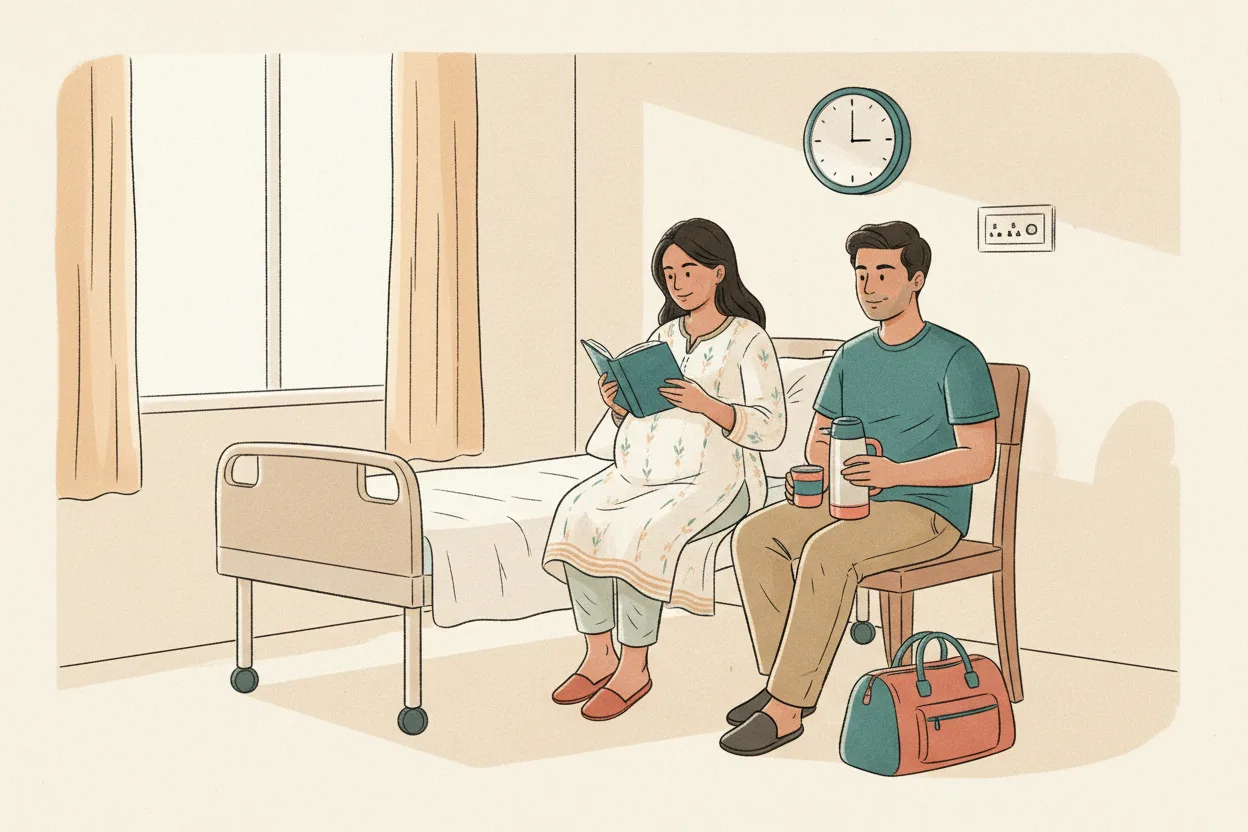
How soon will I go into labour? Nobody can tell you from symptoms. A review of preterm labour prediction found that risk factor assessment alone is unreliable, with over 50 percent of pregnancies that deliver preterm not identified in advance. Keep your bag packed and your maternity unit's number on speed dial, and treat every new symptom as its own phone call.