
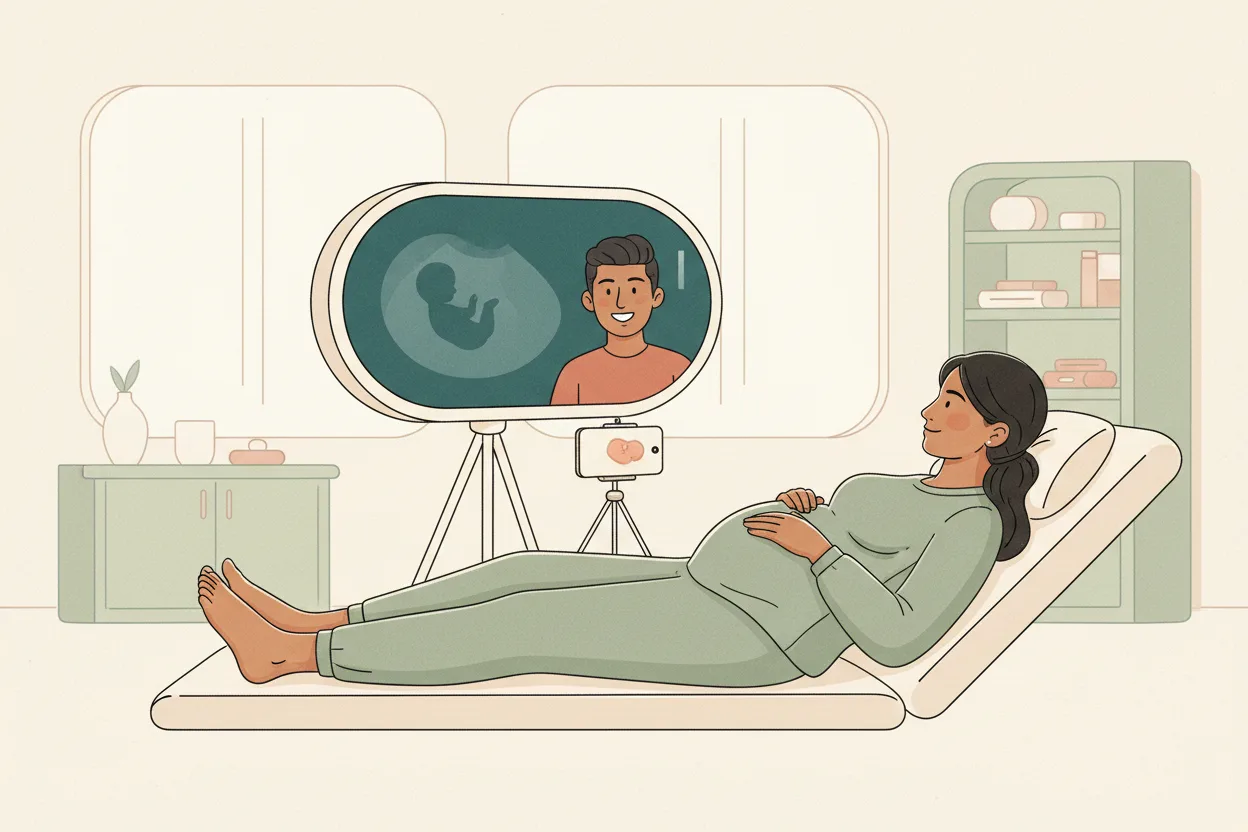
Your partner doesn't have to miss the scan just because they can't be in the room. Ask the sonographer in advance if you can prop your phone up for a live video call, or request that the clinic hand you the scan photos and a short clip to send right after — both are simple asks that most Indian hospitals and diagnostic centres can accommodate with a little notice.
Not medical advice — consult your obstetrician or the scanning centre for guidance specific to your pregnancy.
Why This Comes Up So Often in India
Plenty of Indian couples deal with this: one partner posted abroad in the Gulf or the US, on a ship, deployed with the forces, or simply stuck in back-to-back meetings the one week a scan lands. It doesn't have to mean they're shut out of the pregnancy — it just means you plan the logistics a little differently.
The Scans Worth Planning a Call Around
Not every appointment needs both of you dialed in — but a few specific scans are worth flagging on the calendar in advance.
MedlinePlus (U.S. National Library of Medicine) states that a pregnancy ultrasound done in the first 12 weeks confirms a normal pregnancy, determines the baby's age, and checks the baby's heart rate — for many couples, this is the first scan where there's actually something to see and hear together, which makes it worth prioritizing for a call.
Between 11 and 14 weeks, NICHD (part of the U.S. NIH) states doctors typically perform the nuchal translucency (NT) screening, an ultrasound measurement of the thickness of the back of the fetus's neck used to screen for Down syndrome and other chromosomal conditions.
Later, NHS states the detailed anomaly scan is usually done between 18 and 21 weeks — this is typically the longest, most detailed scan of the pregnancy, and the one where a sonographer has the most to narrate if your partner is watching over video.
More broadly, WHO's antenatal care recommendations state that one ultrasound scan before 24 weeks of gestation is recommended for every pregnant woman, to estimate gestational age, improve detection of fetal anomalies and multiple pregnancies, and improve her overall pregnancy experience — so even if you can only get your partner onto one call, aim for something before the 24-week mark.
| Scan | Typical window | Good to video-call? |
|---|---|---|
| First / dating scan | Up to ~12 weeks | Yes — first heartbeat, often the most emotional one |
| NT screening | 11–14 weeks | Yes, if your partner wants to follow the screening discussion |
| Anomaly scan | 18–21 weeks | Yes — longest scan, most to see and hear |
| Routine check-ups | Every visit | Optional — no ultrasound, but heart rate is still checked |
Getting Your Partner Onto the Call
Call the hospital or diagnostic centre a day or two ahead and ask two things: whether phones are allowed inside the scanning room, and whether the sonographer is comfortable narrating for someone on a video call. Policies vary a lot by centre — some are completely fine with it, others prefer you record from the exam table rather than hold up the phone yourself. Whichever is allowed, ask the receptionist to note it against your appointment so you're not negotiating it fresh in the room.
One thing to brief your partner on before the call: don't ask the sonographer to reveal the baby's sex. A perspective on the PCPNDT Act, published in the Indian Journal of Radiology & Imaging, states that India's PC-PNDT Act was enacted almost solely to stop doctors from "advertising and disclosing the sex of the fetus to the pregnant woman or her relatives" — sonographers in India are legally barred from answering that question, on video call or otherwise, so it's worth setting that expectation in advance rather than putting the sonographer on the spot mid-scan.
Even on visits without an ultrasound, there's usually still something worth sharing live. NICHD (part of the U.S. NIH) states that checking the baby's heart rate is part of every routine prenatal visit, not only the days you get a scan — so a quick video call at a regular check-up can still let your partner hear the heartbeat live, even between the bigger scans.
A small phone tripod or flexible phone mount (Rs. 300–800 on Amazon.in or FirstCry) is worth carrying to appointments — it lets you prop the phone facing the monitor without asking a nurse to hold it, and keeps your hands free.
Recording the Scan: Keep It Short
It's tempting to ask the sonographer to linger so you can capture more footage for someone who couldn't be there — resist that urge. A BMJ news report on an FDA warning states that prenatal ultrasound "keepsake videos," taken by commercial studios outside a proper medical exam, may affect the fetus, according to a US Food and Drug Administration warning. A short recording of the routine, medically necessary scan is enough to share — there's no need to extend the exam itself just to get more video.
Why Staying Involved Matters, Even From a Distance
A short daily video call doesn't just keep your partner updated — it does something for you too. A systematic review in Archives of Women's Mental Health found that instrumental and emotional support from partners and family acts protectively to prevent or support recovery from perinatal mental health conditions. Bringing your partner into scans and appointments, even over video, is a concrete way to keep that support flowing while they're away.
Frequently Asked Questions
Can I ask the sonographer to record every scan for my partner working abroad? You can ask for a short clip of the routine scan, and most centres will oblige — but don't ask them to run the probe longer than medically necessary just to capture more footage. The FDA's warning on keepsake ultrasound videos is specifically about non-medical, extended recording, not the normal length of your actual exam.
Which one scan should we prioritize if my partner can only join one video call? The anomaly scan, done between 18 and 21 weeks, is usually the longest and most detailed, so there's the most for a sonographer to narrate live. If that's not possible, the first scan in the initial 12 weeks is a good second choice since it's often the first shared heartbeat.
What if the hospital doesn't allow phones in the scanning room? Ask for the scan photos or a printed clip immediately after, and do a recap video call right outside the room while it's still fresh — you can hold the printout up to the camera and walk your partner through what the sonographer told you.
Does my partner need to be on every single appointment? No. Plenty of routine visits don't have an ultrasound at all — heart rate checks happen at every prenatal visit regardless, so there will be other, smaller moments to share along the way, not just the big scans.
Is it normal to feel low doing this without my partner in the room? Yes, and it's worth naming rather than pushing through alone. Partner support has a protective effect on perinatal mental health, so keep leaning on video calls, a family member who can come along, or your own support system between scans.
What's the earliest scan we could realistically plan a joint video call around? The first ultrasound, usually done sometime in the first 12 weeks, is the earliest one worth planning around — it's also usually when the heartbeat is checked for the first time.