

Some bleeding for four to six weeks after a C-section is normal — it's called lochia, and it's your uterus healing, not a wound reopening. Cleveland Clinic explains that you'll still bleed for multiple weeks after a cesarean, but it's typically less than the amount of lochia after a vaginal delivery.
Not medical advice — consult your gynaecologist or obstetrician for anything specific to your recovery.
How Long Does Bleeding Last, and What Should It Look Like
Lochia isn't one steady flow — it changes color and volume as your body heals. A clinical review in NCBI's StatPearls notes that the discharge moves through three recognizable stages, tracked from the day of delivery, C-section included:
| Stage | Timing | What it looks like |
|---|---|---|
| Lochia rubra | Days 1–4 | Heavy, bright-to-dark red |
| Lochia serosa | About day 4–10 | Watery, pinkish-brown |
| Lochia alba | Day 10–12 onward | Yellowish-white, light |
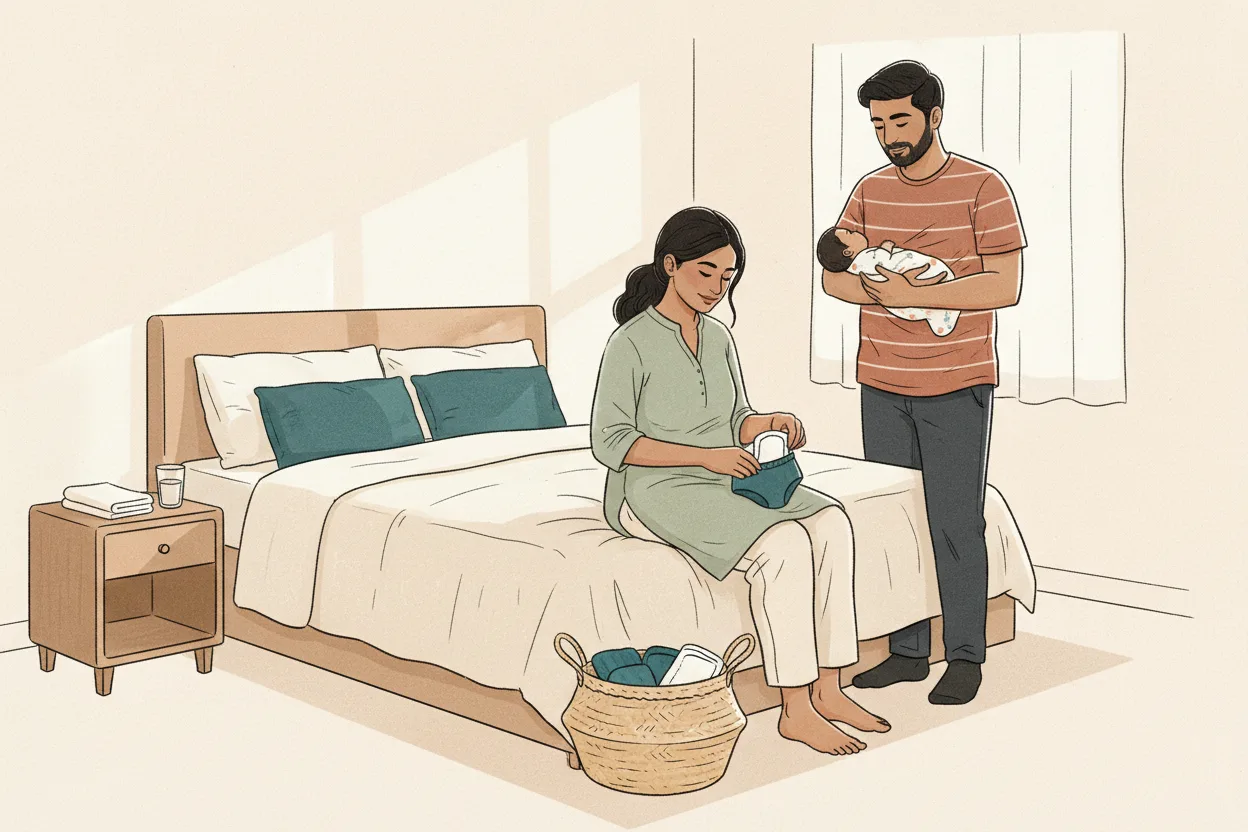
Because a C-section incision and uterine healing happen together, it's easy to fixate on the wound and stop paying attention to the pad. Worth asking your partner to help track this in the first couple of weeks — a change in color, smell, or a suddenly soaked pad is easy to miss when you're sleep-deprived, but easier for someone else to notice.
One pattern that catches people off guard: the NHS explains that breastfeeding makes the womb contract, so lochia often looks redder and heavier during or right after a feed. That's a normal, temporary uptick tied to feeding — not the same thing as the bleeding trending heavier day over day overall, which is what the red flags below are actually about.
Red Flags That Need a Same-Day Call
The Royal College of Obstetricians and Gynaecologists (RCOG) advises that bleeding which gets heavier instead of lighter, develops an offensive smell, or comes with feeling generally unwell — at any point between 24 hours and 12 weeks after birth — is called secondary postpartum haemorrhage and needs urgent medical review.
Separately, a clinical review in NCBI's StatPearls states that any bleeding heavy enough to cause a racing heart, dizziness, or other signs of low blood volume — or an estimated blood loss over 500 mL — should trigger an urgent hemorrhage evaluation rather than a wait-and-watch approach.
Two more concrete cues are easier to judge in the moment than a mL estimate. Cleveland Clinic notes that passing several large blood clots — anything bigger than a golf ball — can be a sign of a problem, and India's National Health Mission (MoHFW) guidance states that soaking more than 2–3 pads in 20–30 minutes after delivery counts as excessive bleeding needing immediate care.
| Sign | What it may mean | What to do |
|---|---|---|
| Bleeding gets heavier, not lighter, after day 4–5 | Possible secondary postpartum haemorrhage | Call your doctor same day |
| Foul or offensive-smelling discharge | Possible infection | Call your doctor same day |
| Racing heart, dizziness, feeling faint while bleeding | Possible significant blood loss | Seek urgent care |
| Fever with lower belly tenderness | Possible uterine infection | Call your doctor same day |
| Clots larger than a golf ball | Possible postpartum haemorrhage | Call your doctor same day |
| Soaking more than 2–3 pads in 20–30 minutes | Excessive bleeding | Seek urgent care |
Watch the Incision Too, Not Just the Bleeding
A C-section adds an infection risk a vaginal delivery doesn't have to the same degree. A clinical review in NCBI's StatPearls states that endometritis — infection of the uterine lining — is 5 to 10 times more common after a cesarean birth than after a vaginal birth, and typically shows up as fever with uterine tenderness and foul-smelling lochia together, not bleeding alone.
This matters specifically in Indian hospital settings: a quality-improvement study at an Indian tertiary hospital, published via NIH/PMC, found that around 3 in 10 C-section patients developed a surgical-site infection — marked by pus-like wound discharge or a fever above 100°F lasting 48 hours or more — before that hospital tightened its infection-control steps. Check the incision daily for redness, swelling, warmth, or discharge, alongside tracking the bleeding — either parent can do this check if bending or twisting is uncomfortable for you.
Wondering whether the stitches themselves should still be there? The NHS states that non-dissolvable stitches or staples are usually removed by a midwife or doctor after 5 to 7 days, while dissolvable stitches break down on their own. So a still-healing, closed incision around that point is expected — it's redness, swelling, warmth, or discharge from the wound that's the actual red flag, not the presence of stitches themselves.
Get the Recovery Checked, Don't Just Assume It's Fine
It's tempting to treat six weeks postpartum as a finish line you either hit or don't, on your own. WHO's postnatal care recommendations state that at least three additional postnatal contacts are recommended for all mothers and newborns — on day 3, between days 7 and 14, and at six weeks after birth. That six-week point is also roughly when lochia should have largely tapered off, so it's a natural moment for your bleeding, incision, and general recovery to get an actual check rather than being assumed normal because no single day felt alarming.
If your hospital or clinic doesn't automatically schedule these, ask for them — particularly the day-3 and day 7–14 contacts, which many first-time parents in India aren't offered unless they ask.
Lifting and Activity While the Incision Heals
Managing a newborn — and often a household — without full-time help at home is a real constraint for many families in India, so it helps to know where the line actually is. Cleveland Clinic advises that during the roughly six-week window while a C-section incision heals, it's recommended to avoid lifting anything heavier than the baby. That covers the toddler sibling, the water can, and the grocery bags too — worth asking a partner, family member, or hired help to take those over until your doctor clears you at a follow-up visit.
Pads vs. Period Panties for C-Section Recovery
Lochia is heavier and messier than a regular period in the first week, tapering off over several weeks. What you wear is a comfort and logistics choice, not a medical one — there's no matrix source claiming one option heals you faster.
| Option | Best for | Price range (India) |
|---|---|---|
| Disposable maternity pads | First 1–2 weeks, heaviest flow, hospital stay | ₹150–₹350 per pack (Amazon.in / FirstCry) |
| Disposable period panties | Overnight, travel, or if bending to change a pad is painful post-surgery | ₹400–₹900 for a pack (Amazon.in) |
| Reusable period panties | After the first couple of weeks, once flow is lighter, for ongoing use | ₹500–₹1,200 per piece (Amazon.in / FirstCry) |
A practical pattern many parents in India use: disposable pads or disposable period panties for the heaviest first one to two weeks (less bending and adjusting right after surgery), then switching to reusable period panties once the flow is down to spotting. Whichever you choose, change it as often as you'd change a heavy-flow pad — a pad or panty that's soaked through faster than expected is itself one of the signs worth mentioning to your doctor.
Frequently Asked Questions
Is bleeding after a C-section lighter than after a normal delivery? Usually, yes. Cleveland Clinic explains that lochia after a C-section is typically less in amount than after a vaginal delivery, though you'll still bleed for multiple weeks either way.
How long is postpartum bleeding supposed to last after a C-section? Expect the color and heaviness to change over roughly 10–12 days as it moves through the three stages described above, and to continue tapering, often for several weeks total, per StatPearls.
When should I call my doctor instead of waiting it out? Same day, if bleeding gets heavier instead of lighter, smells offensive, or you feel unwell, per RCOG — this applies any time from 24 hours up to 12 weeks after birth, not just the first few days.
Could heavy bleeding mean something is seriously wrong? It can. StatPearls notes that bleeding heavy enough to cause a racing heart or dizziness, or an estimated loss over 500 mL, needs urgent evaluation — don't wait to see if it slows down on its own.
Does fever always mean infection? Fever with uterine tenderness and foul-smelling discharge together points toward endometritis, which StatPearls states is several times more common after a C-section than a vaginal birth. Fever alone, or a wound that looks red or is discharging pus, is also worth a same-day call — an Indian hospital audit found surgical-site infection in close to a third of C-section patients before infection-control improvements.
Will my hospital automatically check on me after discharge? Not always — ask. WHO recommends postnatal contacts at day 3, between days 7–14, and at six weeks, and it's reasonable to request these explicitly if your hospital doesn't offer them.