Three weeks of freezer meals is a sensible target, and for most first-time parents it is more than enough. But the number that actually matters is a different one: how many days will nobody else be cooking? Work that out first, then fill the freezer to cover exactly those days.
Not medical advice — talk to your obstetrician about your own recovery and nutrition.
First, Answer the Real Question: Is Someone Coming to Cook?
In most Indian families the freezer is not the main plan. Your mother or your mother-in-law arrives for jaappa, a japa cook is hired for a month, or an aunt sends a tiffin across town twice a week. If that is your situation, three weeks of frozen food over-prepares for the middle of the month and under-prepares for the edges — and the edges are predictable:
- The last stretch of pregnancy, when you are flattened and the baby may well arrive early.
- The first few days home, before whoever came to help has found your masalas.
- The week after she leaves — the hardest one, and almost nobody preps for it.
- Any day the cook doesn't turn up, which in a monsoon month is not much of a surprise.
| Your situation | Single meals to freeze | What it is really for |
|---|---|---|
| Mother or mother-in-law staying six weeks | Eight to ten | Handover days, her days off, her trip home |
| Japa cook from day one | Six to eight | No-shows, festival leave, the week she finishes |
| Nobody coming, partner has leave | Eighteen to twenty-one | Here, three weeks is genuinely the right target |
| Nobody coming, little or no leave | As much as fits, plus a restock plan | The freezer alone will not carry this one |
That last row is the one to be honest about. If nobody is coming, the freezer is your main plan — and a main plan needs a second half: a standing grocery order, a tiffin service lined up before delivery, and a batch-cook slot booked for the third week. A freezer is a bridge, not a solution.
The Food-Safety Rules Worth Getting Right
Freezing is forgiving. Cooling is not, and that is the part worth doing properly in an Indian kitchen.
NHS food safety and hygiene guidance says to cool cooked food as quickly as possible — ideally within one to two hours — before it goes into the fridge or freezer, and to divide it into smaller portions in shallow containers so it cools fast. Cooked rice gets a tighter window of one hour.
Cambridge University Hospitals NHS Foundation Trust's food safety advice puts a freezer at or below minus 18°C, says reheated food should reach at least 70°C in the middle, and says not to reheat cooked food more than once. Most Indian fridges have a dial rather than a temperature readout, so a cheap freezer thermometer earns its place.
WHO's food safety advice for hot weather says to reheat all leftovers until they are steaming hot, not to leave cooked food at room temperature for more than two hours, and to defrost frozen food in the refrigerator, in cold water or in a microwave rather than at room temperature. In a Chennai summer or a Mumbai monsoon, that two-hour line bites faster than it reads.
Buckinghamshire Healthcare NHS Trust's food hygiene advice is blunt about thawing: defrost in the fridge, do not refreeze thawed food, eat fridge leftovers within two days, and keep leftover rice no longer than a day.
Mississippi State University Extension's freezer guidance lists cooked soups, stews, casseroles and cooked meat at two to three months for best quality, and tells you to label and date and to freeze in small containers so food freezes faster. Cook in your eighth month and the food is still at its best in your baby's second month — which is roughly when the first wave of help goes home.
What Freezes Well, and What Collapses
This part is kitchen craft rather than science, so take it as practical guidance. Indian food is unusually freezer-friendly, because so much of it is a slow-cooked gravy.
| Dish | How it freezes | Make it work |
|---|---|---|
| Toor, moong, masoor dal | Excellent | Freeze it slightly thin; it thickens on standing |
| Rajma, chole, chana, lobia | Excellent, often better than fresh | Freeze in the gravy, not drained |
| Bhuna tomato-onion masala base | Excellent | Ice-cube trays, then bag the cubes |
| Keema, chicken curry, egg curry gravy | Very good | Keep it saucier than you would serve it |
| Khichdi, dalia, pongal | Good | Freezes dense; loosen with hot water |
| Palak, methi and other green gravies | Good | Colour dulls; lemon at the end revives it |
| Cooked rice, pulao | Good | Freeze flat and thin, reheat with a splash of water |
| Parathas and rotis | Good | Half-cook, cool, stack with butter paper, freeze flat |
| Steamed idli | Good | Freeze the idlis, not the batter |
| Fermented idli-dosa batter | Poor | The ferment suffers; keep batter in the fridge |
| Paneer in gravy | Poor | Freeze the gravy; add fresh paneer while reheating |
| Curd-based gravies: kadhi, dahi aloo | Poor | They split into grains and water |
| Potato in curry | Poor | Turns grainy and waterlogged |
| Fried items, pakoras, cutlets | Poor | They lose the only thing that made them good |
Four things belong after reheating, in the bowl: fresh coriander, a fresh tadka of jeera and hing, fried onions, and a squeeze of lime. They all fade in the freezer, and adding them at the end is the difference between "frozen food" and "food".
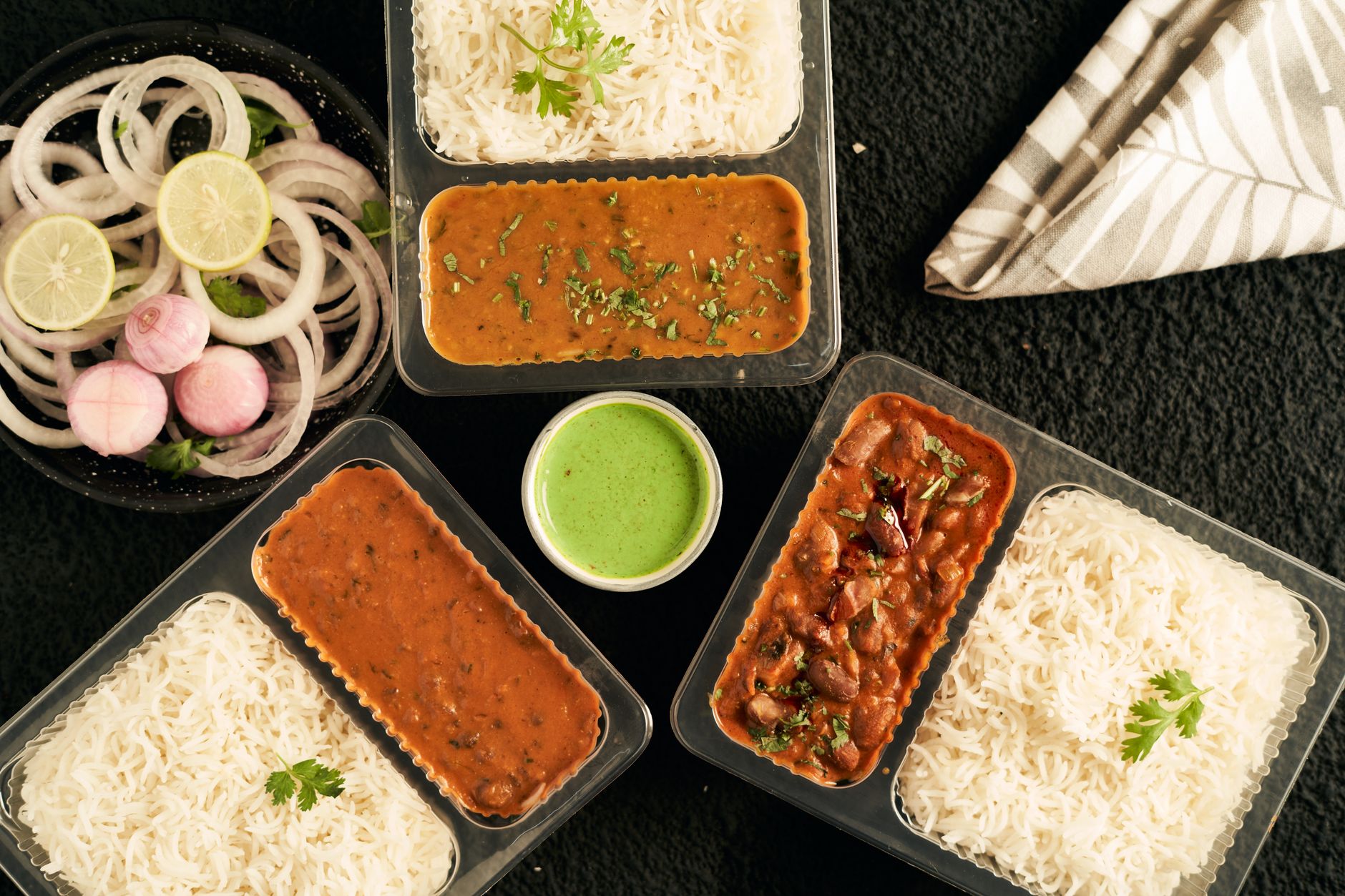
One tip beats any recipe: freeze bases, not finished dishes. A bag of bhuna masala cubes, a box of boiled dal and a box of boiled chole become four different meals in ten minutes. Twenty identical boxes of rajma become something you stop wanting on day five.
The Constraint You Haven't Planned For
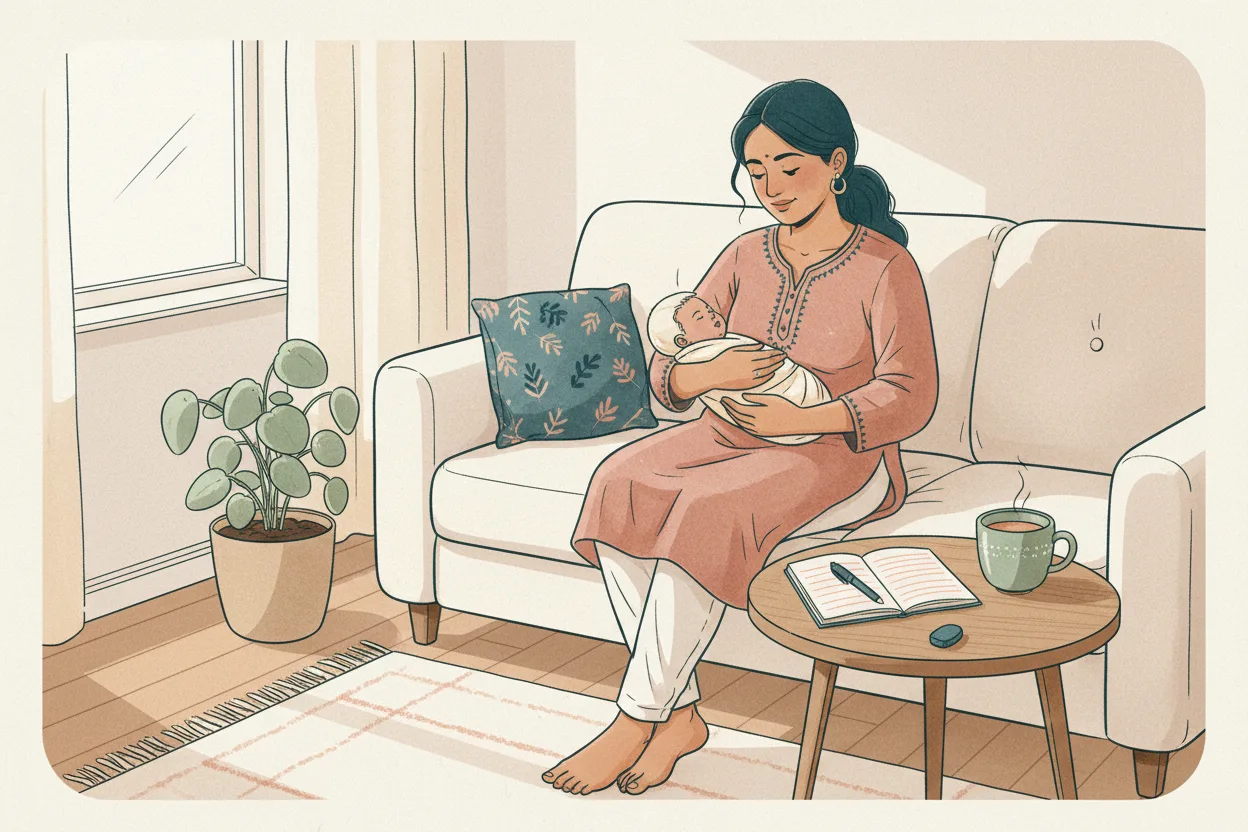
Postpartum eating is not dinner. It is one hand, at an unpredictable hour, often while a baby feeds on the other side, and frequently cold — because the baby woke up between the microwave and the bowl. Design the freezer for that:
- Single servings, not family portions. One box, one meal, one hand. A thali you have to assemble is a thali you will skip.
- One bowl, one spoon. Dal-rice, khichdi, pulao, a thick curry over rice — things you can eat with a spoon and nothing else.
- Masking tape and a marker on the fridge. Name and date on every box. At three in the morning nothing is recognisable through a layer of frost.
- A no-cook shelf at eye level. Bananas, dates, roasted chana, nuts, poha, khakhra, peanut butter, curd, a tin of laddoos — food that needs no plan at all.
- A full water bottle wherever you feed. Thirst arrives the second the baby latches.
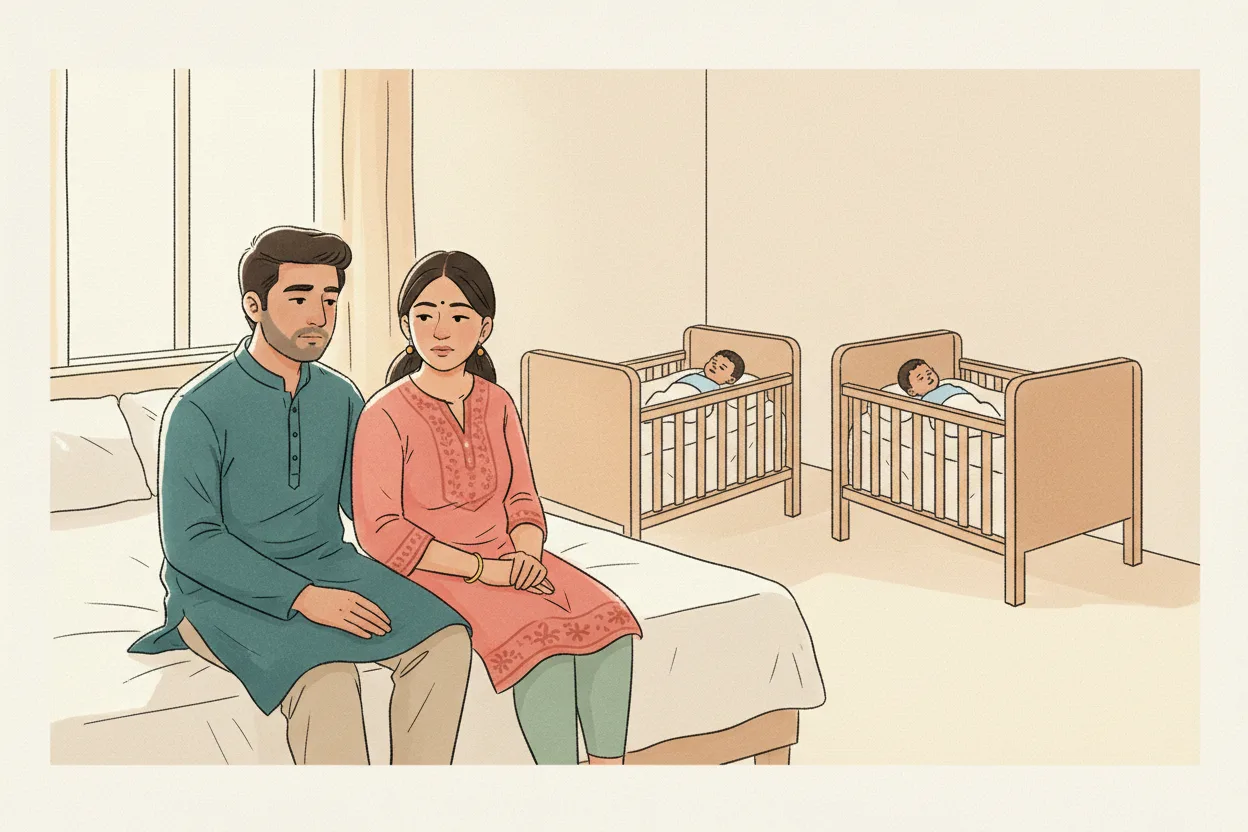
This is also the single most useful job a father can own in the first month, and it is not "helping with dinner" — it is owning the food entirely. He reheats, he plates, he restocks the no-cook shelf, he keeps the water bottles filled, and he notices she hasn't eaten since the morning feed.
Where Jaappa Foods Fit
Panjiri, gond ke laddoo, methi laddoo, ajwain and jeera water, extra ghee in everything — these are the foods your family will arrive carrying, and they are worth welcoming rather than managing. They are warm, calorie-dense, easy to eat with one hand, and they keep for weeks in a steel tin without using any freezer space. On the logistics alone they are excellent postpartum food.
Be honest about the rest. Whether panjiri or methi genuinely improves milk supply has not been settled by good trials in either direction, so treat them as food and comfort rather than as medicine.
The longer list of jaappa food rules — no curd, no cold water, no rice at night — is a separate argument we have already had: see our guide to which postpartum diet restrictions are actually necessary rather than re-litigating it at your dining table.
Eating Enough Beats Eating Perfectly
A 2016 review of nutrition recommendations in pregnancy and lactation found that women who breastfeed require approximately 500 additional kcal a day beyond what is recommended for non-pregnant women. That, and not any particular superfood, is the real argument for a full freezer.
NHS guidance on diet while breastfeeding says you do not need to follow a special diet while you are breastfeeding, suggests keeping a drink beside you when you settle down to feed, and sets a ceiling of no more than two portions of oily fish a week.
The AAP's HealthyChildren guidance puts calcium at 1,000 mg a day for women aged eighteen to fifty, and notes that iron helps breastfeeding mothers maintain their energy level — so the dal, rajma, ragi, sesame, curd and green gravies in that freezer are quietly doing a lot of work. The same guidance notes elsewhere that a less-than-ideal diet will probably not affect your breastfeeding child, but it may leave your own body at nutritional risk.
On iron specifically, WHO's guidance on postpartum iron supplementation states that oral iron, alone or with folic acid, may be provided to postpartum women for six to twelve weeks following delivery to reduce the risk of anaemia in settings where gestational anaemia is of public health concern. Ask your obstetrician whether that applies to you, especially if your haemoglobin was low in pregnancy.
FAQ
Is three weeks of freezer meals actually enough?
If somebody else is coming to cook, three weeks is more than enough — halve it. If nobody is coming, three weeks is the right target, and the thing to plan alongside it is the restock for the fourth week onwards, because that is when a freezer-only plan runs out.
When should I start cooking?
The eighth month suits the bulk of it, so the food is at its best when you need it — frozen soups, stews and cooked meat keep their quality for about two to three months. Do a last batch early in the ninth month if you still have the energy, and hand the chopping to whoever is around.
Can I freeze cooked rice and rotis?
Yes to both, with care. Rice has the tightest safety window in your kitchen: cool it within an hour of cooking, and keep leftover rice in the fridge no longer than a day. Rotis and parathas freeze beautifully if you half-cook them, cool them fully, stack them with butter paper between each one, and freeze the stack flat.
How do I stop everything tasting the same by the second week?
Freeze bases rather than finished dishes, and finish each bowl differently — lemon and coriander one day, a fresh jeera tadka the next, ghee and crushed papad after that.
Do I need a separate deep freezer?
Almost certainly not. A standard double-door fridge freezer holds roughly fifteen to twenty single-serve boxes if you freeze things flat in zip bags and stand them upright like files, and masala bases take almost no room as frozen cubes. Clear out the old ice trays and half-empty packets instead of buying an appliance.