
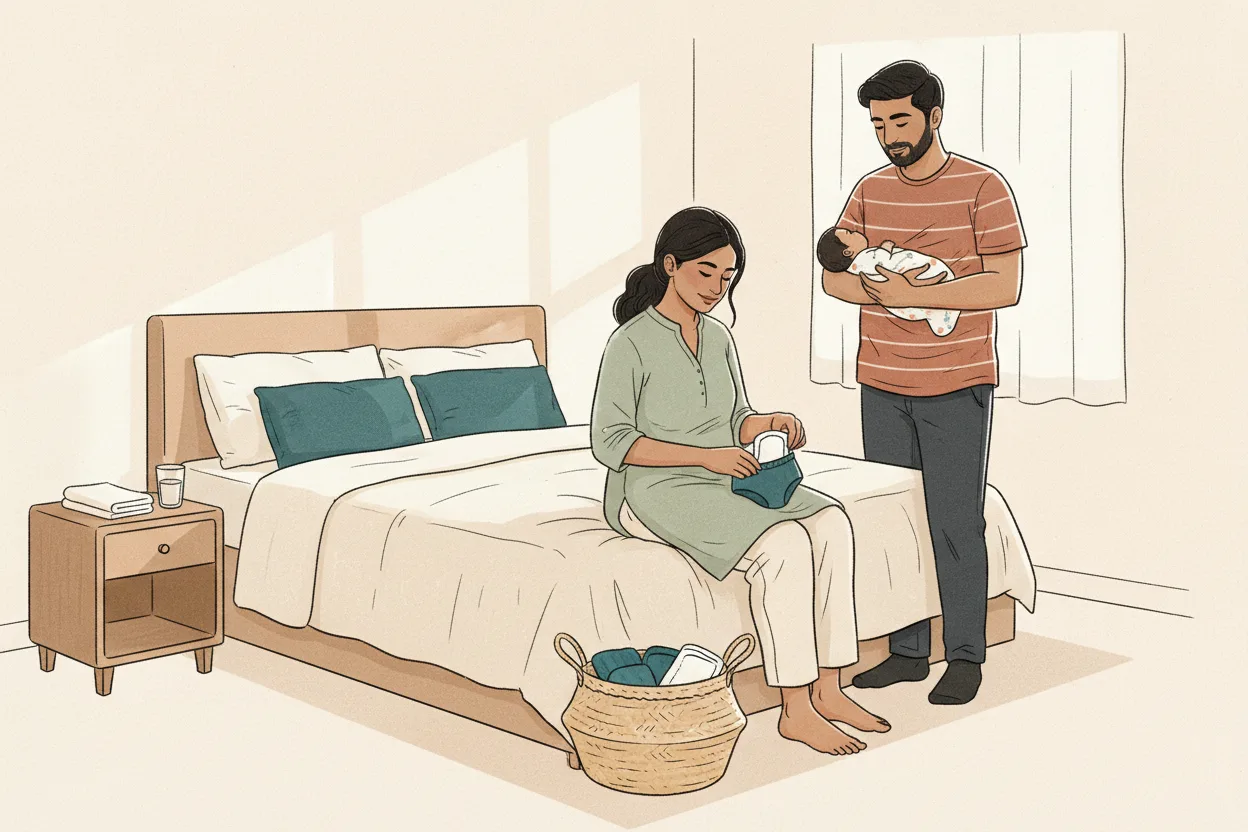
Period panties and maternity panties are not the same product. Period panties are disposable, high-absorbency stretch briefs built to catch heavy postpartum bleeding without a separate pad. Maternity panties are usually just soft, high-waisted cotton underwear sized for a healing body — comfortable, but not built to hold bleeding on their own. Most new parents end up needing both, in different amounts, depending on how the birth went.
Not medical advice — consult your obstetrician or midwife for guidance specific to your delivery and recovery.
How much bleeding is actually normal
Cleveland Clinic explains that this bleeding, called lochia, typically lasts up to six weeks, and some people notice traces of it for up to eight weeks, as the flow tapers from red, to pink-brown, to a yellowish white. That's a long runway — which is exactly why the right underwear matters more than most first-time parents expect going in.
Within that normal range, Cleveland Clinic advises wearing a pad to catch the bleeding, never a tampon, while your body heals. This is the main reason period panties exist as a category: they hold a built-in absorbent pad-equivalent in place without anything internal, which matters for a healing perineum or c-section incision either way.
Period Panties vs Maternity Panties, Side by Side
| Period (postpartum) panties | Maternity panties | |
|---|---|---|
| What they do | Absorb bleeding directly — no separate pad needed | Hold a regular maternity pad in place |
| Best for | First 1–2 weeks, heaviest flow, overnight | Once flow has tapered, general comfort |
| Fabric | Disposable, non-woven, mesh-like stretch | Reusable cotton or cotton-blend |
| Waist | High-rise, wide, sits above a c-section incision | High-rise, soft, non-elastic band options available |
| Cost per use | Higher (disposable) | Lower (washable, reusable) |
Both are worth having. Period panties do the heavy lifting in the first one to two weeks; maternity panties take over for comfort once the flow has settled and you're using a slimmer pad.
What to Stock Up On, By Delivery Type
Vaginal delivery: Start with disposable period panties for the first week, when flow is heaviest, then move to maternity panties with a maxi pad as bleeding tapers. Keep a few period panties in reserve for overnight, since lying down for longer stretches means more pooling.
C-section: The waistband matters as much as the absorbency. Look for period and maternity panties with a wide, soft, high-rise band that sits above the incision rather than pressing on it. MedlinePlus (U.S. National Library of Medicine) instructs avoiding lifting anything heavier than your baby and skipping heavy exercise for six to eight weeks after a caesarean — a low-pressure, non-elastic waistband that doesn't dig into the healing area makes that stretch noticeably more comfortable.
MedlinePlus also flags specific incision warning signs to call your doctor about: redness, warmth, swelling, or drainage at the incision site, or a fever above 100°F (37.8°C). Keep an eye on your incision each time you change underwear — it's the easiest moment to check.
Warning Signs: When Bleeding Needs a Doctor, Not Just More Panties
Buying enough absorbent underwear solves comfort and leaks. It does not substitute for knowing when bleeding is no longer normal. A StatPearls (NCBI Bookshelf) clinical review states that soaking a pad — or a pair of period panties — in under an hour is a warning sign that needs prompt medical attention. Cleveland Clinic notes that passing blood clots larger than a golf ball is also a sign of postpartum hemorrhage and needs medical attention right away.
These signs matter after you're home too, not just in the hospital. The Royal College of Obstetricians and Gynaecologists (RCOG) advises contacting your midwife or doctor if your bleeding gets heavier again after you're home, if your lochia develops an offensive smell, or if you generally feel unwell — these can be signs of a secondary postpartum haemorrhage. It's worth telling your partner what these signs look like too, so either of you can flag a soaked pair of panties or a bad smell without waiting for the other to notice — postpartum recovery goes more smoothly when both parents are watching for it together.
One warning sign is not about your underwear at all, and it's easy to miss if you're only watching for bleeding: RCOG explains that a deep vein thrombosis (a blood clot in the leg) usually shows up in only one leg — as redness, heat, and swelling, with pain or tenderness — and should be reported to a doctor or midwife immediately, since a clot that travels to the lung can become a life-threatening pulmonary embolism. This is a different problem from the vaginal blood clots covered above, and the restricted movement recommended after a c-section is exactly when it's worth staying alert to it.
What to Actually Buy
Indian D2C brands like Nua and Evereve sell disposable postpartum period panties specifically, alongside the more familiar maternity/nursing panty brands sold on general marketplaces. A reasonable starting stock for the first two weeks is 8–10 disposable period panties plus 4–6 reusable maternity panties to rotate in as flow tapers.
| Product | Typical price | Where to buy |
|---|---|---|
| Disposable postpartum period panties (Nua, Evereve, or similar) | Rs. 700 – Rs. 1,400 for a pack of 8–10 | Amazon.in / FirstCry |
| High-waist maternity/postpartum panties (reusable cotton) | Rs. 400 – Rs. 900 for a pack of 3–4 | Amazon.in / FirstCry |
| Maternity maxi pads (for use with reusable panties) | Rs. 200 – Rs. 400 per pack | Amazon.in |
Buy period panties in a size up from your pre-pregnancy size — the point is a loose, non-restrictive fit over a still-healing body, not a snug one.
Frequently Asked Questions
Can I use regular period panties instead of postpartum-specific ones? Regular period panties are designed for menstrual flow, not the heavier early postpartum flow. Postpartum-specific panties are built wider and more absorbent, with a softer waistband that clears a c-section incision, so they're the better starting point before switching to regular period or maternity panties.
How long will I actually need these? Cleveland Clinic explains that lochia typically lasts up to six weeks, with some traces lasting up to eight, so plan on needing some form of absorbent underwear for that full stretch — heaviest in week one, lightest by week five or six.
Is it ever okay to use a tampon instead? No. Cleveland Clinic advises wearing a pad to catch postpartum bleeding, not a tampon, while your body heals.
What counts as "too much" bleeding — when should I call the doctor? A StatPearls clinical review states that soaking a pad in under an hour needs prompt medical attention, and Cleveland Clinic notes that clots larger than a golf ball are also a warning sign. Call your doctor immediately if you see either.
I was fine at the hospital, but my bleeding got heavier again after I came home. Is that normal? Not necessarily. RCOG advises contacting your midwife or doctor if bleeding gets heavier again after discharge, if it develops an offensive smell, or if you feel generally unwell.
Any special underwear concerns after a c-section specifically? Yes — waistband placement. MedlinePlus instructs avoiding heavy lifting and heavy exercise for six to eight weeks after a caesarean, so a soft, high-rise band that sits above the incision (not pressing on it) matters more than absorbency alone. Also watch the incision for redness, warmth, swelling, drainage, or a fever above 100°F, and call your doctor if you see any of those.