
Partly — and much less than you are imagining. Flavours from a mother's diet in pregnancy do reach the amniotic fluid her baby swallows, and in a randomised carrot-juice trial, prenatal and early postnatal exposure to a flavour enhanced how much babies enjoyed that flavour at weaning. That is the evidence behind "your baby tastes what you taste".
What it does not show is the mirror image. Nine months of not being able to look at white rice or an egg is not a lesson your daughter received. The influence that is genuinely large is still ahead of you, in the six months that start now.
Not medical advice — consult your paediatrician for guidance specific to your baby.
So did your aversions get passed on?
No — and the reassurance is in the detail.
Every study in this field runs in one direction. A flavour is added to the mother's diet, and the baby's response to that same flavour is measured afterwards. A 2023 systematic review and meta-analysis in PLOS ONE found only 12 eligible studies, with just four in each pooled analysis and most of them not randomised, and what they measured was how long babies turned their heads or mouthed towards a flavour they had met before birth. Nothing in that design produces a dislike out of a food you left on the plate.
Your rice and eggs are not carrying a mark. Your daughter arrives with a liking for sweet, a wariness of bitter, and no verdict on idli.
What the flavour evidence does and does not support
Many flavours a mother eats or inhales are transmitted into her milk as well as her amniotic fluid, and exposure to a variety of flavours appears to make it easier for a baby to accept new foods. So if you are breastfeeding, going back to your normal varied food — sambar, methi, jeera, garlic — is doing quiet work for you.
Hold it loosely, though. The effects are modest, the studies are small, and much of what is known about how a mother's diet changes her milk is indirect.
| The claim you will hear | What the evidence actually supports |
|---|---|
| "Whatever you eat in pregnancy, your baby will love" | Exposure to one flavour raised enjoyment of that one flavour at weaning, in small trials |
| "Whatever you refused, your baby will refuse" | Not tested, and not implied by anything in this literature |
| "Breast milk tastes like your dinner" | Flavours do transmit into milk; how much reaches long-term preference is unclear |
| "Flavour variety now means an easy eater later" | Variety helps acceptance of new foods; it is a nudge, not a guarantee |
"Babies can't have spice" — what the guidance actually restricts
You will hear this from everyone, at the same volume. The named restrictions are salt and sugar, not flavour. The NHS says babies should not eat much salt because it is not good for their kidneys, and that a baby does not need sugar or sweeteners. The AAP's guidance is that all fresh foods for a baby should be cooked with no added salt or seasoning — which is about salt and strong seasoning, not about whether dal may contain haldi.
On individual Indian spices there is no guideline to quote, in either direction. No paediatric body publishes a list clearing jeera and hing or banning them, so anyone telling you a rule is telling you a custom. What the Indian Academy of Pediatrics does say is useful on this exact argument: its parent guideline prefers regular family food that is locally available and culturally acceptable over specially cooked foods, asks for a variety of nutrient-rich foods, and says that when a preparation is refused you should try different combinations with different tastes and textures.
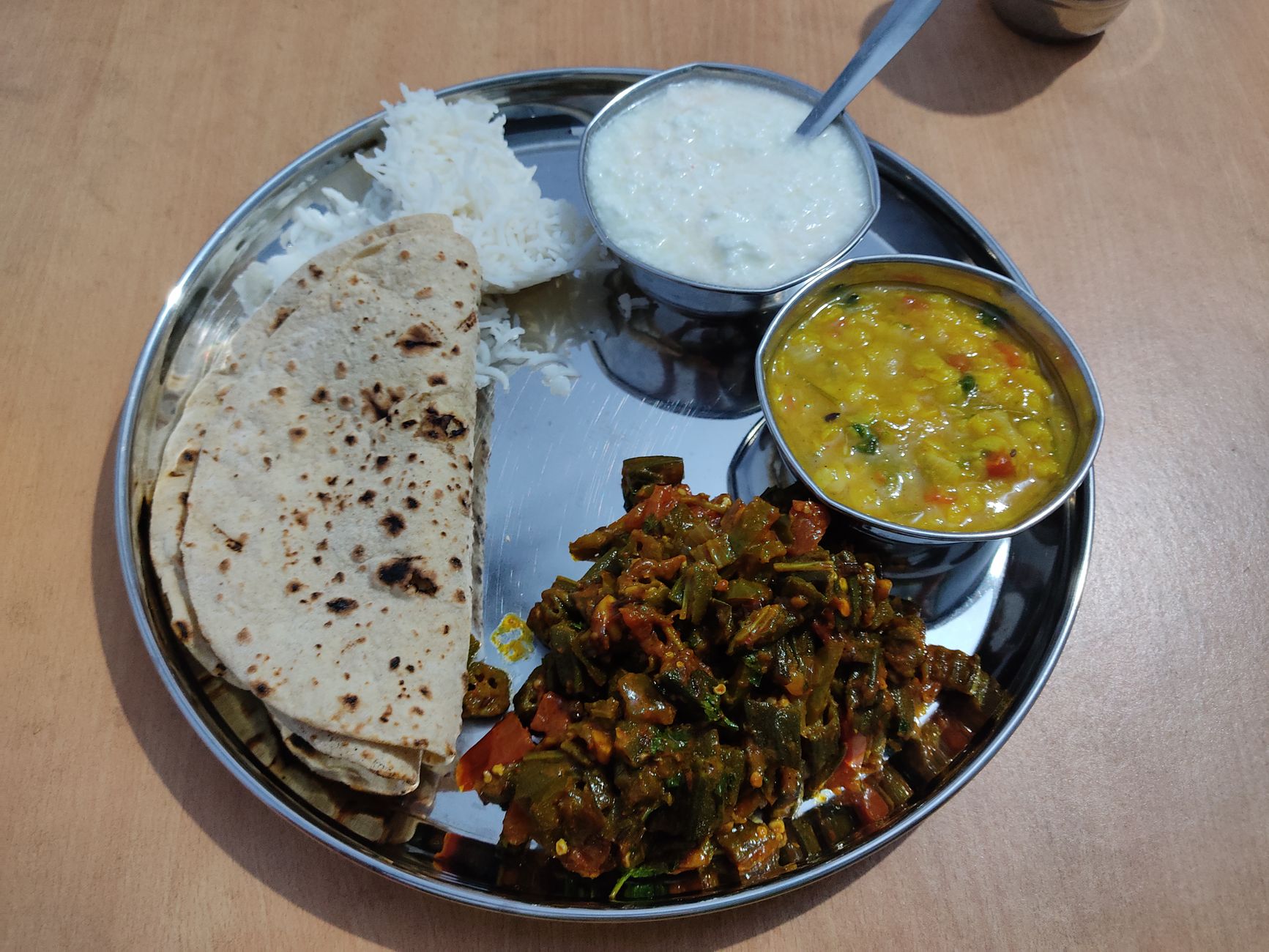
The practical version: mild, not bland. Your dal and sabzi, cooked without extra salt, mashed to the right thickness, with the mirchi held back for now.
The six months that are actually in your hands
This is where your influence sits.
WHO advises starting complementary foods at six months with small amounts, gradually increasing both consistency and variety, and practising responsive feeding — recognising and responding to signs of hunger and fullness. Two words in that are doing the heavy lifting: variety and responsive.
Expect many repeats before anything is "liked". Reviews put it at roughly 6 to 15 exposures to a new food before intake and preference go up. Most of us quit after three tries and conclude the baby hates lauki. A refusal on try four is data about try four.
Use the window before fussiness arrives. Food neophobia — the refusal of unfamiliar food — rises sharply after the complementary feeding period and peaks between two and six years, and babies generally do not show it before about 20 to 24 months. The months between six and eighteen are therefore unusually generous. If her appetite falls off a cliff after her first birthday, that is its own ordinary story — we cover it in the toddler appetite drop after one.
Keep the division clear. You decide what is offered and when; she decides how much goes in. The AAP's instruction is blunt: if your baby cries or turns away when you feed them, do not make them eat.
Equipment matters less than this does — for bowls, chairs and spoons, see our baby-led weaning starter kit for India.
Your own history with food
You said you have had a hard relationship with food for most of your life, and that you want something different for her. The most protective thing available to you is also the simplest: skip the pressure playbook entirely.
In a twin-cohort analysis, greater pressure to eat was prospectively associated with slower eating and higher food fussiness, using food to reward or soothe was associated with increases in food responsiveness, and the authors concluded that pressuring practices — however well-intentioned — may have a detrimental impact on children's eating behaviours. IAP puts the same point plainly: do not force-feed, because that is how a child starts disliking food and the process of feeding itself.
In an Indian kitchen the pressure rarely comes from you. It comes as one more spoon from a grandparent, a bribe of something sweet, a count of how many bites. You are allowed to be the one stopping the count.
What is not in your hands
Some of this is simply her. Children are biologically inclined to prefer sweeter and saltier tastes and to reject bitter ones more than adults do, and genetically determined individual differences in taste exist and interact with experience. Two babies in the same family, fed identically, will not land in the same place.
What you can offer is a wide, unpressured, repeated introduction to real food. Whether she becomes a child asking for extra karela is not on your performance review.
Questions Indian parents actually ask
I vomited at the sight of rice for nine months. Will she hate rice? There is no evidence route from your aversion to her preference. The studies in this area added a flavour to the mother's diet and then measured the baby's response to that same flavour; a food left out of the diet was not what they tested.
I'm breastfeeding and eating very plain food. Have I missed the flavour window? No. Flavour learning continues through milk and then directly through complementary foods, and variety across meals helps acceptance of new foods. Start eating your own normal food again; that is the intervention.
My mother-in-law says no masala before one year. Who's right? Neither of you can cite a rule, because there isn't one for individual spices. IAP's own preference is regular family food that is culturally acceptable rather than separately cooked baby food, with salt and sugar being the restrictions that are actually named.
She spat out palak twice. Do I drop it? Not yet. Six to fifteen tries is the realistic range before liking shifts, and IAP suggests retrying refused preparations in different combinations, tastes and textures.
Can I guarantee an adventurous eater if I do all this? No, and anyone promising that is selling something. Individual genetic differences in taste are real and interact with everything you do. You are improving odds, not programming an outcome.