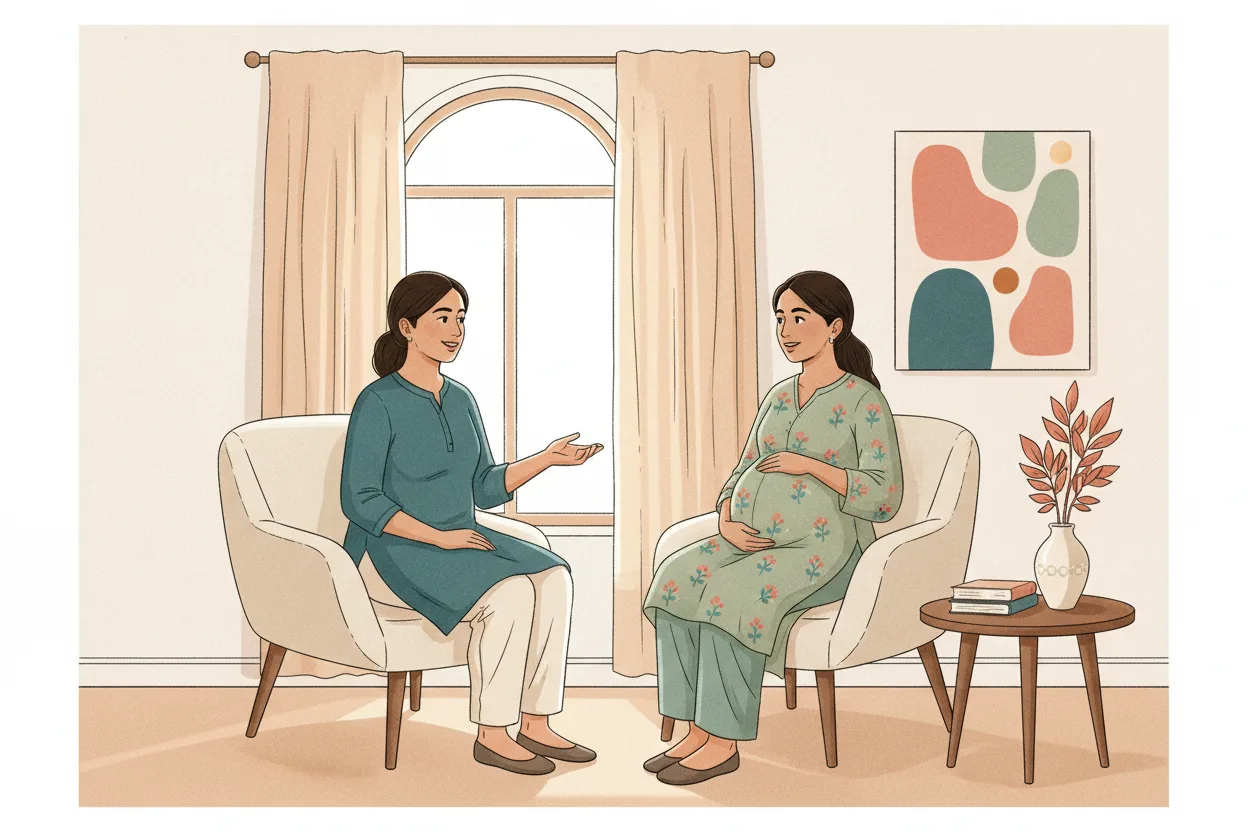
Your doctor felt your pelvis at a check-up and said it seems "small" or "narrow" — that alone does not mean you need a planned c-section. It means your doctor wants to watch labour closely and decide as it unfolds, not that the decision is already made.
Not medical advice — consult your obstetrician for guidance specific to your pregnancy.
Why a Pelvic Exam Alone Doesn't Decide Your Delivery
A clinical pelvic exam is a rough estimate, not a precise measurement. In the past, doctors sometimes used X-ray pelvimetry — imaging the pelvis to measure it — to try to predict whether labour would succeed. A Cochrane systematic review found there is not enough evidence to support using X-ray pelvimetry to decide on mode of delivery when the baby is head-down, and that relying on it raises the cesarean rate without a proven benefit to the baby. This is a big part of why a hands-on pelvic impression, which is far less precise than an X-ray, shouldn't by itself settle the question of how you'll deliver. In fact, a review in Cureus on the modern utility of pelvimetry states there is no modern evidence that a manual pelvic assessment has any benefit to prenatal or intrapartum care at all — the only reliable way to test whether your pelvis is adequate is by attempting labour itself.
Babies' heads also mould, and the pelvis has some give during labour that a resting exam can't capture. That's why "possibly small pelvis" more often becomes a plan to attempt labour with close monitoring, called a trial of labour, rather than an automatic booking for surgery.
What "Trial of Labour" Actually Means
A trial of labour means your care team lets labour start and progress naturally, tracking it in real time, and moves to a c-section only if a genuine problem shows up along the way — not because of a prediction made weeks earlier.
WHO's Labour Care Guide manual states that the tool is designed to support good-quality, evidence-based, respectful care during labour and childbirth, irrespective of the setting or level of health care. In practice, this means your doctor or midwife charts your cervix's dilation, your baby's heart rate, and your contractions on a standard timeline through labour — watching for a genuine departure from normal progress, not deciding your outcome in advance. That standard has also gotten more forgiving: a FIGO position statement on the WHO Labour Care Guide states that a cervical dilation rate as slow as 0.5 cm an hour is still considered normal, not the older 1 cm-an-hour benchmark, because that older standard turned out to be unrealistically fast for many women. So slower-than-expected progress alone isn't automatically a red flag.
One of the recognized reasons a cesarean does become necessary is when labour simply isn't progressing as it should. NIH's MedlinePlus states that "labor is not moving along as it should" is among the medical reasons for a c-section — but this is something assessed hour by hour once you are actually in labour, using tools like the Labour Care Guide, not decided from a pelvis measurement taken during a routine antenatal visit.
The Bigger Picture: C-Section Rates in India
It helps to know the context your doctor is weighing this in. An analysis of National Family Health Survey (NFHS-5) data found that India's cesarean delivery rate has climbed sharply — from 8.5% in 2005-06, to 17.2% in 2015-16, to 21.5% in 2019-21. That rise is part of why many obstetricians today are more cautious about defaulting to a planned c-section on a suspected small pelvis alone.
Globally, the pattern looks similar. A study in Nature Medicine on the WHO Labour Care Guide pilot in Indian hospitals found that the global cesarean rate increased by 19 percentage points between 1990 and 2018, driven in large part by cesareans performed without a clear medical indication — that is, unnecessary cesareans. That's exactly why tools like the Labour Care Guide have been piloted in Indian hospitals: to support decisions grounded in how labour is actually going, rather than in assumptions made beforehand.
This doesn't mean c-sections are being discouraged when they're genuinely needed. The WHO Statement on Caesarean Section Rates states that a cesarean should be undertaken when medically necessary, and that rather than striving to hit a specific population rate, the focus should be on providing a cesarean to every woman who actually needs one. In other words, the well-known "10-15%" figure you may have heard isn't a rule for judging your individual pregnancy — it was a population-level benchmark. Your case is decided on your labour, not a national statistic.
Weighing the Decision: What's Actually at Stake
If your doctor is offering you a genuine choice between attempting labour and a planned c-section, it helps to understand why many doctors lean toward giving labour a real chance when there's no other complication. A systematic review and meta-analysis found that cesarean delivery is associated with long-term risks for the baby and for future pregnancies, compared with vaginal delivery. This is a meaningful part of why doctors take a trial of labour seriously rather than defaulting straight to surgery — it isn't just about this delivery, but about your next pregnancy too, if you're planning one.
None of this means a trial of labour is risk-free, or that a planned c-section is the wrong call when there's a real medical reason for one — twins, a breech baby, placenta previa, or a genuinely obstructed labour, for instance, are different situations entirely. The point is that "your pelvis felt small on exam" is a prompt for closer monitoring, not a verdict.
Questions to Ask Your Doctor
Walking into your next antenatal visit with clear questions helps you understand your specific plan instead of just an odds guess:
- What exactly did the exam suggest, and how confident are you in that impression?
- Would you recommend attempting a trial of labour, and what would make you move to a c-section during labour?
- Which hospital facilities do you have for monitoring labour progress closely (partogram or Labour Care Guide, continuous fetal monitoring, on-call surgical team)?
- If we do need a c-section, would it be planned in advance or decided during labour?
- What does "failure to progress" look like in practice — how long would you let labour continue before deciding?
Bring your partner to this conversation. Understanding the plan together makes the decision — and the birth itself — feel less like something that's happening to you and more like something you're both prepared for.
Frequently Asked Questions
Does a "small pelvis" on a physical exam mean I'll definitely need a c-section? No. A hands-on pelvic exam is an estimate, and the evidence doesn't support using pelvis measurements alone to decide mode of delivery. Most doctors recommend attempting labour with close monitoring unless another complication is present.
What is cephalopelvic disproportion (CPD)? A study on childbirth simulation and cephalopelvic disproportion, published in Nature's Scientific Reports, states that CPD is a mismatch between the size or shape of the baby's head and the mother's pelvis that causes labour to fail to progress. It's confirmed by how labour actually unfolds — a slowing of labour, a stall in cervical dilation, or the baby's head not descending — not predicted beforehand from an exam. Even among cases where labour isn't progressing normally at term, most still end in a vaginal birth: roughly 75-80% deliver vaginally, with a cesarean needed in the remaining 20-25%.
Why did my cesarean rate feel so common among people I know? C-section rates in India have risen substantially over the past two decades. That rise is exactly why many obstetricians today are more cautious about recommending a planned c-section without a clear medical reason.
Is it safe to attempt labour if my doctor mentioned a small pelvis? That's a decision to make with your doctor based on your full picture — your baby's size and position, how your pregnancy has gone, and your hospital's monitoring capability. A trial of labour is a supervised, monitored process, not an unsupported gamble.
What happens if labour doesn't progress during a trial of labour? Your care team will be tracking labour closely. Labour not progressing as it should is a recognized reason a cesarean may become necessary, and your doctor will discuss it with you as it happens rather than as a decision made in advance.
Does choosing a trial of labour mean I'm taking on more risk than a planned c-section? Both paths carry different trade-offs. Research shows cesarean delivery carries its own long-term risks for future pregnancies, which is one reason many doctors support a genuine trial of labour when there's no other complication. Ask your doctor to walk you through the specific trade-offs for your situation.