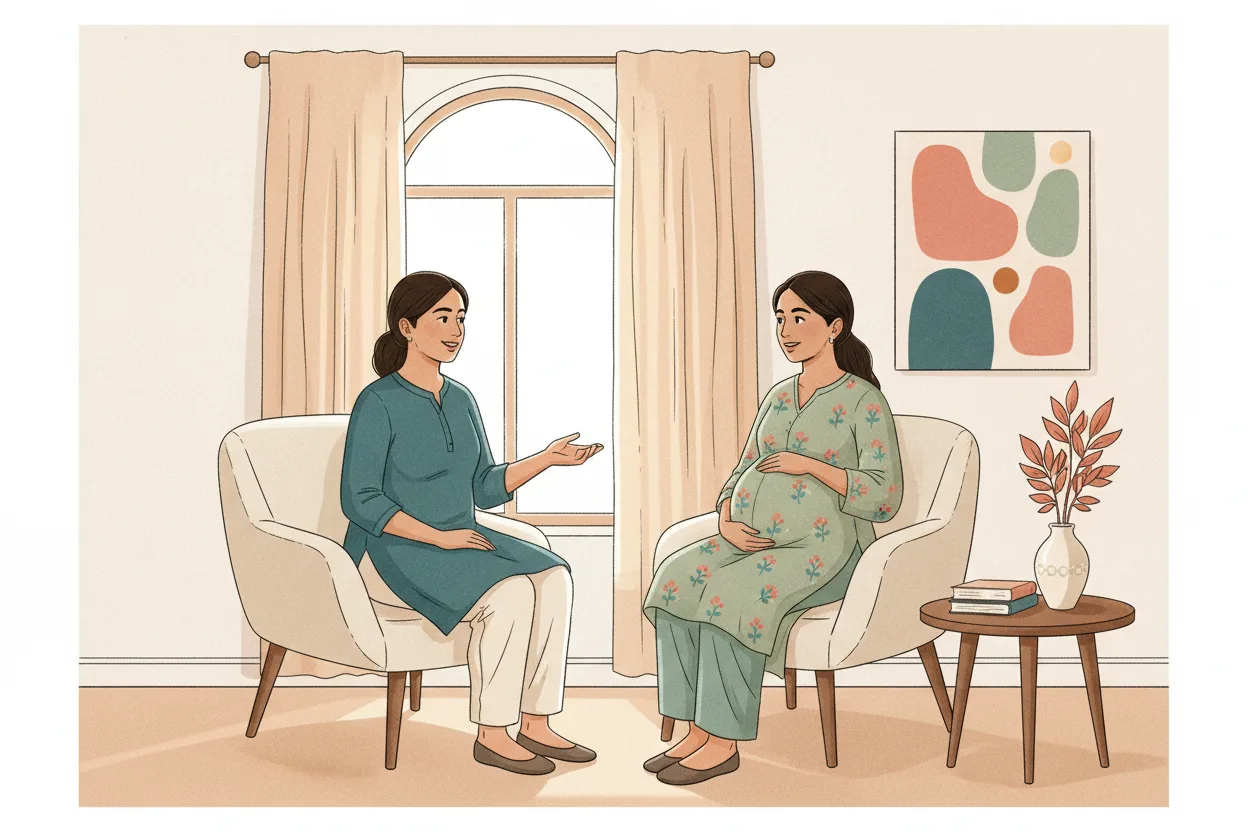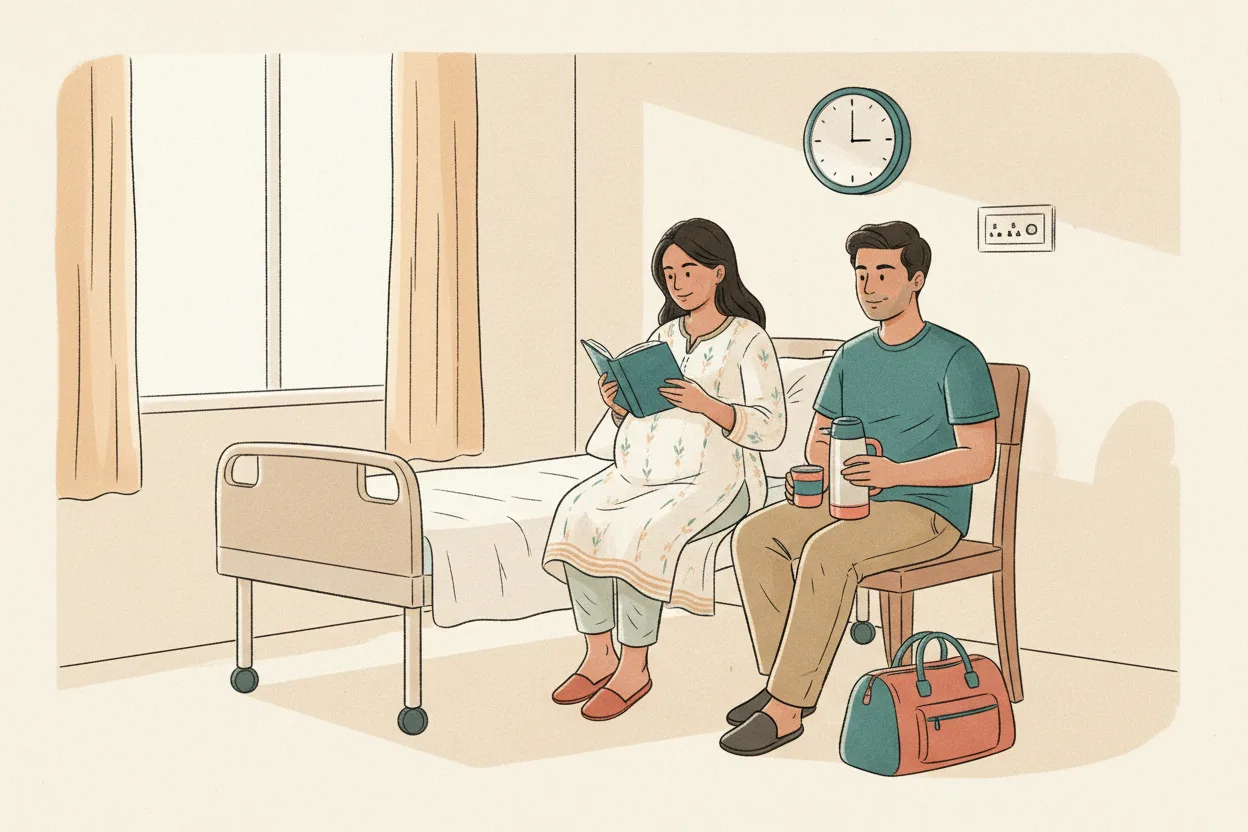
If your doctor keeps saying "let's see how labour progresses" instead of committing to vaginal delivery or a planned C-section, that isn't your doctor being vague. Vaginal birth is usually the safer option with a shorter recovery, but a C-section can turn out to be the only safe option depending on how your labour actually unfolds — which is exactly why a good obstetrician won't lock in a mode of delivery months in advance.
Not medical advice — consult your obstetrician for guidance specific to your pregnancy.
Why your doctor won't commit to one plan
It can feel unsettling to reach the third trimester without a fixed answer, especially when relatives keep asking "normal delivery ya operation?" as if it's a simple choice you're supposed to make. It isn't. The World Health Organization does not recommend that countries or individual doctors aim for a specific caesarean rate — the goal is to give a C-section to the women who medically need one, not to hit a target number, and definitely not to promise one in advance for convenience.
This "wait and see" approach has a clinical basis. A joint workshop report from NICHD, the Society for Maternal-Fetal Medicine, and ACOG states that adequate time should be allowed for the first and second stages of labour to progress before a doctor diagnoses arrest of labour and moves to a caesarean, unless there is a medical reason to act sooner. In plain terms: your body gets a fair chance to labour on its own terms first, and the decision on how you deliver is made in real time, based on how you and your baby are actually doing — not on a plan drawn up in month seven.
What would actually tip the decision. It helps to know the specific things your doctor is watching for, rather than treating "wait and see" as a black box. The same NICHD/SMFM/ACOG workshop report defines arrest of active labour as no cervical change for 4 or more hours despite adequate, strong contractions — or 6 or more hours if contractions are weaker than ideal — before a caesarean is considered on that basis alone. Your baby's heart rate pattern is the other main trigger: the same framework sorts fetal heart rate tracings into three categories, where a reassuring ("Category I") pattern needs no action, a "Category II" pattern prompts closer monitoring and simple interventions like a position change or fluids, and a "Category III" pattern — predictive of the baby not getting enough oxygen — is what actually moves a doctor toward an urgent C-section. Knowing these two triggers (labour not progressing on a defined timeline, or the baby's heart rate pattern turning concerning) turns "wait and see" into a checklist you can ask your doctor about directly, instead of an open-ended unknown.
The India-specific context
This is a genuinely important message in India right now. An analysis of NFHS-5 government survey data found that India's caesarean section rate has risen to 21.5% nationally — well above the range the WHO associates with medical necessity. That backdrop is part of why more Indian obstetricians are deliberately avoiding a default-to-C-section approach and instead waiting to see how labour actually goes: it's the evidence-based response to a system that has, in aggregate, been intervening more than it needs to. This isn't only a global concern imported into India — FOGSI, the Federation of Obstetric and Gynaecological Societies of India, has itself called for a national registry that tracks caesarean rates hospital-by-hospital using the WHO's Robson classification system, specifically to identify and curb unnecessary primary C-sections, so your doctor's "wait and see" approach reflects a priority Indian obstetric bodies have set for themselves, not an outside standard being applied to you.
It also helps to have a real number in mind rather than just the abstract possibility of a switch. One observational study of women admitted in spontaneous labour at an Indian tertiary care hospital found that about 4 in 5 went on to deliver vaginally, and roughly 1 in 8 needed a C-section — useful context for calibrating how likely a mid-labour switch actually is, even though the exact figure will vary with your own health history and hospital.
It also means you may be surrounded by family members whose own deliveries were more prescriptive — a scheduled C-section on an "auspicious date," or a strong family pressure toward one mode or the other. Your doctor keeping the door open on both isn't indecision. It's your doctor treating your labour as the thing that will decide the outcome, not a preference set months earlier.
Coping with not having a fixed plan
Not having a fixed birth plan is uncomfortable precisely because pregnancy already comes with so much you can't control. That discomfort is real and common. A 2021 Cochrane review notes that for some women, fear of childbirth is so severe that it affects their daily lives and spoils the experience of pregnancy — so if the uncertainty is weighing on you, you are not overreacting, and it's worth naming that to your doctor rather than sitting with it alone.
A few things genuinely help:
Ask for the plan behind the "no plan." Your doctor isn't refusing to plan — they're planning for both paths. Ask directly: "What would tip this toward a C-section for me specifically, and what would keep me on track for vaginal delivery?" Understanding your own specific factors — the baby's position, how labour is progressing, your health history — turns vague uncertainty into a concrete, known set of possibilities.
Line up support for labour itself, not just an outcome. A meta-synthesis of women's experiences of continuous labour support — from a partner, doula, or known caregiver — found that it reduces the need for medical interventions and improves both maternal and newborn outcomes. This is something concrete you and your partner can plan for right now, even while the delivery mode itself stays open: decide who will be with you through labour, and make sure your partner knows their role isn't a "helper" on the sidelines — they're your continuous support, and that support has a measurable effect regardless of how you end up delivering.
Take a structured antenatal class, not just Instagram reels. A review of WHO recommendations states that health education for women is an essential component of antenatal care, and that structured programmes — including childbirth workshops, relaxation training, and psychoeducation for fear of pain — are recommended specifically to reduce unnecessary caesarean births. A good class run by your hospital or a certified childbirth educator will walk you through what labour actually feels like stage by stage, which does more for your anxiety than any fixed plan would, because it prepares you for the process itself rather than one predicted ending.
Separate "no fixed delivery mode" from "no birth preferences." You can still write down what matters to you within either scenario — the people allowed in the room, whether you want delayed cord clamping, your preference for skin-to-skin contact, pain relief options you're open to. Share this with your doctor as a preferences list, not a delivery-mode demand. It gives you a sense of agency over the parts that are actually yours to decide.
What this means for your hospital bag and logistics
Since either path is genuinely possible for you, pack and plan for both.
| Situation | What to prepare |
|---|---|
| Vaginal delivery | Comfortable nightwear that opens at the front for early skin-to-skin and breastfeeding, a birthing ball if your hospital allows one, snacks for early labour |
| C-section (planned or unplanned) | Loose, high-waisted clothing that won't rub the incision, a small pillow to hold against your abdomen during coughs or laughs, information on your hospital's post-op recovery routine |
| Either way | Your medical file and test reports, phone charger, list of emergency contacts, your partner's or support person's ID for hospital admission |
Ask your hospital in advance what their policy is on your support person staying with you if labour shifts to an unplanned C-section — policies vary between Indian hospitals, and knowing this ahead of time removes one more unknown.
Frequently Asked Questions
Is it normal for my doctor to not tell me how I'll deliver until I'm in labour? Yes. Vaginal birth is generally safer with a shorter recovery, but a C-section can be the only safe option depending on how your specific labour unfolds, so most obstetricians deliberately keep the decision open until they can see how you and your baby are actually doing.
Should I ask for a scheduled C-section just to have certainty? Talk to your doctor about your specific situation rather than requesting a mode of delivery for the sake of avoiding uncertainty. WHO's position is that caesareans should be reserved for women who need them medically, not scheduled to hit convenience or a target rate.
My in-laws keep asking which type of delivery I'm having. What do I say? You can honestly tell them your doctor is monitoring your labour and will decide with you in real time, based on what's safest for you and the baby. That is the medically correct answer, not an evasive one.
Does not having a birth plan mean I have no say in what happens? No. You can still set preferences for either scenario — the support person with you, pain relief choices, skin-to-skin contact, cord clamping — and discuss them with your doctor. What stays undecided is only the mode of delivery itself.
Is my anxiety about not knowing normal, or should I get help? It's common to feel anxious about this. A 2021 Cochrane review found that for some women, fear of childbirth is severe enough to affect daily life and spoil the experience of pregnancy — if that's you, mention it to your obstetrician at your next visit; many hospitals in Indian cities can refer you to a counsellor experienced with pregnancy-related anxiety.
Can antenatal classes actually reduce my chances of needing a C-section? Structured antenatal education is one of the tools a WHO-recommendations review points to for reducing unnecessary caesarean births, alongside relaxation training and support for fear of labour pain. It won't guarantee a vaginal delivery, but it's a concrete, evidence-backed way to prepare.