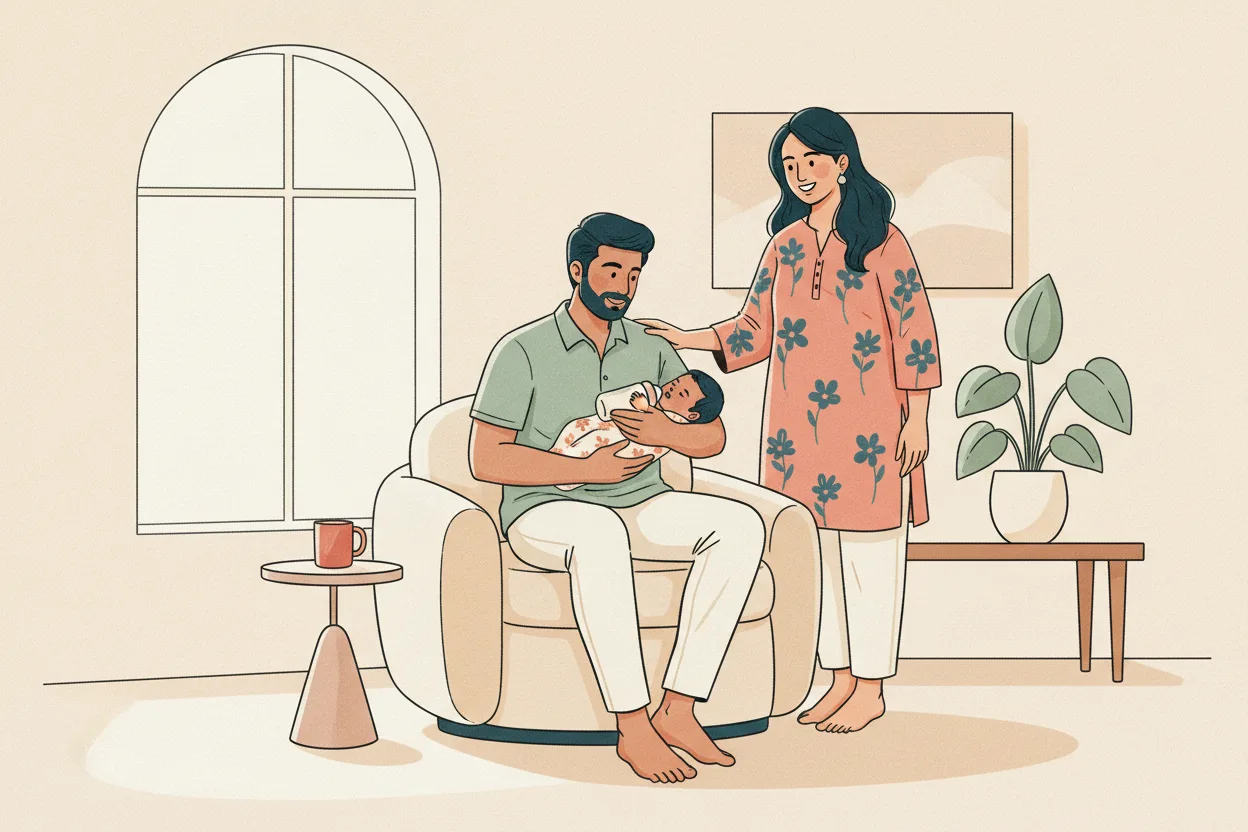


That knot in your stomach when your mother-in-law, your own mother, or a nanny you trust is holding your baby in the next room isn't a sign that you're an overprotective new parent. A peer-reviewed review in Social Cognitive and Affective Neuroscience found that the postpartum brain reliably activates brain networks in response to a baby's distress cues — you are neurologically primed to stay tuned in, even when you know your baby is safe. Once you understand what's driving that hypervigilance, you can tell normal new-parent watchfulness apart from something that needs attention, and start actually using the break you're being given.
Not medical advice — consult your doctor or a mental health professional if this is affecting your daily life.
Why It Feels Sharper in an Indian Joint Family
In a lot of Western advice, "let someone else watch the baby" is framed as a simple errand. In an Indian home, it's rarely that simple. You might be handing your baby to a mother-in-law with strong opinions of her own on burping, feeding, or dressing the baby for the weather, different from yours. Or to a nanny you've known for three weeks. Or you're stepping out for a haircut while your own mother insists you "go and relax" and then calls you twice in twenty minutes with updates you weren't expecting.
None of this is really about whether the caregiver is competent. It's your own nervous system doing its job a little too well, layered on top of family dynamics you're still negotiating. Naming that separately — "this is my brain, not a judgment on her" — often helps.
What's Actually Happening in Your Brain
This is, quite literally, in your head — and it's temporary and adaptive, not a flaw.
A peer-reviewed review in Social Cognitive and Affective Neuroscience found that infant distress cues — sounds, photos, even videos — consistently activate networks in the postpartum brain, including the amygdala, the region tied to threat-detection and vigilance. That's why you can be mid-conversation and still clock the exact moment your baby's cry changes pitch two rooms away.
A 2024 review in Translational Psychiatry found that these early structural changes in emotion-processing regions of the brain are linked to more attentive caregiving in the first three months. The same wiring that makes you acutely tuned in to your baby is also what makes you a responsive parent — it's a feature that's currently running a little hot, not a malfunction.
It also gets worse when you're exhausted. A peer-reviewed study of postpartum women found that poor sleep quality was significantly associated with greater anxiety symptoms in the postpartum period — so the nights you're most drained are often exactly when handing off the baby feels hardest to tolerate.
Normal Watchfulness or Something More?
Most new parents feel some version of this. The question is where the line sits.
| Normal new-parent watchfulness | Worth a conversation with a doctor | |
|---|---|---|
| Feeling | Alert, a little uneasy, eases within minutes | Constant, hard to switch off |
| While baby is with a trusted caregiver | You check in once, then relax | You can't focus on anything else the whole time |
| After the handover ends | Relief, back to normal | Relief doesn't fully arrive; worry carries into the next thing |
| Sleep and appetite | Mostly intact | Noticeably disrupted beyond baby's own waking |
Cleveland Clinic explains that with postpartum anxiety specifically, "the worry can be all-consuming and nonstop" — which is the practical line between the ordinary watchfulness almost every new parent feels and something that deserves support.
Handing Your Baby Over Doesn't Undo the Bond
A common fear underneath the anxiety is that stepping away — even for an hour — will somehow weaken your baby's attachment to you. A peer-reviewed research review notes that secure attachment comes from a caregiver's consistent, sensitive responsiveness, not from one parent's constant physical presence. A grandmother or nanny who responds warmly and consistently when your baby is upset isn't competing with your bond — she's supporting the same kind of security you're building.
Your baby forming a comfortable relationship with another trusted adult is a good sign, not a sign you're being replaced.
How to Actually Rest During the Break
Knowing the anxiety is normal doesn't automatically make it switch off. A few things that give your body an actual off-ramp:
Use the time on purpose, not on your phone. Fidgeting with the baby monitor app for an hour isn't rest — it keeps the same vigilance circuit running. Cleveland Clinic explains that it's normal to check on a new baby out of anxiety, but constantly checking to the point that you can't rest — like repeatedly checking that a sleeping baby is still breathing — goes beyond ordinary watchfulness and is worth naming. Step outside, shower, or lie down instead.
Build a breathing habit before you need it. NHS guidance states that a calming breathing technique helps most "if you do it regularly, as part of your daily routine" — not just in the anxious moment itself. One simple option is box breathing: an NIH clinical reference describes it as four equal steps — breathe in through the nose for a count of 4, hold for 4, breathe out for 4, and hold for 4. A few rounds each morning, before the first handover of the day, makes it easier to reach for in the moment.
Move your body when you can. A peer-reviewed meta-analysis found that moderate aerobic exercise after childbirth can help ease postpartum anxiety and depression symptoms. A 20-minute walk while your baby naps with your mother or the nanny does double duty — it's both the break and the treatment.
Start with short, low-stakes handovers. Fifteen minutes in the next room, then an hour out of the house, then longer. Trust tends to build in steps, not one leap.
When to Talk to a Doctor
The American Academy of Pediatrics notes that about 12% of birthing parents experience depression during pregnancy or in the first year after childbirth — a reminder that perinatal mood and anxiety changes are a common medical reality, not a personal failing or an overreaction. It isn't just a Western statistic, either: a community-based study of postpartum women in rural India, published in the Indian Journal of Medical Research, found that a combined 5.59% had postpartum depression, anxiety, or both.
Cleveland Clinic advises that if anxious, low, or worried feelings continue beyond your second week postpartum, you should contact a healthcare provider rather than wait for it to pass on its own. If you dread every handover, can't enjoy the break once it starts, or the worry is spilling into sleep, appetite, or your relationship with your partner, that's worth raising with your doctor at your next visit — or sooner.
Frequently Asked Questions
Is it normal to not fully trust anyone else with my baby, even my own mother? Some wariness in the early months is common and tied to real changes in your postpartum brain, not a comment on the caregiver. Research shows new mothers' brains are primed to notice and react to infant distress cues.
Will leaving my baby with grandparents or a nanny affect our bond? No. Secure attachment comes from consistent, sensitive responsiveness from a caregiver — it isn't limited to the mother's constant physical presence. A baby can be securely attached to you and comfortable with another trusted, responsive caregiver at the same time.
How long before this hypervigilance eases? Many parents notice it settling over the first few months as sleep improves and routines take shape, though the exact timeline is different for everyone. If it isn't settling — or is getting worse — by the time your baby is a few months old, raise it with your doctor rather than wait it out.
I feel anxious even when the baby is asleep in the next room with my husband. Is that normal? Mild alertness, yes — that's the same underlying wiring at work regardless of who's watching. If the anxiety is constant and doesn't ease once you've checked in, that's worth discussing with a healthcare provider.
Can exercise or breathing exercises really make a difference? Yes, for many people. Moderate aerobic exercise has been shown to ease postpartum anxiety symptoms, and a regular breathing practice reduces the physical symptoms of stress when practiced consistently, not just reached for in the moment.
When should I actually see a doctor about this? If anxious or low feelings continue past your second week postpartum, don't wait for it to resolve on its own — contact your doctor. Perinatal anxiety and depression are common and treatable, and getting help early makes it easier to actually enjoy the support the people around you want to give.