
A nanny stepping out once to buy medicine is nothing. The same half-hour absence almost every day, with a new reason each time, is a pattern — and a pattern is a management problem, not a verdict on her character.
That distinction decides what you do. Read it as suspicion and you end up watching her, feeling awful, and ending a job over something nobody ever spelled out. Read it as unstated terms plus a habit with room to grow, and you have something you can fix in one conversation — or close cleanly, on purpose.
Not medical advice — consult your paediatrician for personal guidance.
There is almost no published guidance on the employment side of this. Where the evidence is real — what a baby this age can do, what supervision buys you — this piece cites it. The rest is judgement, and labelled as such.
One errand is not a pattern
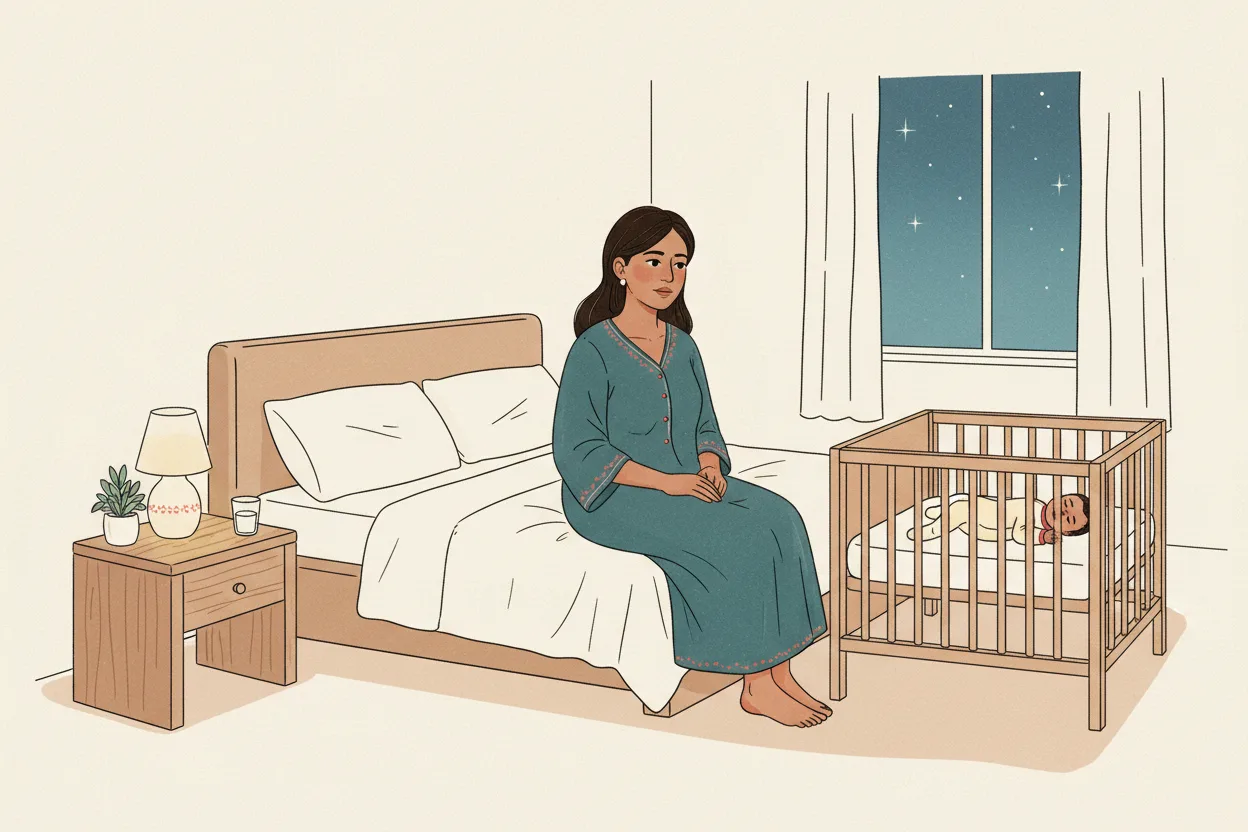
Day three: a headache, medicine, back in half an hour empty-handed. Then her father, waiting downstairs. Now, most days, something new. One at a time each is believable; together the shape is plain — leaving for half an hour has cost her nothing, because nobody set a rule and nobody said anything the first time. That is not sinister. People test the edges of a new job quietly, especially one with no written terms. It is also not workable, because the edge she is testing is the one stretch of your week with no slack in it.
The hours that actually matter
Your baby is almost seven months old. The CDC's six-month milestone checklist lists rolling from tummy to back, pushing up with straight arms on the tummy, and putting things in the mouth to explore them; by nine months the CDC checklist expects a baby to get to a sitting position by herself and sit without support. More reach, more roll, more mouth, every week.
The AAP's guidance on changing tables is blunt: never leave a child unattended on a dressing table, even for a moment, even if he is strapped. The same reasoning runs along your living-room floor, where the AAP's home-safety checklist advises checking constantly for small objects that can be dangerous if a child swallows them. A baby this age also has no way to call anyone.
Supervision is not all-or-nothing either. A 2014 study in the journal Injury Prevention found that lower levels of adult supervision are associated with higher odds of more severe injury in young children. The question is not whether something will certainly happen in thirty minutes — it is that those thirty minutes remove the thing that keeps an injury small.
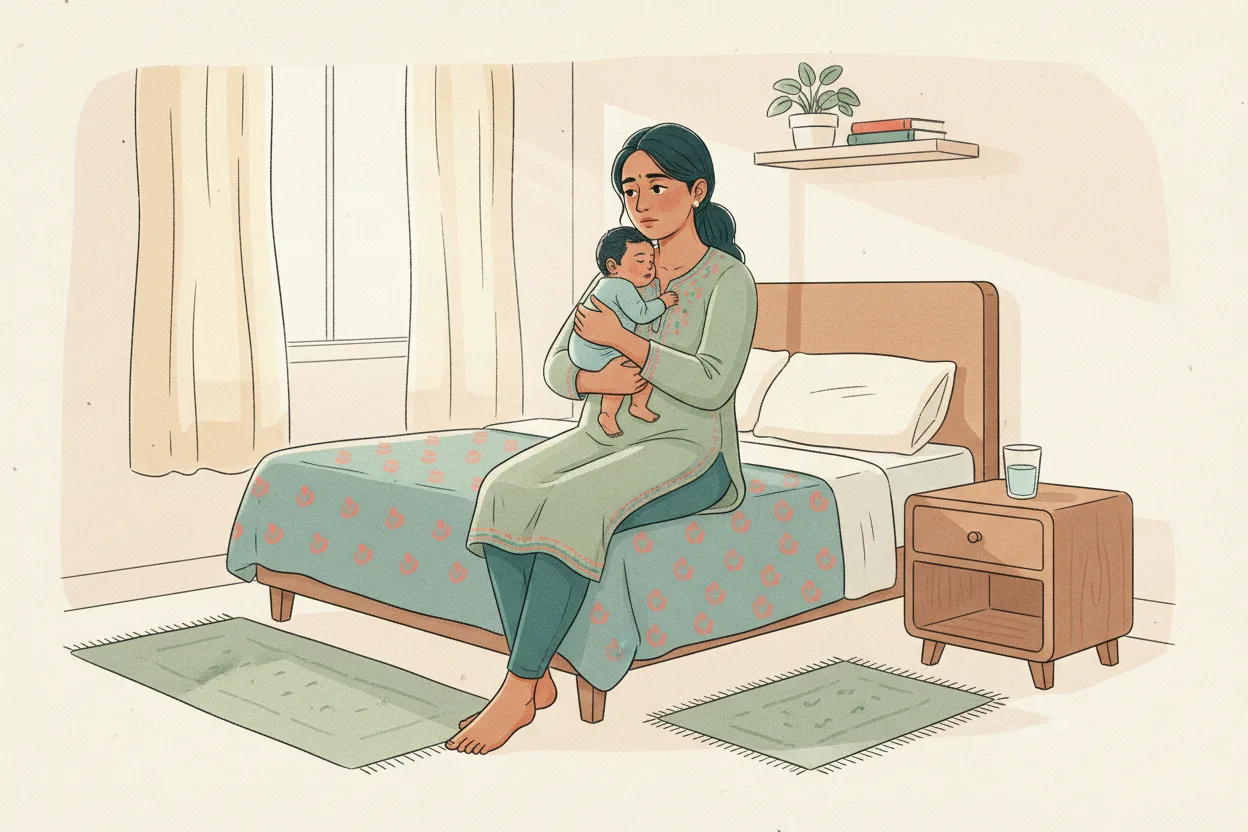
Your mother-in-law being in the house is why the absences have cost nothing yet, and why the habit had room to settle in. Two things end that. One is the morning she leaves for your hometown, after which the shift-split between your office and his leaves a two-to-three hour hole with no parent at home. The other may already be happening: if she was not told she had the baby that afternoon, then for those thirty minutes nobody did.
Write the terms down
No outside rule fills this gap: how much notice she gives before stepping out is a term you set. A February 2019 reply in the Rajya Sabha, released by the Press Information Bureau, stated that the Central Government has not enacted any separate law to protect the interest of domestic workers, with a National Policy on Domestic Workers still in draft at that point. Whatever the two of you write down is the arrangement.
The AAP's guidance on finding a sitter says to make sure a caregiver understands the rules that apply at your home — taking your child outside among them — and to explain your expectations fully. Its checklist for parents and sitters adds that you should tell the sitter where you will be and when you will return, leave emergency contacts written down, and tell her to call or text for help with any problem. In your house, none of that is on paper yet. One page, six lines:
| The term | What it says | The sentence to say |
|---|---|---|
| Hours | 9–6, Mon–Sat, lunch 1–2 taken in the house | "Your hours are nine to six. Lunch is one to two, and you take it here." |
| Leaving the premises | Not during duty hours, except by prior agreement | "If you need to go out, ask me the day before — or call and wait for me to say yes. Please don't step out and tell me afterwards." |
| Who is in charge if you do go | A named adult, told directly, confirmed by message | "Before you leave, tell Mummyji to her face that she has the baby, and message me. Not a note, not an assumption." |
| The phone | On, on you, answered | "Keep your phone on and with you. If I call twice and you don't pick up, I'll call Mummyji and then I'll come home." |
| On the fridge | Both our numbers, Mummyji's, the paediatrician's, the guard's, the flat address | "This stays on the fridge. If anything happens, call me first, then the doctor." |
| What follows a repeat | First time: this conversation. Next time: the job ends, dues paid | "I'm saying this once, clearly, so there's no confusion later. If it happens again, we'll finish there and I'll pay you for the days you've worked." |
Hand her the page, keep a copy, and ask her to say it back in her own words. The AAP notes that an in-home caregiver should be willing to provide a complete daily schedule and report of your child's activities — resistance to writing the day down is information in itself.
Deciding whether to keep her
Two nannies in two months is a real cost and a real reason to go slowly: every change buys another round of training, another stranger learning your baby's naps, another stretch of managing instead of working. A month already invested is worth something.
One line, though, is not a matter of patience: whether your baby was unsupervised. An annoying habit — long calls, a slow start, opinions you didn't ask for — is something you manage. Thirty minutes with no adult in the house is a different category, and it doesn't get a second chance. If you can establish it happened even once, that is a clean reason to end the arrangement, said plainly, without assembling a case.
You may not be able to establish it: your mother-in-law may genuinely not recall which afternoons she had the baby herself. That ambiguity is the reason to set the terms this week, so the next instance is unambiguous and the decision makes itself.
Settle the fallback before she books her ticket. The AAP's guidance on child-care choices points out that you need a backup plan in place for those times when your child's caregiver is sick; a backstop leaving the state is the same problem with more notice. Realistically: one parent's office hours formally shifted so the gap closes, a second trusted adult on call, or daycare brought forward. Choosing now is what stops you keeping a nanny you have stopped trusting because there is nothing behind her.
Monitoring, and saying so
A camera in the shared living areas — where the baby plays and naps during the day — is a legitimate option, and plenty of urban Indian households run one. Two conditions keep it defensible: common space only, not her room or bathroom or wherever she rests; and she is told on day one. Telling her is also the more effective choice, because a camera she knows about changes what happens, while a hidden one only tells you afterwards and costs you the relationship the day she finds it.
Section 3 of India's Digital Personal Data Protection Act, 2023 states that the Act does not apply to personal data processed by an individual for any personal or domestic purpose, which puts a household camera kept for your own use outside that statute — not the same as anything goes. Recording where she sleeps or washes, or recording audio covertly, raises separate questions under general law that we could not settle from a primary source, so treat it as an ethical and employment matter first.
If a camera feels like too much, the same AAP page suggests frequent, unannounced visits from friends or family members, precisely because it is not easy to know for sure what your child's caregiver is doing when you're not there. A relative dropping in at an unscheduled hour does much of the same work.
What this is not
Three things tangle with this one and are separate: the ordinary dread of handing your baby to anyone at all, a nanny with firm views on how you parent, and a mother-in-law taking over the hiring. If what you want is a spot where the baby is fine for ten minutes, that is a setup question.
One conversation, one page, one clear line around the hours when she is the only adult in the house. If the half hours stop, you have a nanny worth keeping and a month of training that wasn't wasted. If they carry on, you aren't ending this over a headache — she has already answered the question.