
AAP's HealthyChildren.org explains that colds are caused by viruses — not bacteria — which means antibiotics cannot treat them. For most young babies with a cold, supportive care at home is the right approach while the illness clears on its own.
Not medical advice — consult your paediatrician for personal guidance.
Why Monsoon Colds Are Harder to Navigate in India
India's monsoon season brings cool, damp conditions that keep families indoors together — ideal conditions for respiratory viruses to spread. Young babies in the first few months of life are especially vulnerable because their immune systems are still developing. A cold in a newborn can feel alarming, and the instinct to act quickly is understandable.
One of the most effective things parents can do is reduce the chance of the virus reaching the baby in the first place. AAP's HealthyChildren.org recommends washing hands with soap and water for at least 20 seconds before touching the baby, and limiting baby's exposure to anyone with a cold — including older siblings who may come home with school-spread viruses during the monsoon months.
What makes this trickier in India is the pressure to do something visible. Grandparents may suggest remedies passed down through generations. Some paediatricians reach for a prescription at the first visit. A 2023 cross-sectional study of Indian children found that 18.7% of under-three-year-olds with symptoms of acute respiratory infection received antibiotics as treatment — even though the vast majority of such infections are caused by viruses. Knowing what actually helps — and what to push back on — matters.
What's Safe to Do at Home
Saline Drops and Gentle Suctioning
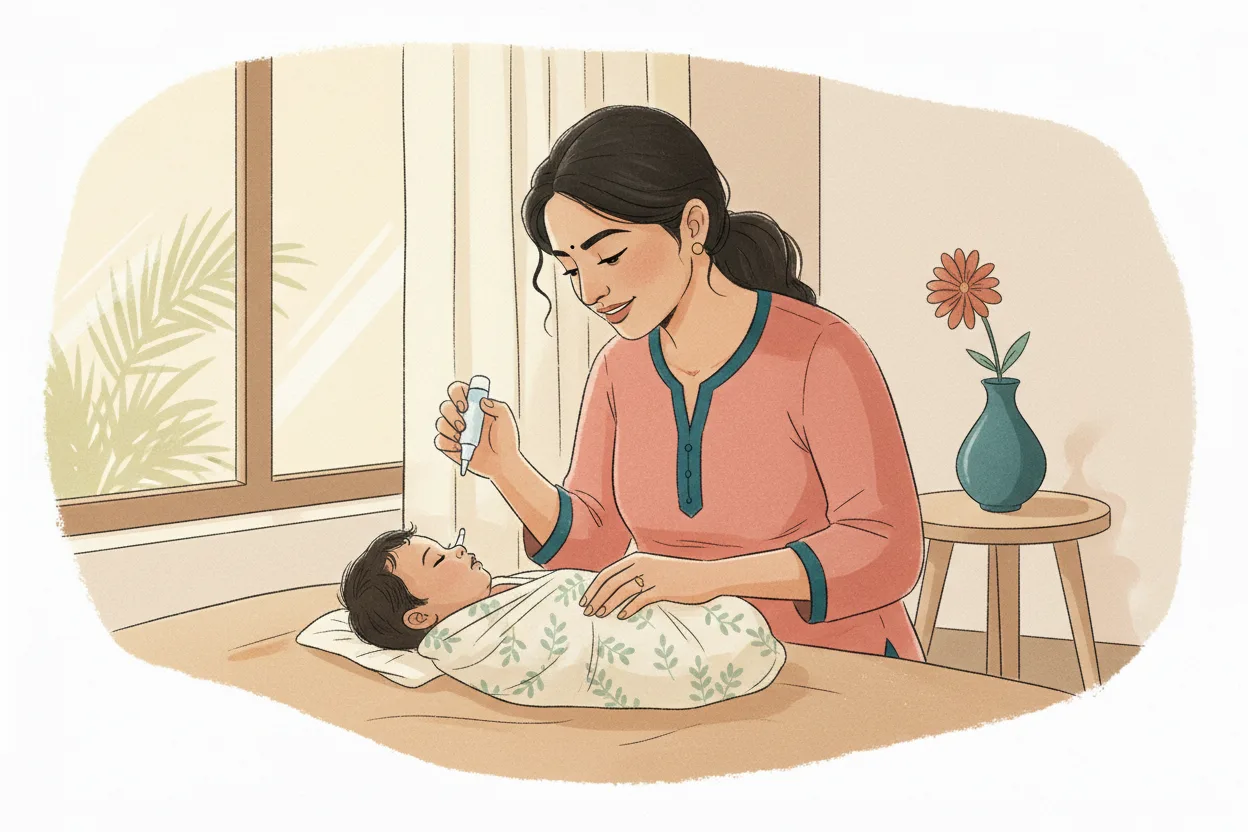
A blocked nose is one of the hardest parts of a baby cold because it makes feeding uncomfortable. AAP's HealthyChildren.org recommends placing two drops of saline solution in each nostril to loosen congestion, then using a suction bulb to draw out the saline and mucus. This is medication-free and safe for newborns.
Sterile saline nasal drops are available at any pharmacy across India without a prescription. Use the bulb syringe before feeds so baby can breathe and latch more comfortably.
One thing to avoid while clearing congestion: AAP's HealthyChildren.org warns it is NOT safe to prop up your baby on towels or incline their mattress to ease breathing. When a baby's head is propped up, the neck can bend forward and narrow the airway, making breathing harder rather than easier. Always lay baby flat on a firm surface for sleep.
Cool-Mist Humidifier
Adding moisture to the air can help relieve a stuffy nose and dry coughs. AAP's HealthyChildren.org explains that cool-mist humidifiers are generally considered safer for young children than warm-mist humidifiers or steam vaporizers because there is no risk of burns. Change the water daily and clean the unit regularly to prevent mould and bacterial build-up, which can be an issue in India's humid monsoon conditions. Place it near the baby but out of reach, and do not aim it directly at the cot.
Keep Breastfeeding
If you are breastfeeding, keep going — even if feeds are shorter or more frequent than usual. A 2019 systematic review found that all studies examining lower respiratory tract infections as the outcome showed decreased risks of these infections in breastfed infants — your milk delivers immune support to baby at exactly the time they need it most.
A blocked nose can make latching uncomfortable. Saline drops before a feed and a slightly more upright nursing position often help.
What to Avoid
Over-the-Counter Cough and Cold Medicines
AAP's HealthyChildren.org warns that over-the-counter (OTC) cough and cold medicines should NOT be given to infants and children under 4 years of age because of the risk of dangerous side effects. This includes cough syrups, decongestants, antihistamines, and combination cold products — even formulations marketed specifically for children. If you are unsure about a product, check with your paediatrician before giving it to a young baby.
Honey
The CDC warns not to feed honey to a child who is younger than 1 year old. Honey can contain bacterial spores that cause infant botulism, a potentially life-threatening illness. This applies to all forms of honey — raw, processed, in warm water, or mixed into any food.
Antibiotics
AAP's HealthyChildren.org cautions that treating viral infections with antibiotics almost never prevents bacterial infections; however, they may instead cause diarrhea or other side effects. If a paediatrician prescribes antibiotics for what appears to be a straightforward cold, it is reasonable to ask whether the illness is confirmed to be bacterial before proceeding.
When to Call Your Paediatrician Right Away
Most colds resolve without medical treatment. Two situations need urgent action.
Fever in a baby three months old or younger. AAP's HealthyChildren.org advises that if your baby is 3 months of age or younger and has a rectal temperature of 100.4 degrees Fahrenheit (38 degrees Celsius) or higher, call your pediatrician immediately. In a very young baby, fever signals that something more serious may be happening — do not wait to see if it comes down on its own.
Signs of serious breathing difficulty. AAP's HealthyChildren.org describes the warning signs that breathing has become very hard: a bluish tint around the lips or fingertips, nostrils flaring wide with each breath, visible retractions between or below the ribs, or wheezing. These are emergency warning signs — go to a hospital emergency department right away.
Mention these to your paediatrician the same day:
- Baby is feeding noticeably less than usual, or producing far fewer wet nappies
- Symptoms seem to be worsening rather than improving after several days
- Baby seems unusually hard to rouse or is very lethargic
- Baby is younger than one month old with any cold symptoms
Practical Products That Help
| Product | Purpose | Price range | Where to buy |
|---|---|---|---|
| Sterile saline nasal drops | Loosens nasal congestion before suctioning | Rs. 60 – Rs. 200 | Amazon.in / FirstCry |
| Nasal aspirator / bulb syringe | Suctions mucus after saline drops | Rs. 100 – Rs. 400 | Amazon.in / FirstCry |
| Digital rectal thermometer | Most accurate temperature reading for newborns | Rs. 300 – Rs. 900 | Amazon.in |
| Cool-mist humidifier | Adds moisture to ease congestion; safer than steam vaporizers | Rs. 1,500 – Rs. 4,000 | Amazon.in / FirstCry |
A rectal thermometer is the most accurate way to check temperature in a newborn. Keep one at home if you have a baby under three months — taking temperature by touch is not reliable for a fever decision.
Frequently Asked Questions
Can I use Vicks VapoRub on my baby? AAP's HealthyChildren.org warns against OTC cough and cold medicines and products for infants. Do not apply Vicks or similar camphor-based products to a young baby — camphor is potentially toxic to infants even through skin contact.
My paediatrician has prescribed antibiotics for baby's cold. What should I ask? Ask whether the illness is confirmed bacterial or viral. AAP's HealthyChildren.org cautions that treating viral infections with antibiotics almost never prevents bacterial infections and may cause side effects such as diarrhoea. If a bacterial co-infection such as an ear infection is confirmed, antibiotics may be warranted — but for a straightforward viral cold, they are not.
Can I give gripe water or ajwain water for baby's cough? These have no evidence base for treating colds or coughs in newborns. A baby under six months needs only breastmilk or formula. Check with your paediatrician before offering anything else.
How long does a baby cold usually last? Most viral colds in babies improve over the course of a week or so. Symptoms tend to be worst in the middle days and then gradually get better. If baby develops a fever and is three months old or younger, call your paediatrician immediately — do not wait.
Is it safe to take baby out during India's monsoon? Brief outings in mild weather are generally fine once baby is past the newborn stage. During a cold, keep baby away from crowded indoor spaces and other young children until symptoms have cleared. The main concern is spreading the virus to other babies, not outdoor air itself.
Should we keep the room warm when baby has a cold? Comfortable room temperature is best — not overheated. A very warm room can make a congested baby more uncomfortable. If using air conditioning, set it to a comfortable temperature and make sure it is not blowing directly at baby.
Illustrations: RaisingWell.