
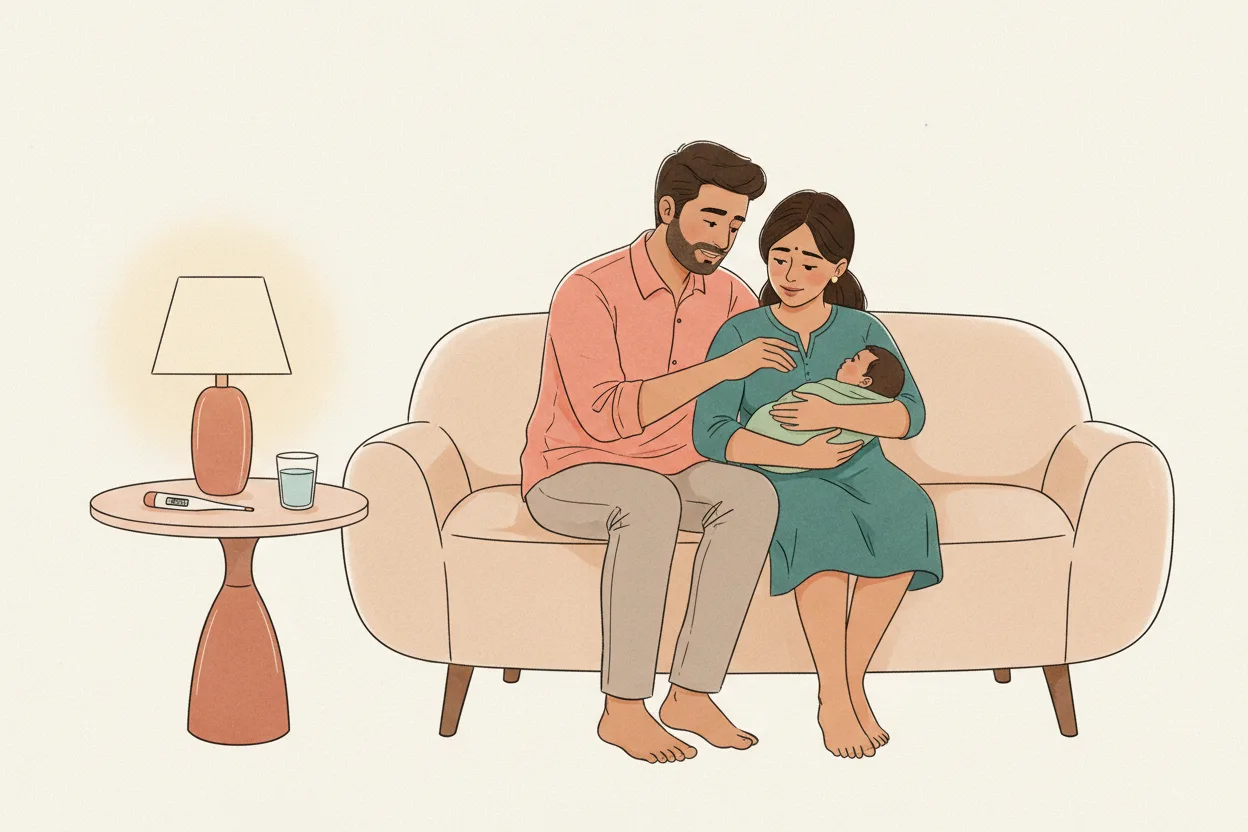
The fear spiral during your baby's first real illness — the first fever, the first cough that won't quit — is one of the most universal, least talked-about parts of new parenthood. It hits harder than you expect, and it is not a sign you're failing. Most of it is your body doing exactly what a new parent's body is built to do.
Not medical advice — consult your pediatrician for any concern about your baby's health.
Why the First Illness Hits So Hard
Nobody warns you that the panic isn't really about the number on the thermometer — it's about not yet having a feel for your particular baby. You and your partner haven't built the calibration yet: which cries mean pain versus tiredness, which cough is "just a cough." That calibration comes with repetition, and the first illness is where it starts.
It helps to know the baseline you're building toward. HealthyChildren.org (AAP) notes that most children have around 8 to 10 colds in their first two years alone — more if they're in daycare or have older siblings bringing bugs home from school. Your baby getting sick often in year one is the expected pattern, not evidence that something is wrong with their immunity or your care.
What's Actually Normal vs. What Needs Urgent Care
A lot of first-illness anxiety comes from not knowing which symptoms are routine and which deserve real attention. The two are not the same, and mixing them up is what keeps parents up all night Googling.
A 2011 AAP clinical report in Pediatrics (via PubMed) states that fever is a physiological, protective response to infection, not the illness itself, and there is no evidence that fever on its own worsens the course of an illness. The goal of treating a feverish baby is comfort — a cool room, fluids, a cuddle — not forcing the number on the thermometer back to 98.6°F.
If you do reach for fever medicine, dose it by weight, not by guesswork, and check with your pediatrician first for a very young baby. HealthyChildren.org (AAP) advises using your child's weight to decide the right amount of acetaminophen, and that it should not be given to children under 2 years of age without a doctor's guidance — a quick call to confirm the dose is a normal, sensible step, not overreacting.
That said, some signs genuinely do warrant urgent action. WHO's Pocket Book of Hospital Care for Children (via NCBI Bookshelf) lists not feeding well, convulsions, drowsiness or unconsciousness, fast breathing, severe chest indrawing, and a very high or very low temperature as danger signs needing urgent hospital care — a different category entirely from an ordinary viral illness.
| Usually just a routine illness | Get medical help now | |
|---|---|---|
| Feeding | Feeding a bit less, still taking some milk | Refusing to feed at all |
| Alertness | Cranky but wakes and settles normally | Very drowsy, hard to rouse, or unconscious |
| Breathing | Slightly stuffy or a mild cough | Fast, laboured breathing or the chest visibly pulling in with each breath |
| Temperature | Mild fever, baby still responsive | Very high or very low body temperature |
| Movement | Normal movement between naps | Convulsions, or no movement at all |
A companion worry, especially with a vomiting or diarrhoea illness, is dehydration. WHO's Pocket Book of Hospital Care for Children, Diarrhoea chapter (via NCBI Bookshelf), states that restlessness or irritability, sunken eyes, eager thirst, and a skin pinch that goes back slowly are signs of dehydration, and that a child showing these should be given oral rehydration solution (ORS) according to their weight — a normal, at-home response rather than a reason to panic, though a baby who stops drinking altogether or seems lethargic needs medical attention per the danger signs above.
One age cutoff matters more than any symptom checklist. HealthyChildren.org (AAP) advises that if your baby is 3 months old or younger and has a rectal temperature of 100.4°F (38°C) or higher, you should call your pediatrician immediately — even if baby seems otherwise fine. Below three months, that number alone is the signal to act, no waiting required.
Is This Normal Worry, or Something More?
Some anxiety during a first illness is expected and even useful — it's what makes you check the breathing, count the wet diapers, keep the pediatrician's number handy. But it's worth knowing where "normal new-parent vigilance" tips into something that deserves its own support.
NIMH's diagnostic guidance on generalized anxiety disorder states that when worry is hard to control on most days for six months or more, alongside symptoms like restlessness, fatigue, trouble concentrating, irritability, muscle tension, or disrupted sleep, that pattern points toward generalized anxiety disorder rather than ordinary situational worry about a sick baby.
If that sounds familiar, you are far from alone. A peer-reviewed study on postpartum anxiety (PMC) reports that globally, an estimated 1 in 4 women experience postpartum anxiety, which can last up to a year after childbirth. The picture looks similar closer to home: a systematic review and meta-analysis of postpartum depression in India (PMC) found a pooled prevalence of 22% among Indian mothers — not a distant, global-only statistic, but a number drawn from Indian cohorts. And it isn't only mothers who carry this. A peer-reviewed review on paternal depression (PMC), citing Cameron et al. (2016), reports that around 8.4% of fathers experience depression during pregnancy and the postpartum period, rising to about 13% between three and six months postpartum — exactly the window when a baby's first serious illness often lands. If either of you is finding the worry constant rather than tied to the illness itself, that's worth raising with a doctor, not something to push through alone — and you don't need to describe it perfectly to start that conversation. A meta-analysis of postnatal depression screening in India (PMC) found that the Edinburgh Postnatal Depression Scale, now validated in eight Indian regional languages, is the most commonly used screening tool for postnatal depression in India — asking your doctor for it by name is a concrete, low-friction way to start, rather than trying to put the worry into your own words first.
Coping Strategies That Actually Help
The good news: the things that genuinely help with this anxiety are simple, and grounded in real evidence — not vague self-care advice.
A systematic review of mindfulness-based interventions in perinatal mental health (PMC) found that mothers who took part in a mindfulness-based programme saw reductions in perinatal anxiety of moderate to large magnitude. You don't need a course to benefit from the same principle — a few slow breaths while you wait out the next temperature check, instead of refreshing search results, is a legitimate coping tool, not a platitude.
Sharing the load matters too, and it isn't just emotionally nicer — it's protective. A study on social support and postpartum maternal mental health (PMC) found that higher perceived social support, including from a partner, was associated with a reduced risk of anxiety and depressive symptoms at three months postpartum. Splitting the night's temperature checks with your partner, or asking a grandparent to sit with the baby for two hours so one of you can sleep, is protective — not a sign either of you can't cope.
Protect your own sleep where you can, even in small pieces. The Sleep Foundation notes that insufficient sleep raises the risk of negative moods, anxiety, and depression — which is exactly why the broken nights of a first fever leave you feeling frayed in a way that has nothing to do with willpower. Trade off "on duty" shifts with your partner where possible, rather than both of you staying awake through every check.
Frequently Asked Questions
My baby has had four colds already this year — is that normal? Yes. HealthyChildren.org (AAP) notes that most children get around 8 to 10 colds in their first two years, more with daycare or siblings at home. Frequent colds in year one are the expected pattern, not a red flag.
Should I try to get my baby's fever back down to 98.6°F? No — the AAP's clinical guidance states there's no evidence fever itself worsens illness, and the goal is comfort, not a specific number. Focus on keeping baby comfortable, hydrated, and watching for the genuine danger signs rather than chasing the thermometer.
At what temperature should I call the pediatrician immediately? If your baby is 3 months or younger, the AAP advises calling immediately for a rectal temperature of 100.4°F (38°C) or higher, regardless of other symptoms. For older babies, watch for the danger signs above rather than a single number.
How do I know if my worry is normal or something I need help for? NIMH's guidance describes worry that's hard to control most days for six months or more, with symptoms like restlessness, fatigue, or disrupted sleep, as pointing toward an anxiety disorder rather than everyday worry. If that's you well beyond the illness itself, talk to a doctor.
Is it normal for dads to feel this anxious too? Yes. A peer-reviewed review reports that around 8.4% of fathers experience depression during pregnancy and the postpartum period, rising to about 13% between three and six months postpartum. Fathers' anxiety and low mood around a baby's illness are real and worth naming, not brushing off.
What actually helps in the moment, besides "try not to worry"? Splitting night checks with your partner, protecting sleep in shifts, and a few slow breaths instead of another search query all have evidence behind them: social support and mindfulness practice are both linked to real reductions in perinatal anxiety, and protecting sleep reduces the mood and anxiety toll of the sleepless nights that come with a sick baby.