
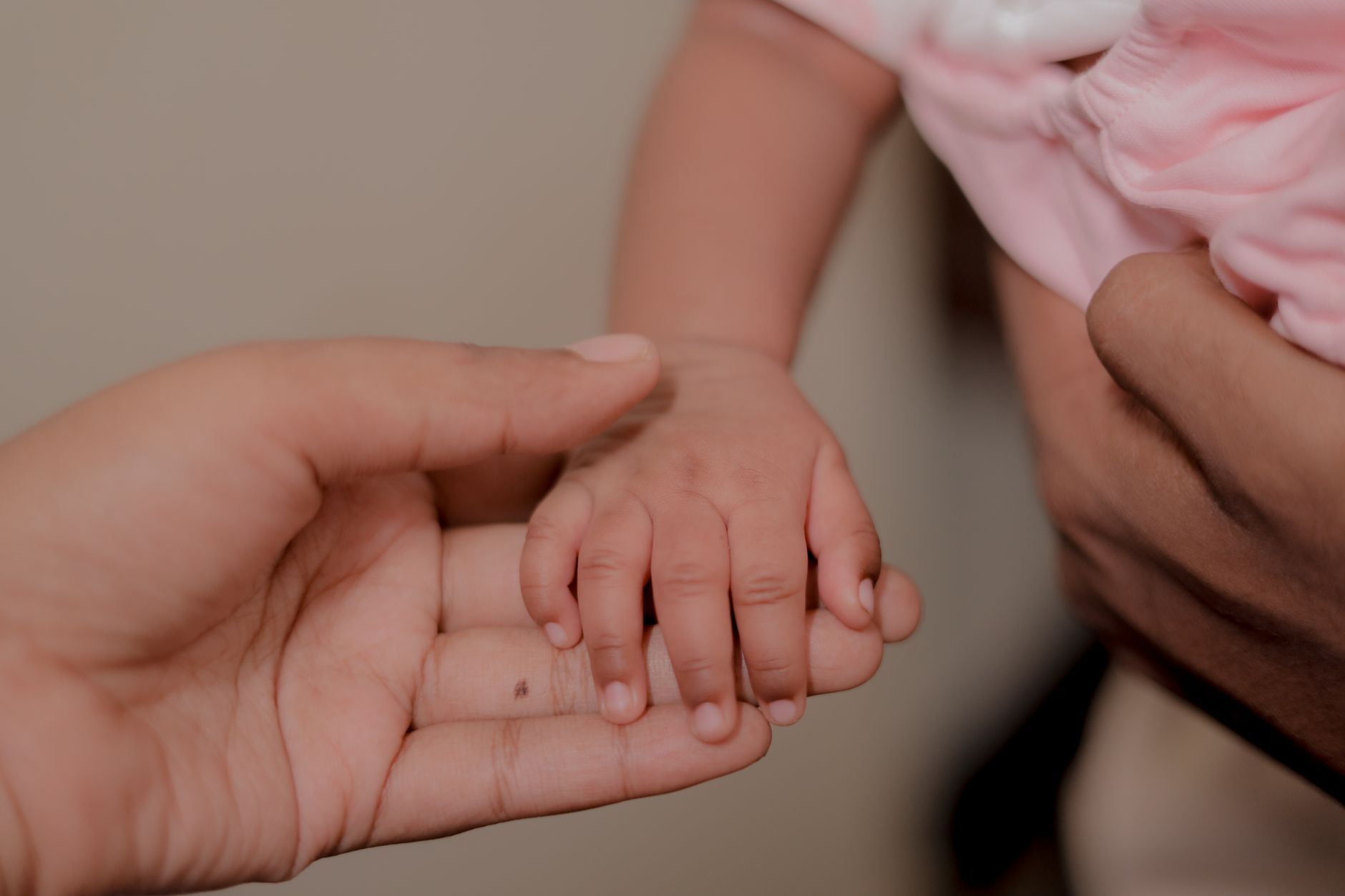
Cut them while your baby is asleep, press the fingertip pad down and away from the nail, and take off only the free edge. The American Academy of Pediatrics' HealthyChildren.org advises trimming or filing a baby's nails at least once a week and doing it while they are asleep, and warns that biting or peeling the nails off instead can lead to infection. That is the whole job. The fear is normal; the task is genuinely small.
Not medical advice — consult your pediatrician for guidance specific to your baby.
Why you can't just leave them
Newborns have almost no control over their arms, so long nails end up on their own face. The AAP puts it plainly: long nails on hands the baby cannot yet steer predictably result in stray scratches. NHS newborn-care guidance adds that some babies are born with long nails already, and that it is important to cut them in case they scratch themselves.
The scratch parents dread is the one near the eye. The StatPearls review of corneal abrasion lists fingernail-induced injury among the recognised causes, and notes that most uncomplicated superficial abrasions recover completely in three to five days. Reassuring — but a short nail is the version where it never happens.
Be gentle with whatever tool you pick, too. A 2025 review of infant skin barrier function reports that a baby's outer skin layer is up to about 30% thinner than an adult's and the epidermis up to about 20% thinner, making infant skin more permeable and more susceptible to skin infections. Baby fingertips are not small adult fingertips.
The technique that stops you nicking skin
Work in daylight or under a bright lamp, baby on your lap or on a bed. In the first month it is easiest as a two-person job — one holds the hand steady, the other cuts. Good task for dad to own: a steady hand and four minutes, during the deep sleep after a feed.
- Wash your hands first. NHS handwashing guidance says washing properly with soap for about 20 seconds — including rubbing your fingertips against your palm — removes dirt, viruses and bacteria before they spread to other people and objects.
- Wait until your baby is asleep or settled. Both the AAP and the NHS advise cutting when the hands are not a moving target.
- Isolate one finger. Hold it away from the others, then push the fingertip skin down and away from the nail so the blade clears both sides — this is the single step that prevents most nicks.
- Take small bites, not one big cut. Two or three short snips across a nail give you far more control than trying to clear it in one go.
- Toenails go straight across. InformedHealth.org, on the NIH's NCBI Bookshelf, states that toenails should be cut straight across and left long enough that the corners lie loosely against the skin — not too short, not rounded at the edges, and never shaped into a point, because improper trimming is a leading cause of ingrown toenails.
- Finish with a file. The AAP notes that a nail file alone is enough to keep things under control, and a few passes after clipping takes the sharp corner off.
Toenails need this far less often than fingernails. Fingernails grow at roughly 3 mm a month while toenails manage about 1 mm, and MedlinePlus, the US National Library of Medicine's health encyclopedia, puts the newborn routine at cutting fingernails at least once a week and toenails only a couple of times a month.
Please don't bite them off
Someone in the family will offer. It is a genuinely common practice in Indian homes and it comes from a kind place — no blade near the baby. But the AAP is direct that biting or peeling a baby's nails off can lead to infection.
Knowing the mechanism helps you explain it politely rather than just refusing. The StatPearls review of paronychia explains that infection of the skin fold around a nail follows a break in the seal between nail and nail fold — from trauma, nail-biting or aggressive grooming — and shows up as a red, swollen, tender nail fold, sometimes with pus. Tearing a nail rather than cutting it is exactly that kind of break.
Clippers, scissors, file or electric trimmer?
The NHS says you can buy special baby nail clippers or small, round-ended safety scissors, that both are safer than adult clippers or scissors, and that filing down with a fine emery board is an alternative. MedlinePlus goes further and calls a nail file or emery board the safest method of the lot, with blunt-tipped baby scissors or baby clippers next, and says adult-sized clippers should not be used because you can clip the tip of the finger instead of the nail. The electric trimmer is a fourth option neither covers — treat it as a convenience choice rather than a safety upgrade.
| Tool | How it works | Suits | The catch |
|---|---|---|---|
| Baby nail clipper | Small jaws, often with a plastic finger guard and a magnifier | Parents who want the job over in two minutes | The guard hides the nail edge; you cut partly by feel |
| Round-ended safety scissors | Blunted tips, curved blades | Very tiny newborn nails and peeling corners | Needs two hands and a still baby |
| Emery board or glass file | Abrasive surface, no blade | The first weeks, and nervous parents | Slow; dust and flaking on paper boards |
| Electric trimmer | Rotating disc inside a shaped guard | Sleeping babies, and anyone who cannot bring themselves to use a blade | Motor noise; discs wear out and need replacing |
What to actually compare on an electric trimmer
Ignore the marketing. These are the things you can check yourself:
- The guard, not the disc. The plastic cap limiting how much nail meets the disc is what keeps the fingertip out of it. Look for a guard sized for newborns, not one "small" head covering birth to five years.
- Disc grades. Kits ship a set — softer emery-style pads for newborn nails, firmer ceramic-style heads for toddlers. Check which one the manual marks for a newborn.
- Replacement heads in India. The one that catches people. A trimmer whose pads are only sold abroad becomes a paperweight, so search the model plus "replacement heads" on Indian listings before you buy.
- Noise. The whole point is trimming a sleeping baby. Look for a low-speed setting, and test it near your own ear first.
- Battery type. Replaceable AA/AAA cells versus a sealed USB-rechargeable pack — sealed is tidier, cells are fixable years later.
- Warranty and service route. Check the seller is the brand's authorised India distributor; a grey-market import with no Indian service route is a gamble however good the reviews look.
Compare current listings on Amazon.in and FirstCry rather than trusting a price quoted in any article — this category churns constantly. Keep whatever you buy as the baby's own set in a clean pouch, separate from the family's adult clippers. And if you do an oil malish before bath, wipe the fingers with a clean cloth first — oiled nails slip out of a clipper.
Mittens: a good week-one answer, not a good month-three one
Scratch mitts on a newborn while you find your nerve are completely reasonable. Keeping them on all day for months is a different thing, because those hands have work to do.
The AAP's movement milestones for birth to three months describe how babies become increasingly interested in their own hands, spend a lot of time trying to move them into view, eventually get them to their mouth, and use sucking on them to soothe themselves. Mittens sit directly on top of all three. Trimming the nails properly is what lets you take the mitts off.
There is a second reason to turn mitts and socks inside out before they go on. A 2019 study of hair tourniquet syndrome reports that a loose hair or clothing thread can wrap around a baby's toe or finger and strangle it, that most cases are in babies under about five months, that movement inside socks or mittens is one way the fibre wraps, that the mother's post-delivery hair shedding is a known contributor, and that it is an emergency in which the thread must come off as soon as possible. Postpartum hair fall is near-universal, so give the mitts a ten-second check — and look at the toes if a baby cries inconsolably and you cannot find why.
You nicked the skin. Now what?
It happens to almost everyone, and the finger bleeds more than the size of the cut suggests. Stay calm — your baby reads your face before they read the injury.
NHS first-aid guidance for cuts and grazes says to put pressure on the wound with a bandage or a clean, folded cloth, then rinse it with water, pat it dry and cover it with a sterile dressing or plaster. The AAP adds that a bleeding fingertip should be washed with soap and water and covered with a soft, sterile dressing, and that you should call your doctor straight away if there is excessive swelling, a deep cut, or blood under the nail. Check any dressing often, and take it off once the bleeding has stopped.
When a nail problem needs a doctor
- The AAP advises watching for any increase in pain, swelling, redness or drainage from the injured area, or a fever starting 24 to 72 hours after the injury — that pattern is the one that needs a call rather than a wait.
- A red, swollen, tender nail fold, especially with pus, is the picture of paronychia and is a reason to see your pediatrician rather than to treat at home.
- NHS guidance counts 38C or above as a high temperature and says to seek same-day advice for any baby under three months who has one — in a young baby that is urgent regardless of what the finger looks like.
- A toenail corner that keeps digging in, or a toe that stays red and sore, is worth showing your pediatrician; improper trimming is the common cause and the fix starts with cutting straight across.
The short version
Once a week, while they sleep, fingertip pad pressed down, small snips, file the corner smooth, toenails straight across. Buy on the guard and the availability of replacement heads, not on the marketing. Take the mittens off as soon as the nails are short. And the first time you nick a finger, remember that pressure with a clean cloth is the whole treatment — you have not broken anything.