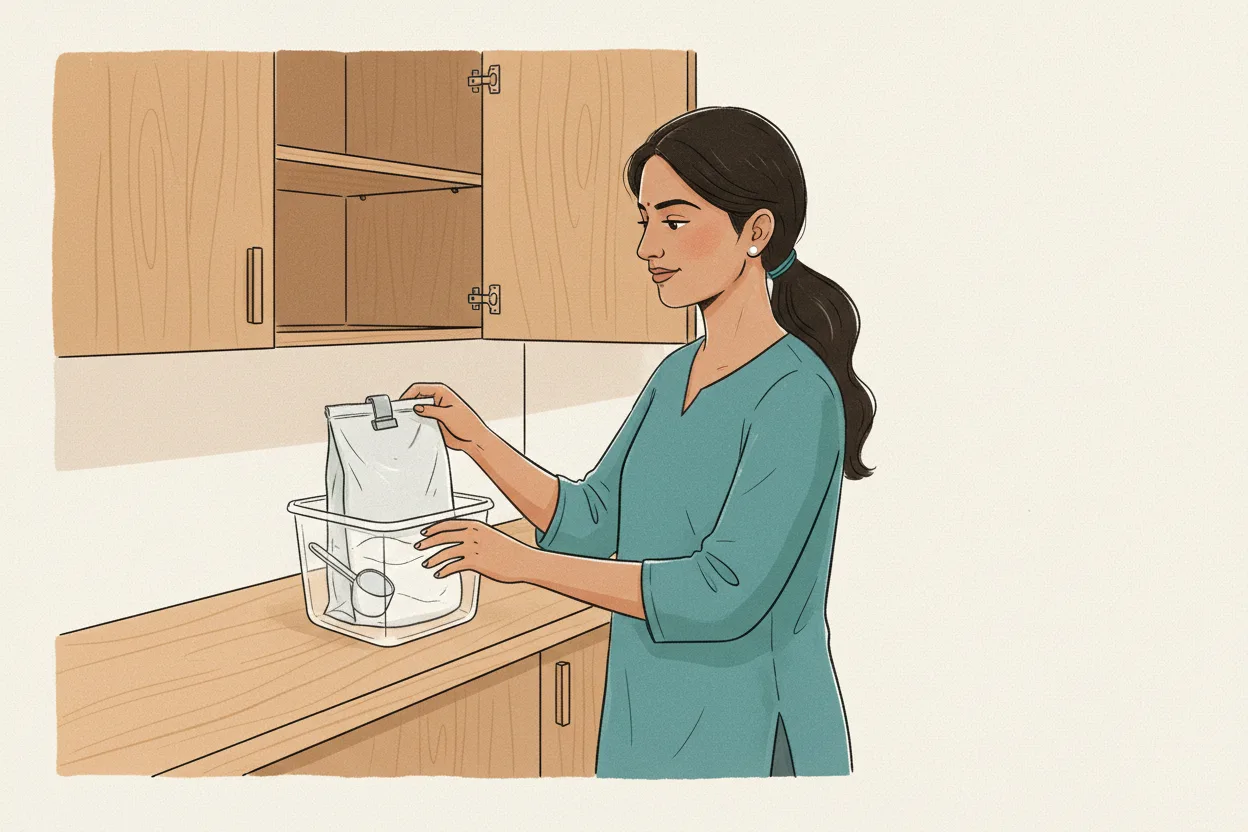
Keep the powder in the pack it came in. If a 400 g refill pouch flops over in your cupboard, stand the whole pack inside a dry lidded box rather than tipping the powder out — and the container you were planning to sterilise is the one thing here that could make matters worse, because powdered infant formula is not a sterile product to begin with. A boiled box with a film of water inside it hands the powder the one thing it needs protecting from.
Not medical advice — consult your pediatrician for guidance specific to you and your baby.
Sterilising Is the Right Instinct in the Wrong Place
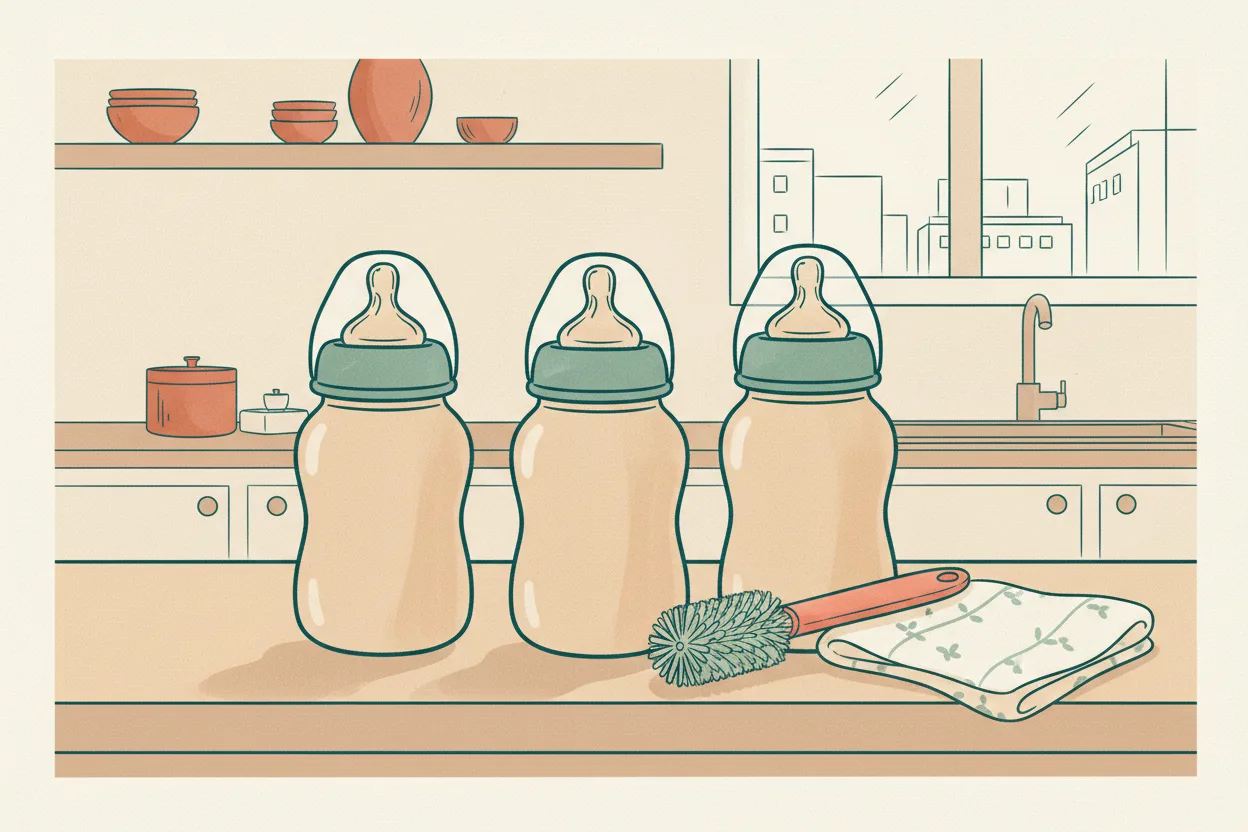
Sterilising is a habit worth keeping — it just belongs to a different set of objects. The NHS advises sterilising all your baby's feeding equipment, "including bottles and teats", until they're at least 12 months old, because that is where milk sits wet and warm. A dry powder in a cupboard is a different problem, for two reasons that both run against intuition.
First, you cannot sterilise your way out of what is already in the powder. WHO and FAO's guidelines are blunt: "PIF is not a sterile product, even if it has been manufactured to meet current hygiene standards. This means that it may occasionally contain pathogens that can cause serious illness." Nor does dryness finish them off — a 2017 study in Frontiers in Microbiology reports that Cronobacter, the organism of most concern, "can persist in PIF for more than 1 year" in dry formula.
Second, dryness still protects your baby — not by killing anything, but by stopping it multiplying. The FDA's guide to water activity explains that a food can hold "sufficient moisture to support the growth of bacteria, yeasts, and mold", and that "the amount of available moisture can be reduced to a point which will inhibit the growth of the organisms." A sealed pack of powder is exactly that: too dry for anything to grow in.
So the hazard in your cupboard is damp, not germs on plastic, and a clean bone-dry box beats a freshly sterilised one. Anything the powder will touch has to be completely dry — hours open to the air, not a wipe with a kitchen towel.
The Pack Is Doing More Work Than You Think
India's Food Safety and Standards (Foods for Infant Nutrition) Regulations, 2020 spell out what every infant formula label must carry: the storage condition, worded "Store in a cool and dry place in an air tight container" or the like, with "after opening use the contents within the period mentioned or the expiry date whichever is earlier"; the "quantity per scoop (scoop to be given with pack)"; and the "Batch number, Month and Year of its manufacture, Use by date".
Read that as a list of things decanting throws away.
The batch number and month of manufacture are how you tell whether your pack is the one named in a recall, or answer a pediatrician asking which lot your baby has been on. On a pouch in the bin they are gone — exactly when you most need them, which is why the law puts them on the pack.
The use-by date is not a formality. The FDA describes it as "the date up to which the manufacturer guarantees the nutrient content and the quality of the formula", after which a container "should not be fed to infants".
The period after opening is printed on your particular pack. The CDC says most formulas "need to be used within 1 month of opening the container" and tells you to "confirm this by checking the label" — one month is the CDC's general rule, not a promise about your pouch. Brands differ; the number that counts is yours.
The scoop belongs to that product, since Indian labelling rules require it to be supplied with the pack along with the quantity per scoop. A stage 2 scoop and a stage 1 scoop are not interchangeable just because both are plastic.
Worth saying plainly: no food-safety authority tells parents to move formula into a container of their own. Every storage instruction written for parents — the FSSAI wording, the CDC's "lid tightly closed" — assumes the pack it came in.
What to Do With a Pouch That Won't Stand Up
Your problem is real: a floppy 400 g pouch in a deep cupboard is how powder ends up spilled and left half-open. Solve that without touching the powder.
Keep the powder in its own pack, shut with its own clip or folded over tightly. The CDC asks you to "close containers of formula as soon as possible after using them" — a clip does that, and so does a firm fold held with a clothes peg.
Stand the pack inside a dry lidded box. The box is a holder, not a new container: it keeps the pouch upright and keeps dust and kitchen steam off the opening. Choose it for being dry and shutting properly, not for being sterilisable.
Cupboard, not fridge. The CDC is explicit that opened powder goes "in a cool, dry place with the lid tightly closed" and says "do not store it in the refrigerator." Chilling it is wrong for the same reason sterilising is: every time the pack comes back into a warm kitchen, condensation forms on it. Through a Mumbai or Bengaluru monsoon, pick a high cupboard away from the hob, the kettle and the sink.
Keep the scoop dry, and leave it alone. The CDC says "don't set the formula scoop on the counter, in the sink, or on any other surface" and to "keep lids and scoops clean and completely dry" — so don't wash it between feeds and drop it back in damp. The CDC is specific about how Cronobacter gets into formula at home: "if you place formula lids or scoops on contaminated surfaces and later touch the formula."
Write the opening date on the pack in marker, beside the printed use-by date. The CDC suggests exactly this habit so nobody in the house has to guess.
| The instinct | What to do instead |
|---|---|
| Sterilise a container for the powder | Keep it dry; sterilising is for bottles and teats |
| Tip the pouch into a jar | Keep the pouch; stand the pouch in the box |
| Fridge it so it lasts | Cool, dry cupboard — not the refrigerator |
| Rinse the scoop after each use | Keep it clean and completely dry, inside the pack |
Mixing the bottle itself — water temperature, how long a made-up feed keeps — is covered in formula storage for occasional and backup feeds, and warming a stored bottle has its own guide.
Frequently Asked Questions
If I really cannot live with the pouch, what is the least-bad way to decant? You lose the batch number, the use-by date and the pack's own period after opening, all of which Indian labelling rules put on the pack for a reason. If you do it anyway: copy those onto the box in marker, tape the cut-out label panel inside the lid, move the pack's own scoop across, use a container that is airtight and bone dry rather than freshly washed, and never tip fresh powder in on top of old.
The powder has gone a bit clumpy. Is that a damp problem? Treat it as one: clumping says moisture has reached the powder, and the FDA's water-activity guide is clear that reducing available moisture is what inhibits microbial growth. Check your opening date and the use-by date, and if either has passed, the FDA's position is that formula should not be fed to infants after that date. If you are unsure, ask your pediatrician rather than guessing.
How long does an opened refill pack last? Go by your pack. The CDC's general rule is most formulas within 1 month of opening, confirmed against the label; Indian rules require each pack to state its own period after opening, and to use the contents within that period or the expiry date, whichever is earlier. With a 400 g pack, the window is usually academic — the pack runs out first.