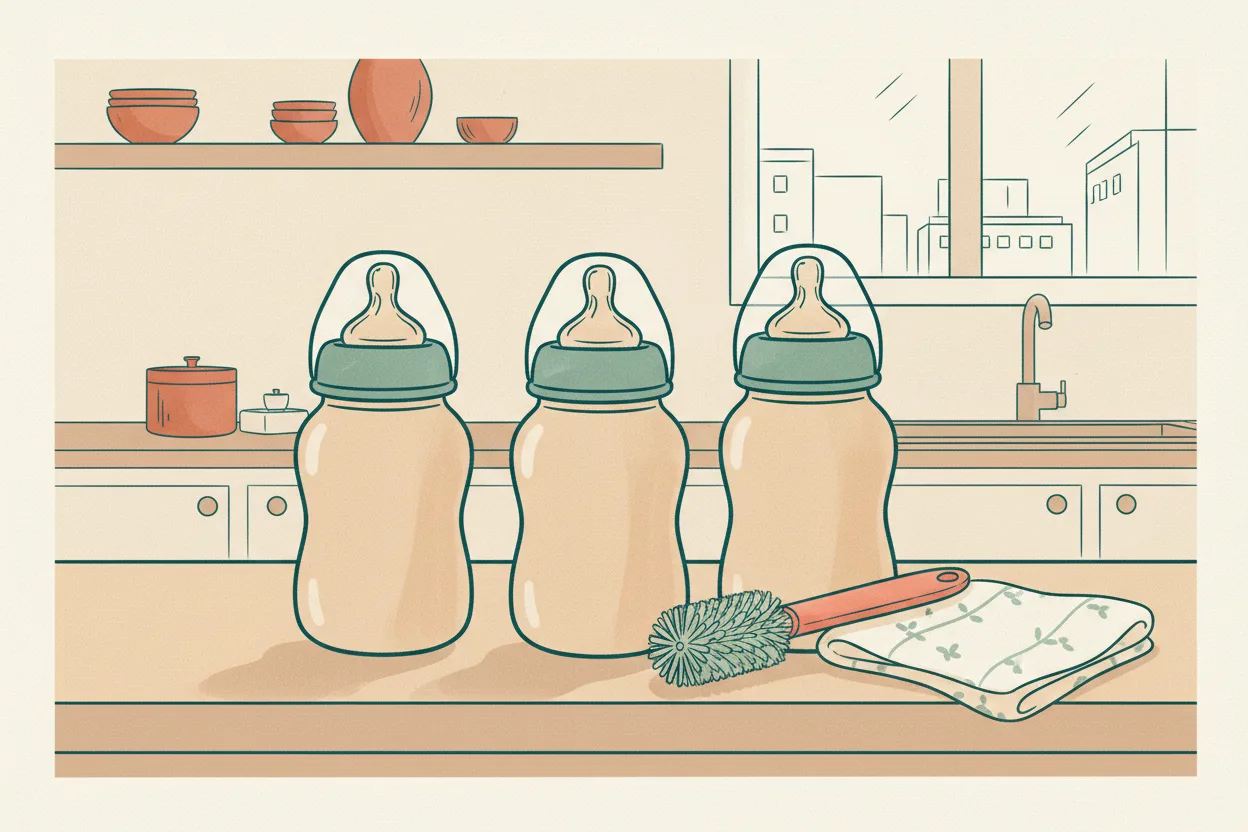
Three is enough. Buy nothing more before the birth.
If you already have two narrow-neck bottles and one wide-neck bottle sitting in a cupboard, you are stocked for the plan you described — breastfeeding, with a bottle when direct feeding is awkward. The case for stopping here is not thrift. It is that nearly every input into "how many bottles" is still unknown to you, and a cupboard of six matching bottles bought in the eighth month is the single most common way this money gets wasted.
Not medical advice — talk to your paediatrician or lactation consultant about your own feeding plan.
Three things you cannot know yet
How much milk you will be moving. WHO recommends exclusive breastfeeding for the first six months, and whether yours becomes an occasional-bottle household or a daily-expressing one depends on how the first fortnight goes. The CDC's breastfeeding guidance states that a newborn feeds about 8 to 12 times in 24 hours and that frequent feeding helps increase supply — so the early weeks are the thing that sets your volumes, and they have not happened yet.
Whether this baby takes a bottle. Some do on the first try and some object for a fortnight. That is its own question, with its own answer, and nothing you buy now changes it.
Which teat suits him. This is the one that really decides the purchase, and it is worth its own section.
The teat decides whether a bottle works — not the brand
The part of a bottle a baby actually interacts with is the teat. And teats are far less standardised than the packaging suggests.
Researchers have measured this directly. A 2015 bench study in the American Journal of Speech-Language Pathology reported that flow rates varied widely between teats, ranging from 2.10 mL/min at one end to 85.34 mL/min at the other — a fortyfold spread across products a shop shelf presents as interchangeable. Worse for anyone shopping, a 2016 study in MCN: The American Journal of Maternal/Child Nursing concluded that the name of the teat does not provide clear information about its flow rate to guide parents in decision making. "Slow flow" on one box and "slow flow" on another are not the same thing. A 2021 review in Nursing for Women's Health adds that within the same type of teat there can be significant variability in flow from one teat to another.
This explains something you have probably already noticed: ask ten mothers which bottle to buy and you get ten confident, contradictory answers. Each of them is reporting their baby's response to one teat — which is real, and which does not transfer to your baby. It is also why the teat, not the bottle, is the consumable here. The NHS advises regularly checking that teats and bottles are not torn, cracked or damaged — in practice it is the teats that fail first, and the plastic body usually outlives several of them.
What genuinely differs between bottles
Two properties are worth knowing, stated as properties rather than verdicts.
Venting. Some bottles have a vent or internal straw; some are plain. This changes the physics of the flow rather than the taste or the shape. A 2023 bench study found that dripping continued throughout the full 20-minute testing period in the vented bottle, while flow in the unvented bottle slowed and eventually ceased as pressure dropped. Neither behaviour is "better" — it is a difference in how the bottle behaves when a baby pauses mid-feed.
Neck width. A wide-neck body takes a hand and a brush more easily; a narrow one is slimmer in a bag. Pump flanges also thread onto one neck size or the other, so a bottle that screws directly onto your pump saves you a transfer. None of this is published guidance — it is ordinary household convenience, and you should treat it as such.
Beyond that, the authorities decline to pick. The NHS says there is no evidence that one type of teat or bottle is better than any other, and that simple bottles that are easy to wash and sterilise are probably best. On the American Academy of Pediatrics' HealthyChildren site, a paediatrician answering exactly your question writes that he has not seen good scientific literature supporting the various brand claims, and so cannot recommend one brand over another.
How the number scales with the plan
| Your feeding plan | Bottles | What to add |
|---|---|---|
| Breastfeeding, occasional bottle | 2–3 | A spare teat once you know which flow he takes |
| Back at work, carer feeds him by day | 4–6 | Storage bags or cups, so bottles aren't doing storage duty |
| Exclusive pumping or formula feeding | 6–8 | A second brush, and a drying rack |
These counts are convention, not guideline. No health authority publishes a bottle number; the NHS gets no more specific than "several bottles, teats and a bottle brush". So read the table as a starting point that experienced households converge on, not as evidence.
The number is set by your sink, not by your baby
Here is the part nobody says out loud. How many bottles you need is decided by how often you are willing to wash and sterilise, not by how much milk the baby drinks.
The CDC advises cleaning baby bottles after every feeding, and sanitising them daily while a baby is under two months old, premature, or immunocompromised. Given that, the arithmetic is simply: bottles needed = bottle feeds between washes, plus one in reserve.
A household where someone rinses and steams the bottle straight after each feed genuinely runs on two. A household that does a single batch in the evening — which is most households with help in the kitchen and a packed day — needs one bottle per bottle feed in that day. The CDC notes that a newborn fed entirely by bottle feeds 8 to 12 times in 24 hours, so a once-a-day washer on that plan would need eight or more. Same baby, same milk, four times the cupboard. Decide the washing rhythm first and the number falls out of it.
Why nobody simply publishes the comparison
There is a specifically Indian reason you are asking other mothers rather than reading a review. India's National Health Mission summary of the IMS Act, 1992 states that the Act prohibits the advertisement of infant milk substitutes and feeding bottles. That restriction exists on purpose — it mirrors the international marketing code WHO asks governments to legislate — and it means there is no brand campaign, no sponsored shootout and no legitimate ranked comparison for you to find. The vacuum gets filled by other mothers' personal experience, which, as the flow-rate research shows, is the one kind of evidence that cannot generalise to your baby.
So: what to buy in December
Nothing. Take the three you own to the hospital bag stage, see which teat your son accepts, and then buy a second teat of that flow — plus a bottle brush, if one is missing. That is the whole list.
Spend the money you just saved on the things that are genuinely hard to improvise later: a pump that fits you, if expressing is in the plan. And when feeds do start, the CDC's advice is to watch for cues that he is full and stop there, even if the bottle isn't empty — a half-finished bottle is information, not failure.
Two things to read when they become relevant rather than now: bottle refusal if you return to work, and when you can ease off sterilising every item every time.