
No — moving out of a joint household and into a nuclear setup, even to a new city with no family nearby, does not put your baby's development at risk. A U.S. Department of Health and Human Services (ASPE) commissioned report on infant attachment states that the major determinant of a baby's attachment pattern is the quality of care the primary caregiver or caregivers provide — not the number of people or the size of the social network around the baby.
Not medical advice — consult your pediatrician if you have specific concerns about your child's development.
What Actually Drives a Baby's Development
It helps to know what the research is actually measuring, because "socialization" gets used loosely. WHO's Nurturing Care Framework page states that early childhood development is an outcome of healthy, nurturing interactions between caregivers and children, built through responsive caregiving and early learning — not through how many adults live under one roof. Household size was never the mechanism.
That doesn't mean a bigger circle has no value. The American Academy of Pediatrics (via HealthyChildren.org) notes that babies naturally bond with their parents, but can also form close attachments with other people who regularly and lovingly care for them — grandparents included — and that bonding with more than one person helps a child learn about trust and closeness. A joint household gave your baby that wider circle. A move doesn't take away anything a baby needs; it just means, for now, that circle is smaller and built by you two, plus video calls, instead of people down the hall.
And both of you count fully in that circle — not one parent plus a "helper." A peer-reviewed longitudinal study in NIH's PubMed Central found that a father's involvement and sensitivity independently predicted secure father-child attachment at age three. Dads build their own attachment bond with a baby; it isn't borrowed from the mother's.
Milestones Your Baby Hits With Just the Two of You
Social and emotional development runs on its own clock, no matter how many people are in the house. Here's what to expect at the ages parents in a new setup tend to worry most about:
| Age | What's typical | Source |
|---|---|---|
| ~2 months | Smiles when you talk to or smile at them; calms down when spoken to or picked up | CDC 2-month milestones |
| ~9 months | May be shy, clingy, or fearful around unfamiliar people; smiles or laughs playing peek-a-boo with you | CDC 9-month milestones |
| 8–12 months | Separation anxiety appears — a normal stage, not a sign of a problem | AAP: Emotional and Social Development, 8–12 Months |
The stranger-shyness and clinginess that show up around 9 months to a year can feel alarming right after a move, as if your baby has become anxious because the house got quieter. It's the opposite. The American Academy of Pediatrics (HealthyChildren.org) explains that a baby with a strong, healthy attachment to their caregiver tends to move through separation anxiety earlier and more quickly than other babies, not later. A clingy phase is far more likely to be evidence of a good bond with you than evidence that something is missing.
Where the Real Risk Actually Sits
If there's something worth watching after a move, it isn't your baby's social skills — it's how the two of you are coping without the extra hands. A systematic review in PubMed Central (NIH) on risk factors of postpartum depression states that a lack of spousal and social support is one of the most powerful risk factors for postpartum depression, alongside a prior history of depression and gestational diabetes. Losing the daily, built-in support of a joint household, without replacing it with anything else, is exactly that kind of gap.
This matters for your baby too, not only for you. A systematic review in PubMed Central (NIH), "Consequences of maternal postpartum depression: A systematic review of maternal and infant outcomes," found that untreated postpartum depression can have negative consequences for infants, including poorer cognitive functioning and emotional development. So the real priority after a move isn't engineering more baby socialization — it's making sure both parents have support in place: each other, a pediatrician you trust, and some way to reach other parents nearby, even if it starts online.
Building a Rich Social World for Two (or Three)
A full house is not required to give your baby everything the research points to. A few things carry real weight:
Talk, read, and sing — a lot, from day one. CDC's Positive Parenting Tips for Infants states that talking to your baby, answering their sounds, reading to them, and singing to them all build early language skills and brain development. None of it requires an audience — it's entirely a two-person (or one-person) job.
Protect your face-to-face time from screens. HealthyChildren.org (American Academy of Pediatrics) states that what infants and toddlers need most to learn is interaction with the people around them, and that the responsive, back-and-forth exchange between a baby and caregiver comes to a halt the moment either one is watching a screen instead. In a quieter home, that one-on-one window is your biggest asset — guard it rather than filling gaps with a phone or the TV.
Split hands-on care between both of you. Feeds, baths, nappy changes, the bedtime routine — when both parents are doing all of it, your baby gets two distinct, responsive relationships instead of one stretched thin.
Keep grandparents in the loop on video, deliberately. A short daily or twice-weekly video call where a grandparent reads a book or sings a rhyme keeps a familiar voice and face in your baby's world, even at a distance.
Build a local circle before you need it. A building WhatsApp group, a nearby paediatrician's waiting room, a Sunday park visit, or a new-parent meetup app gives you adult company and your baby other faces — useful for you, not required for your baby's development.
When to Actually Get It Checked
If your baby isn't meeting milestones for their age, the right move is a doctor visit, not a guess about whether the move is the cause. CDC's "Learn the Signs. Act Early." guidance recommends talking to your child's doctor and asking about standardized developmental screening if you have any concern about how your child plays, learns, speaks, acts, or moves — noting that the American Academy of Pediatrics recommends screening at 9, 18, and 30 months, and autism-specific screening at 18 and 24 months, or whenever a parent or provider has a concern.
Frequently Asked Questions
Does my baby need grandparents around to develop normally? No. ASPE's report on infant attachment states that the quality of care from the primary caregiver, not the number of caregivers, is what determines attachment security. A wider family circle is nice to have, not a requirement.
Will my baby bond less with just the two of us instead of a full joint household? No — if anything, a smaller household often means more one-on-one time. WHO's Nurturing Care Framework frames development around the quality of caregiver interaction, and fathers form their own independent attachment bond with a baby through their own involvement.
My baby suddenly cries around new people since we moved cities — is that normal? Yes. CDC's 9-month milestones list being shy, clingy, or fearful around strangers as typical at this age, regardless of household setup.
Is my baby's new clinginess a sign the move has hurt them? The opposite is more likely. The AAP explains that babies with a strong, healthy attachment tend to move through separation anxiety earlier and faster, not slower.
How do I know if it's time to get help — for my baby, or for myself? For your baby, talk to your pediatrician and ask about developmental screening if you have any concern, rather than waiting it out. For yourself, take a lack of spousal or social support seriously — it's one of the most powerful risk factors for postpartum depression, and untreated depression can affect your baby's cognitive and emotional development too, so ask your doctor about support for yourself as readily as you would for your baby.
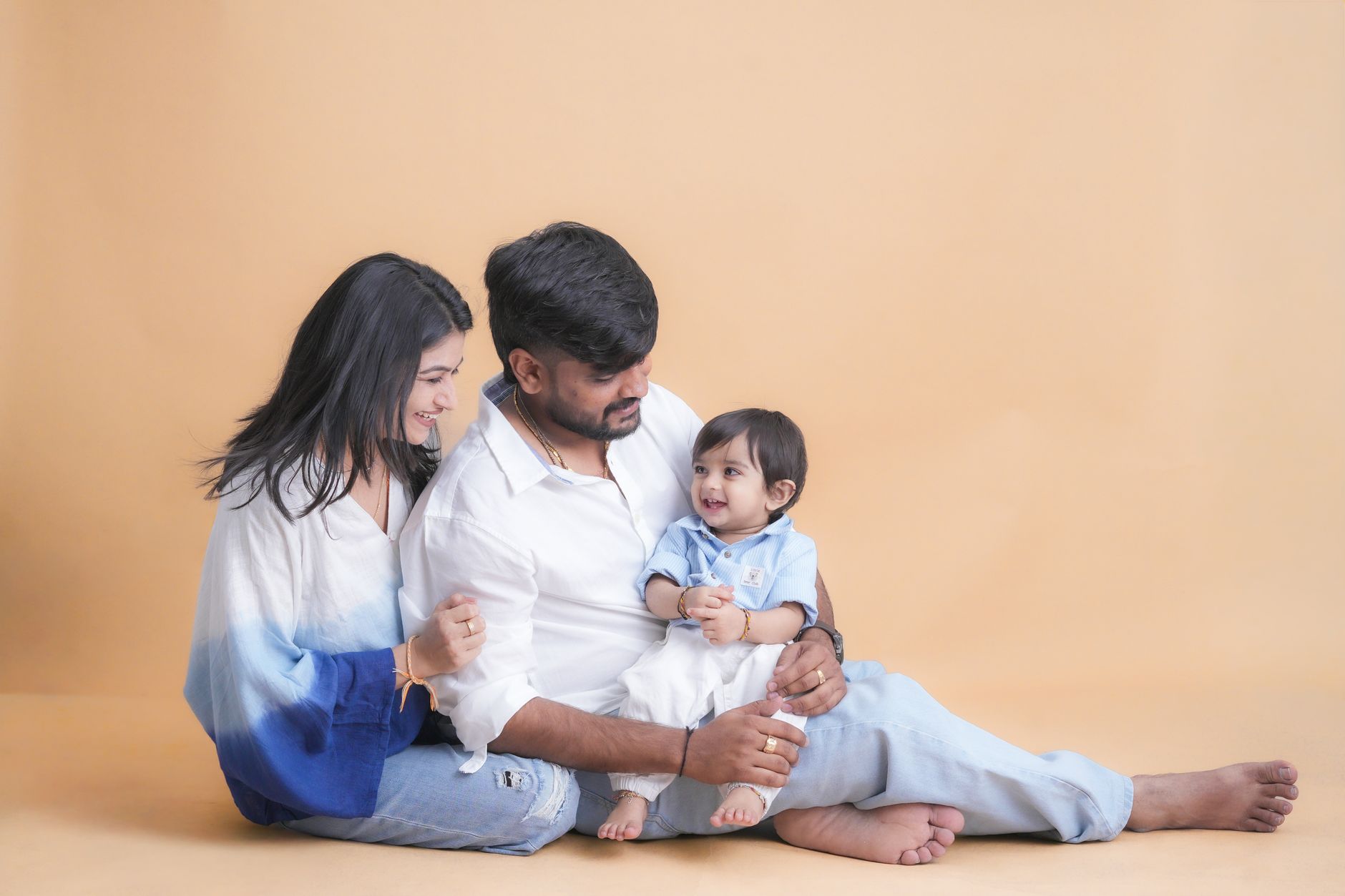
Photo: krishna Kids Photography on Pexels.